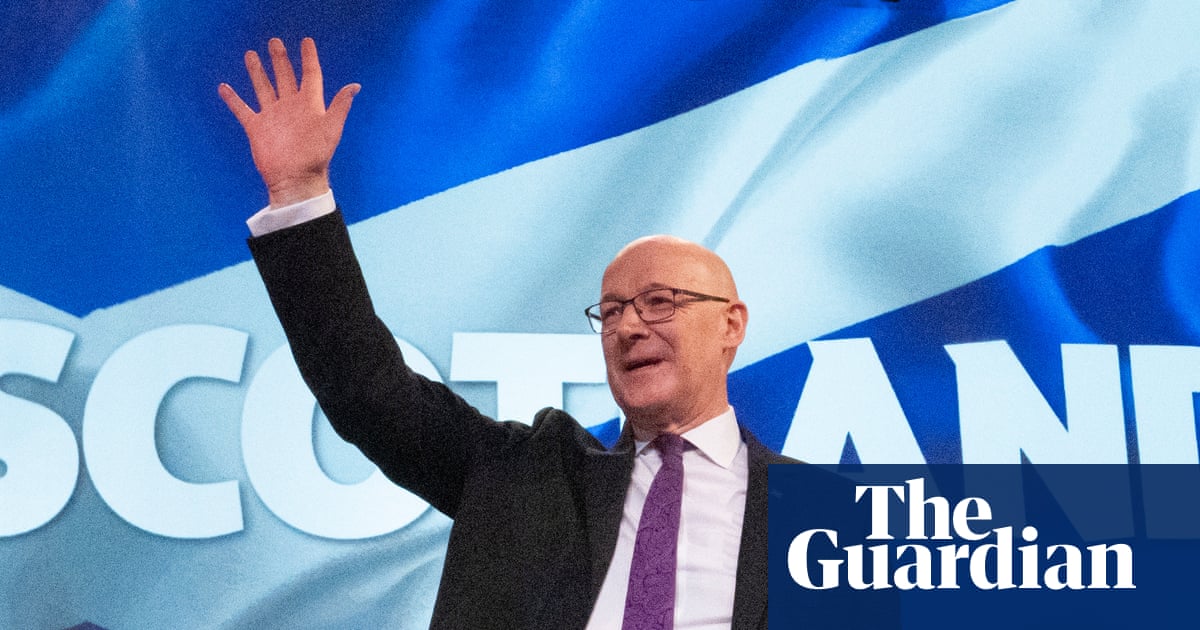
John Swinney has said that the second referendum campaign for Scottish independence “has already begun”, revealing a nationwide effort to renew the argument for leaving the UK in his keynote address to the SNP party conference.
On Saturday, the Scottish first minister said that the SNP would launch its “most sophisticated campaign in history” to convince Scottish of the benefits of independence, backed by “a six-figure war chest”. Called Choose Scotland, the campaign aims to build the consensus for leaving the union.
John Swinney told the SNP party conference in Aberdeen that the “stars were aligning” for the pro-independence cause, arguing that nationalist first ministers of Wales, Scotland and Northern Ireland had panicked pro-union parties.
“For centuries, people in the Celtic nations have been told that we are not good enough. Our languages were derided, our cultures suppressed, our histories rewritten,” he said. “When I stood on a stage recently with pro-independence leaders from Wales and Ireland, it certainly upset some of our opponents.
“From their point of view, they are right to be worried. Watching us pledge to work together and seeing the love and respect we feel for each other’s nations. Never again can they portray us as separatists.”
During the event in Aberdeen, leading SNP figures said that a hung Westminster parliament is the most realistic path to securing a second independence referendum in Scotland as the nationalists would probably “hold the balance of power” in forming a future progressive government.
The party currently holds just eight MPs in parliament, but recent polling indicates that if a vote was held today, that number would surge at the Labour party’s expense in Scotland, although there is uncertainty surrounding how many seats they would gain.
Deputy first minister Jenny Gilruth said that her party would welcome an early general election to reenergise the push for independence. “The polling, of course, suggests that the SNP would hold the balance of power in a hung parliament and really strong support for the SNP across the country allowing us to regain a number of seats,” she said.
The sentiment was echoed by Lara Bird, the MP for Arbroath and Broughty Ferry, who told a podcast by the pro-independence newspaper The National that they could negotiate another poll if the overall results were tight.
“We have a really great opportunity at the next general election to be in a position where that negotiation can seriously start with the next iteration of the Westminster government, whether we have a hung parliament, which is looking very likely, or different coalitions. Perhaps now we are talking about a Lib Dem-Labour coalition. The SNP are polled at getting somewhere between 40 and 50 MPs at the general election. That’s huge. Let’s put it to Westminster and put the onus on them to meet us at the table and set that plan out for us,” she said.
The latest MRP polling by Electoral Calculus this week predicted a narrow Labour victory, with the SNP winning 28 seats, although previous polls have indicated they could win even more.
In a visit to Lanarkshire on Friday, UK prime minister Andy Burnham said the Scottish government needed to “move beyond” the question of independence while offering to work more closely on devolving power from Holyrood with Swinney’s administration. The Westminster government would have to grant a second vote on Scottish independence.
“I just feel we all have to move beyond the constitutional questions. In my view, people in Scotland are suffering the cost of living crisis, like they are in England and everywhere else. And I think our job is to focus on the practicalities, to focus on solutions for people. Right now, too much time is wasted on those dramas. It consumes too much energy,” he said, when asked about the issue.
Although it is not in Swinney’s power to call a second independence referendum, he told the conference in Aberdeen that another vote could happen sooner than expected.
“Our independence is very close,” he said. “Our nearest neighbours will always be our closest friends and our strongest allies. I will always want the very best for the people living in England, Wales and across Ireland. But friends, in the long arc of history, nothing is static. And those that try to hold on to the past fail to grasp the opportunities of the future. In this period of history, the nations of the United Kingdom are evolving into a new relationship. That is something to welcome,” he said.
Disclaimer : This story is auto aggregated by a computer programme and has not been created or edited by DOWNTHENEWS. Publisher: theguardian.com