
The angry protests that have convulsed Spain and France in recent weeks have spilled over to Italy and Portugal, with rioters clashing with police and setting property on fire in Milan, and a tent encampment springing up in Lisbon over the weekend.
A march in central Milan on Saturday to protest against rising living costs began peacefully but ended with masked rioters throwing stones, paving blocks and other objects at riot police and setting fire to barricades made from bar tables.
Police used water cannon and teargas to disperse the crowds, and images of the aftermath showed a severely damaged carabinieri car.
At least two police officers were injured and about 50 demonstrators, including many minors, were detained, the LaPresse news agency reported.
Italy’s prime minister, Giorgia Meloni, said that while demonstrating was a right, “setting our cities ablaze is not”. In a social media post, she said “hooligans” had exploited the protests “to sow chaos, attack those responsible for ensuring security and to hold entire cities hostage”.
Milan’s centre-left mayor, Giuseppe Sala, said that while “the reasons for the protests were understandable, the violence against law enforcement and serious damage to the city are not justifiable”.
In Lisbon, a tent camp reminiscent of the one established in Madrid three weeks ago was set up by protesters demanding action to tackle the housing crisis and living costs.
Hundreds of protesters rallied at night in Rossio square – located in the bustling, touristic heart of the Portuguese capital – following a march that had drawn thousands of people nationwide.
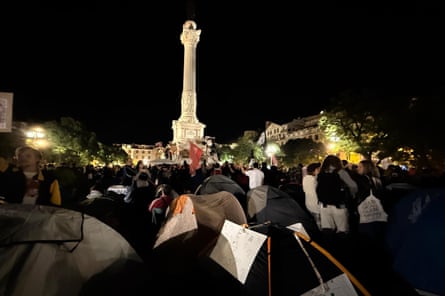
The attenders vowed to stay overnight, with hundreds singing songs as they sat around the statue of King Pedro IV that dominates the square.
“The Portuguese social class that pays taxes, that which keeps this country going, is under attack and is losing its rights, notably its right to housing,” said Elena Costa, a 46-year-old social assistant. “So we are all here together to try to explain that we are suffocating.”
Antonio Margado, a 52-year-old engineer, criticised the centre-right government for “a total liberalisation of rents; owners are protected more and more, while tenants who need a house are those who are protected less and less”.
Portuguese housing prices rose by 124% between 2015 and 2024, roughly twice as fast as the EU average, according to official data. The impact is especially harsh on younger people and those in Lisbon – around a quarter of Portugal’s more than 11 million inhabitants live in the capital’s greater metropolitan area.
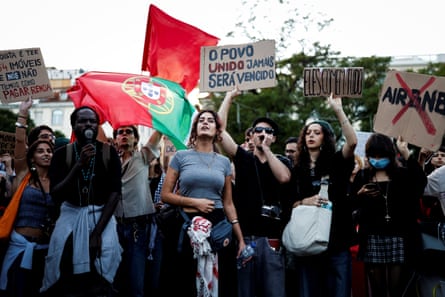
Saturday’s camp in Lisbon amplified a housing protest that started in the northern city of Porto, where dozens of tents had already been set up.
At the earlier protest in Lisbon called by the main CGTP union, demonstrators called for better public services, pensions and wages as well as measures against soaring housing costs.
Portugal’s prime minister, Luís Montenegro, has said his government understands that people want to “express their outrage at what, in their view, may be omissions in public policies”. But he has warned political rivals against “importing into Portugal climates of instability and protest that, in fact, have no support in Portuguese society”, in a likely reference to violent protests in France.
There have also been violent demonstrations in Albania this week, where demonstrators angry over university conditions and high tuition fees have demanded the resignation of the country’s prime minister, Edi Rama.

On Saturday, protesters threw rocks, molotov cocktails, metal objects and pyrotechnic devices at police, and torched cars and litter bins, using them as blazing barricades to stop police advancing.
In a sign of the escalating violence, police fired rubber bullets on the demonstrators for the first time since the protests began. The protests continued into the night, with buildings – including a court, banks and post office – set on fire or severely damaged.
The unrest follows months of anti-government protests in the Balkan nation, initially sparked by a controversial resort development linked to the family of the US president, Donald Trump.
Growing anger over soaring rents and social inequality boiled over in Spain last month after an 87-year-old woman was evicted from her home because she was unable to pay the 230% rent increase sought by the investment firm that had bought her flat.
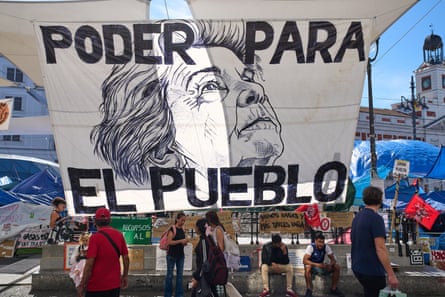
The plight of the late María del Carmen Abascal – and the wider issue it embodied – led to street demonstrations and the creation of a protest camp in the middle of the Spanish capital, and spurred the socialist-led government to propose emergency measures to facilitate and protect access to housing. When rightwing and far-right parties voted down those measures in congress, the prime minister, Pedro Sánchez, responded by announcing a snap general election for the end of November.
In France, fury over teacher absences and shabby facilities in schools in the poor northern suburbs of Paris has snowballed into a nationwide movement against inequality, weak public spending and falling standards.
More than 1,200 people were arrested in France on Saturday after protesters supporting high school students clashed with police, with some demonstrations later spiralling out of control as buildings were set ablaze and shops looted.
The Associated Press and Agence France-Presse contributed to this report
Disclaimer : This story is auto aggregated by a computer programme and has not been created or edited by DOWNTHENEWS. Publisher: theguardian.com