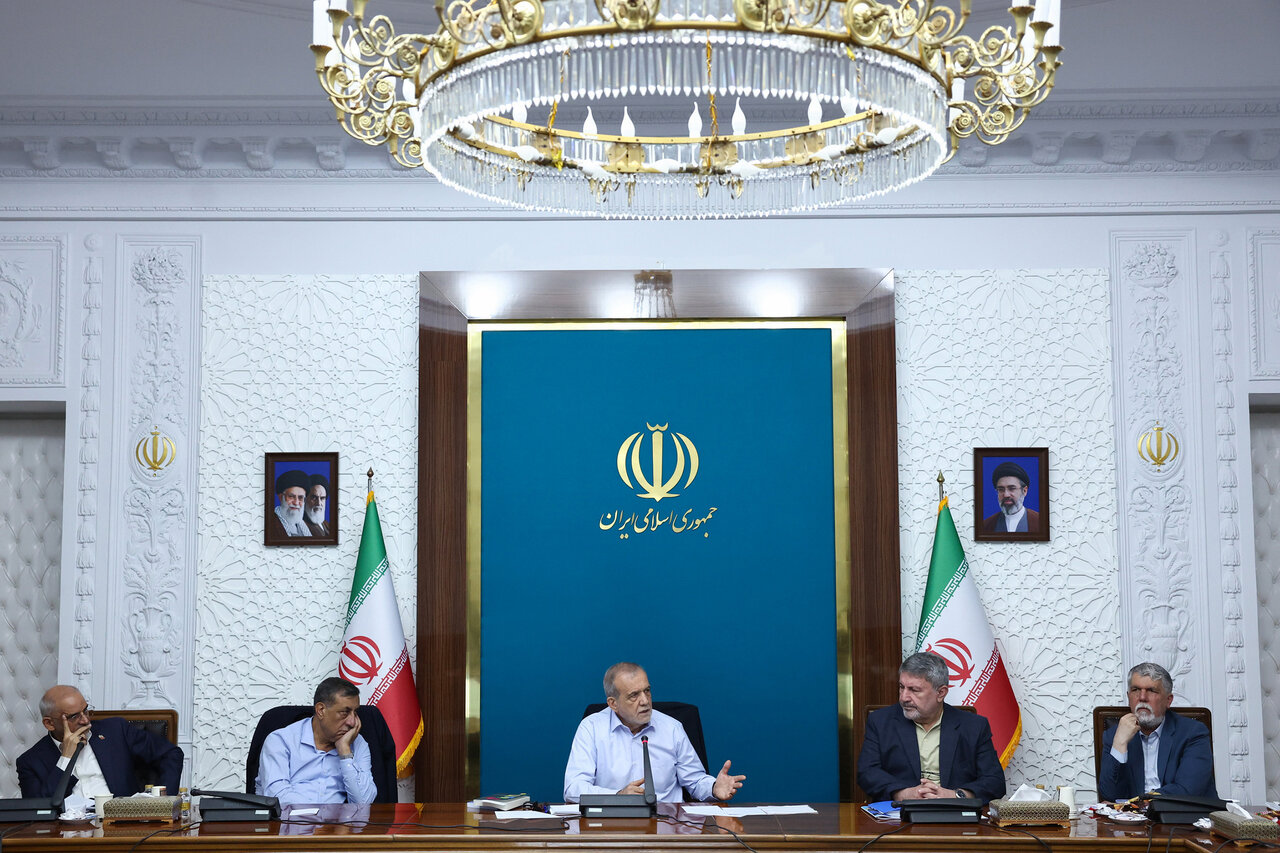
TEHRAN – President Masoud Pezeshkian said Iran has become self-sufficient in gasoline supply through consumption management and public cooperation, stressing that the government will stand against US and Israeli plots with the support of the people.
Speaking at the eighth meeting of the Government Information Council, held in his presence, Pezeshkian said the administration has used all its capacities to prevent disruption to people’s livelihoods, with basic and essential goods supplied through round-the-clock efforts.
According to ISNA, the session reviewed the actions and programs of the council for using the capacity of media outlets and public relations departments to explain the government’s achievements and measures to resolve the country’s crises and problems.
Standing with people against US military and economic war
Emphasizing the full and targeted use of media capacity to realize justice in various fields and continuous all-out efforts to solve people’s problems, the president said the main goal and plan of Iran’s enemies through military aggression, economic pressure and sanctions, and media onslaught is to create and deepen division among the people and strata of society.
“We must all join hands to solve the country’s and people’s problems and use all capacities, including the media, to strengthen unity and cohesion in the country,” Pezeshkian said.
Referring to the difficulties caused by the enemy’s military aggression and economic blockade, he said that despite all the problems, the government has done and will do its utmost to resolve people’s problems, and in this path, securing people’s livelihood must be the first and main priority for all of us.
“If we gain people’s trust and have people with us, no power will be able to harm our country,” the president added. “Despite all the pressure and hardships caused by the enemy’s military and economic war, the government has used all its capacities to ensure people’s livelihood is not disrupted.”
From $12 billion in imports to gasoline self-sufficiency despite US blockade
Pezeshkian also addressed high energy consumption and fuel supply under the economic blockade, saying the administration put saving and consumption management on its agenda to prevent further problems in energy and fuel, which led to significant savings with public cooperation.
“Today we have become needless of gasoline imports, whereas we had to spend 12 billion dollars for importing needed gasoline,” he said.
Stressing that all revenues from fuel price adjustments, savings and consumption management will be paid back to the people themselves, the president said media capacity must be used to accompany people on important issues such as energy consumption management, gasoline saving, and strengthening national unity and social cohesion.
He called on managers in administrative bodies and organizations to work with empathy to encourage government employees, including through plans such as car-free Tuesdays, reduced use of personal cars, increased productivity, and use of teleworking capacity, to control and manage excessive energy and fuel consumption.
Describing the neighborhood-based plan and greater use of public participation, the Basij, benefactors and charities as ways to solve problems and strengthen society’s resilience against enemy aggression, Pezeshkian said the government, with people’s help and accompaniment, will stand against all conspiracies and sinister plans of the US and the Zionist regime and will not allow Iran’s enemies to achieve their objectives.
The president said the 500,000-toman increase in the electronic coupon will definitely be implemented. On the coupon scheme, he said today those with more capital benefit from more subsidies, but the program and goal is to take subsidies from the affluent and financially capable and give more help to the needy.
Continuing his remarks, Pezeshkian stressed the need for all administrative bodies and organizations, as well as companies and the private sector, to strengthen production and increase productivity.
“I invite anyone who can help in this field to cooperate. The country’s managers must use expert and experienced forces to improve the country’s difficult conditions, solve people’s problems and increase productivity,” he said.
Referring to major actions in education, including the inauguration of educational projects and smart schools on Saturday morning, the president said he was very pleased with the major measures taken in a short time, noting that the increase in educational spaces, reform of teaching methods, and development of cultural and sports spaces in educational complexes have been remarkable, with benefactors playing an important role through 48,000 billion tomans in contributions.
On ethnic and gender justice, Pezeshkian stressed continued government efforts, saying the administration seeks to further increase the participation of ethnic groups and women in decision-making and policy implementation.
Media must build unity and trust, not praise the government
“To increase consonance in society and people’s resilience against hardships, pressure and enemy threats, we must all join hands, and media and public relations must accompany with all capacity and strength,” he noted.
Stressing that the accompaniment of media and public relations departments by no means praising government actions, the president said: “I do not like anyone to praise me, tell us our faults and shortcomings so we can work to fix and reform them.”
At the beginning of the session, council members expressed views on the importance and role of media and public relations in explaining the government’s achievements and actions to the people and society.
Among the key points raised were the need for comprehensive understanding of the enemy’s different dimensions and use of all national capacities to neutralize plots against Iran, gaining public trust and aligning people with governance, designing a think tank alongside a narrative room in the government’s media apparatus, strengthening content production by all government pillars and managers along with accountability to public opinion, building hope through respect and continuous engagement with people, having a media engine alongside a media annex for executive plans, avoiding polarization, efforts for social reconstruction and addressing people’s concerns, proper use of cyberspace to foster hope, the need for re-engineering media architecture under military and economic war conditions, effective use of media persons and influential figures, and avoiding ineffective mass production in favor of limited but effective content.
Disclaimer : This story is auto aggregated by a computer programme and has not been created or edited by DOWNTHENEWS. Publisher: tehrantimes.com