An online index of more that 420,000 emails appears to reveal private communications within the far-right party, which include hate speech and open discussions around potential crimes. Here’s what is known, and what is being investigated.
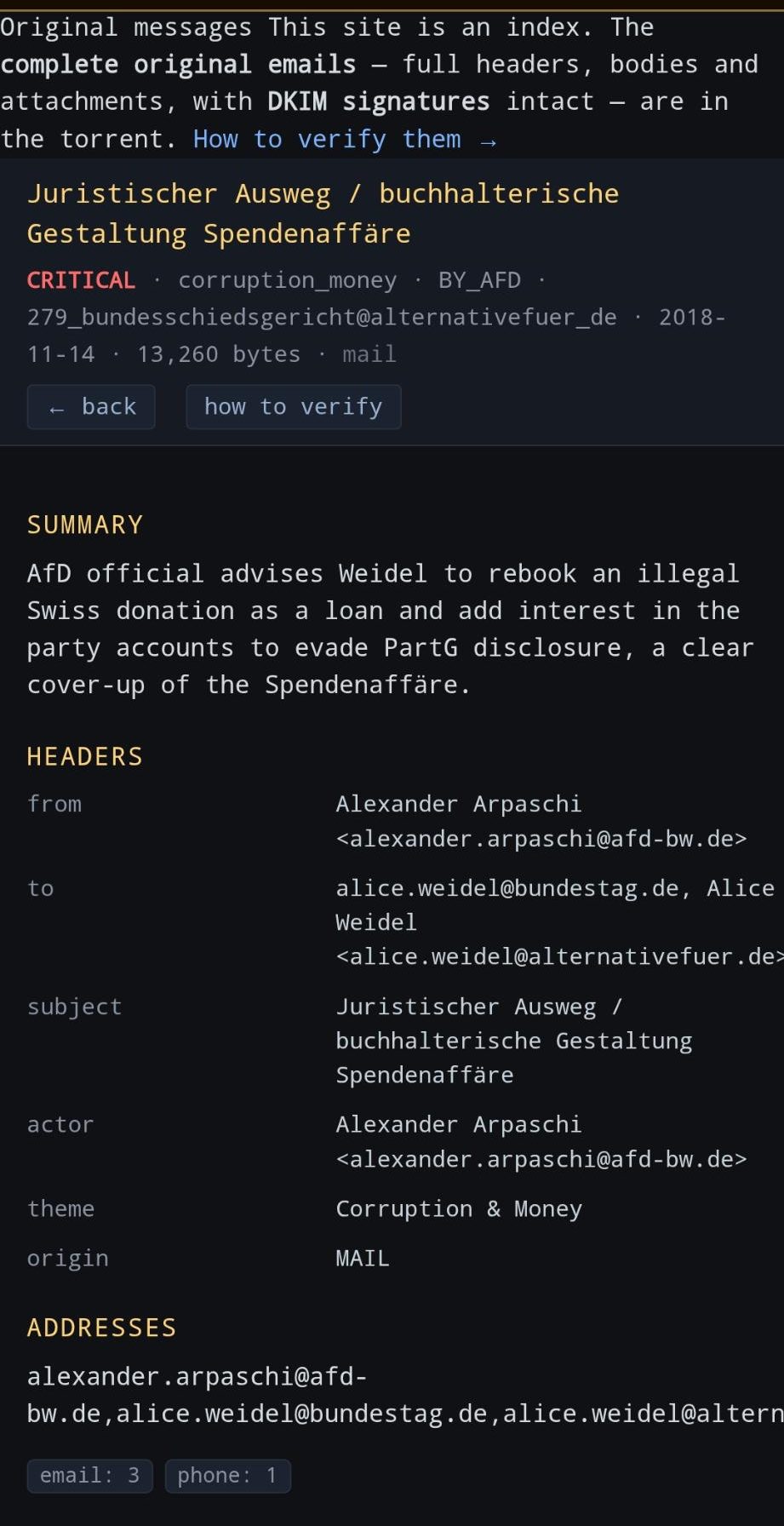
“AfD official advises Weidel to rebook an illegal Swiss donation as a loan and add interest in the party accounts to evade PartG disclosure, a clear cover-up of the Spendenaffäre.”
Thus reads an AI summary of an email – allegedly sent from Alternative for Germany (AfD) politician and member of the Bundestag, Alexander Arpaschi, to the party’s co-leader Alice Weidel – which was made public recently in an online archive following a large scale hack aimed at the far-right party.
On Tuesday it became known that around 421,000 alleged internal emails from at least 10 AfD accounts were available online after the party was hit by a cyberattack.
The party confirmed the hack and the fact that emails and other data was stolen, but the authenticity of the documents still needs to be confirmed.
Meanwhile a publicly viewable archive, created by an anonymous group, allows anyone to easily look through a vast library of AI-generated summaries of emails allegedly sent to or from official AfD accounts.
A glance at the content reveals antisemitic language, hate crimes, and mentions of electoral and financial crimes.
Here’s what is known so far about the leak, and what it could mean for German politics.
What was leaked?
The AfD was hacked and internal data, including emails, were stolen. That much has been confirmed by the party itself.
“In September 2026, a hosting provider of our party was the target of a hacking attack…” an AfD spokesman had confirmed to German media on Tuesday.
The anti-immigration and Russia-friendly party has downplayed the severity of the attack somewhat, suggesting that the stolen data was old.
Most of the email accounts which had been jeopardised “had not been used for years”, the spokesman said.
But other people who have reviewed the files disagree.
“It’s clear that this is by no means old data,” cybersecurity expert Mirko Ross told the Tagesspiegel. “The dataset contains emails dating back to this year.”
Early reports, by Bild and other outlets, said that the leaked data also included sensitive documents, such as a photo of the identity card of Markus Frohnmaier, the party’s deputy parliamentary group leader. Also various invoices, bank statements, certificates, membership applications and membership lists from AfD district associations in North Rhine-Westphalia.
Documents still need to be authenticated before any revelations from the leaked data could really be held against the far-right party and its contacts, but it looks bad.
“The leak could harm the party,” a Spiegel journalist was quoted as saying in the investigative outlet’s daily newsletter on Wednesday, adding that they were actively analysing the data.
READ ALSO: Why the Alternative for Germany is considered a far-right extremist party
What exactly is online?
Seemingly in an effort to make the data widely available to the public, unknown hackers have created an online index where the leaked emails are ranked by level of apparent severity and can be easily searched through.
However, the original documents are not shown on the website.
Instead posts show AI-generated summaries about alleged emails in the archive, along with the sender and recipient(s) and the subject line. Emails are also tagged by theme, e.g. ‘extremism’, ‘financial scandal’, ‘antisemitism’ etc.
Crucially, this means that the original documents need to be downloaded and authenticated before information seen in the index can be confirmed.
The original files were also available to be torrented. The total size of the files amounts to around 300 megabytes, which is a huge amount of data – roughly comparable to 115 ebooks.
Screen shot of a post seen in the index of alleged AfD emails.
The index website also contains information about how it was compiled, and a ‘how-to’ guide with instructions for downloading and verifying files.
According to the authors of the website many of the emails contain a valid DKIM signature, which is a cryptographic signature that helps to prove an email passed through a named domain’s mail server – it confirms an email’s origin and integrity, in other words.
The Local looked through the index and immediately found summaries of emails allegedly sent to or from AfD top-leaders – including Alice Weidel, Tino Chrupalla and Alexander Gauland – which included racist slurs, antisemitic language, Holocaust denial, hate speech and calls for violence.
Perhaps even more damning would be the verification of communications around financial and electoral crimes, such as the summary quoted at the top of this story, which suggests that AfD co-leader Weidel sought advice on covering up illegal donations to her party.
What could this mean for the AfD and German politics?
Again, the documents first need to be verified before they can be considered evidence of any wrongdoing.
If some of the emails are revealed to be authentic, however, there is potential for this to grow into a major scandal for the AfD.
No one who has watched news around the AfD should really be surprised that their internal emails included antisemitism and hate-speech.
However, the severity of the language here is striking, especially at a time when Germany’s leading centrist parties have so loudly condemned the Left party for alleged antisemitism – over language that pales in comparison to the slurs evidently shared widely through the ranks of the AfD.
READ ALSO: Why is a German city banning new ‘stumbling stone’ memorials to Holocaust victims?
But worse for the party, arguably, would be if some of the emails led to new or further investigations into what would be quite serious crimes around funding for the party and electoral fraud.
To give just one more example, an email allegedly sent from Leif-Eirk Holm, the party’s state chairman in Mecklenburg Western-Pomerania, is said to detail allegations that €10,000 were offered to members to vote for a candidate in a state election.
If some of the more serious crimes allegedly discussed in these emails are proven, high-profile AfD leaders could potentially face criminal charges.
In a wider view, the leak could bring more evidence in support of the idea that the far-right party is indeed extremist, and should be banned.
The AfD currently tops Germany’s national voter opinion polls, and came in first in two state elections in September. It scored its biggest win in Saxony-Anhalt, where it hopes to form Germany’s first far-right state government since World War II.
Disclaimer : This story is auto aggregated by a computer programme and has not been created or edited by DOWNTHENEWS. Publisher: thelocal.de