
An organic recycling business has accused the state government of being “in love with landfill” and believes stronger legislation could benefit WA farmers.
C-Wise chief executive Greg Watts said the government is burying valuable nutrients that could be going back into local farms as growers continue to pay eye-watering prices for fertiliser.
It comes after WA Waste Authority figures released last month showed 2.7 million tonnes of waste was sent to landfill in 2024-25.
In the Perth and Peel region, 27.5 per cent of waste went to landfill.
“The figures are high because landfill is still the easy option in WA,” Watts said.
“Instead of burying this waste, we should be recovering the nutrients in it and putting them back into our farms.”
“We’re throwing things into landfill that could be used again.”
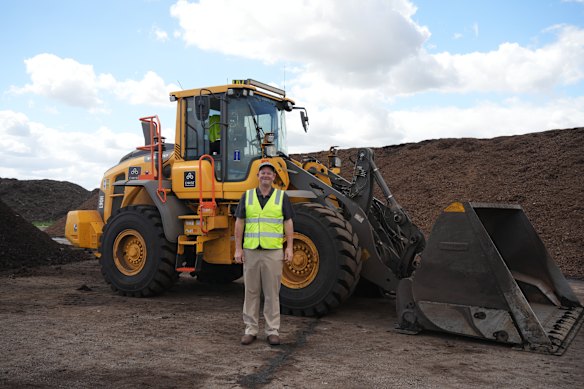
C-Wise is an organic carbon recycling business based out of Nambeelup in Perth’s south.
“Basically, we identify organic waste streams coming out of other industries or sects of the community,” he said.
“We aggregate them, process them through a fairly robust composting process, and that process spits out products like compost that you’ll see in saw yards, or as mulch.
“What we’re aiming to do is to recover more of that from the community and then put it back out into our farmlands or into vegetables or other tree crops like grapes or avocados.”
Currently only two-thirds of metropolitan councils in Perth have introduced FOGO bins for organic waste.
In August, the state government changed the rules over what could be put into green-lid bins.
Households are only allowed to place food scraps, garden waste and certified compostable caddy liners displaying the AS 4736 seedling logo in their FOGO bins.
Items which were previously accepted such as tissues and paper towels, tea bags, and compostable takeaway packaging now have to go in the red-lidded general waste bins.
Watts said this is one of many instances where items could be salvaged for compost.
“In the city, we’re wasting a lot of our garden pruning and if you’ve only got two bins, they’re going to waste-to-energy,” he said.
“If you’ve got compostable cups, coffee grounds, food waste from kitchens, specific event waste where the food trucks rock up, they all have their own organic waste streams, but it all ends up into one bin that goes to landfill.
“There’s all these different events that we could capture these organic wastes a lot better.”
Watts said recovering more nutrients locally could bring a circular economy to people like
He said the failure to look for another use for waste extends beyond what goes into landfill, with unsaleable commercial grain and dead chickens among the resources that are lost rather than recovered.
“That grain could be processed through a composting facility into a fertiliser replacement, but there’s no legislation to make that happen. Chicken mortalities just get buried on-farm. We need to do better, we’ve got all these resources we’re wasting,” he said.
Narrogin farmer Ash Wiese trialled the compost from C-Wise and now uses it as part of his farm nutrition program.
“We did two or three years, just as a small trial basis, over 100 hectares of our farm, and after that, we were pretty convinced it was a good thing. We’ve been doing our whole farm for the last three years,” Wiese told this masthead.
“I really like the concept. I like the circular economy. We grow a lot of oats here for porridge for human consumption, and a lot of their compost is made from the waste when you de-hull an oat, and you’ve got this product left over.
“They use a lot of that as the base of their compost. So I love the idea that they’re pulling nutrition from waste sources, and we’re burying it in the soil and growing food from it again.”
Wiese said the compost has the same effect on his crops as any other fertiliser he has used in the past and is equally cost-effective.
“From 50,000 houses worth of FOGO, we grow about 10,000 tons of oats, which is about 10 million bags of porridge, which is about 200 bags of porridge for every one of those households that would put the FOGO in,” he said.
“So it’s nice to think that if you’re putting a bag of FOGO out, you’re going to get more than a bag of porridge back.”
Wiese believed more farmers would be keen to use compost made from all types of nutrient filled waste.
“We’re all very conscious of building the nutrition in our soil and building the organic matter in our soil as well, and we’re definitely seeing that happen using the compost,” he said.
Watts is now calling on the state government to draw a much harder line on landfill, to stop organic waste being buried when its nutrients could be recovered and put back into WA farms.
“Increase the price of landfill. Because if we make it more expensive to drop it in a hole, then people are going to invest in innovations to reduce that cost,” he said.
“We know that money is the biggest driver in every community. So you’ve got to follow the money.
“Now we’d like people to follow the carbon, but if they won’t follow the carbon, then they can follow the money, and we’ll be cheaper than landfill.”
A state government spokesperson said it was committed to reducing landfill and increasing resource recovery across WA.
“The state government supports the waste hierarchy, which prioritises waste avoidance, reuse and recycling over disposal to landfill, including through the recovery of nutrients and organic matter by composting facilities,” they said.
“We have invested strongly in organics processing infrastructure, including $850,000 for five projects in 2023 and a further $3.66 million for three projects in 2025 to expand capacity.
“We continue to focus on practical measures that divert recoverable material from landfill and return it to productive use.”
From our partners
Disclaimer : This story is auto aggregated by a computer programme and has not been created or edited by DOWNTHENEWS. Publisher: www.smh.com.au