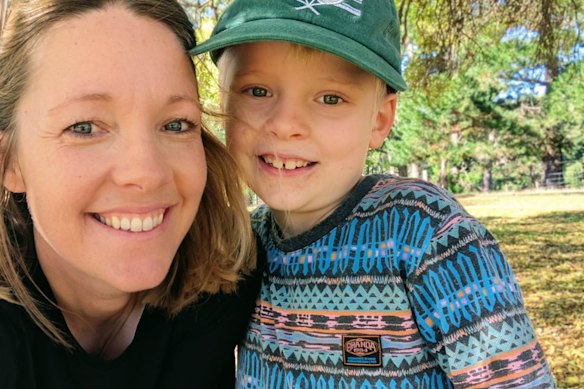

Declan Marshall was diagnosed with type 1 diabetes at just five years old and wears an insulin pump and glucose monitor constantly.
He said managing the condition could be hard, but he struggled more while sitting in class at Capel Primary School.
“It’s so busy at school, and the teachers don’t know as much about it as my mum and dad,” Declan said.
“Sometimes I have to stop playing and sit out because my blood sugar is low and that’s really frustrating. I can still do everything, like play footy and ride my bike, but I have to check my levels first.”
His mother, Alana Marshall, said management of the condition was “a constant balancing act”.
“Too much insulin can cause severe hypoglycaemia, resulting in confusion, loss of consciousness, seizures and, if not treated promptly, can be fatal. Too little insulin can lead to diabetic ketoacidosis, a life-threatening medical emergency,” she said.
In school, the importance of managing the condition effectively is recognised through Individual Disability Allocation funding which can be used by the school to better resource classrooms including by hiring an education assistant.
“It takes extra time for education staff to perform the clinical tasks necessary to keep Declan safe at school,” Alana said.
The funding is automatically given until year 2 when it is cut off.
Parents and schools then have to apply to keep it running on a case-by-case basis under the assumption students can now manage their own condition adequately.
“The impact on Declan is reduced participation in learning and school activities, more erratic blood glucose levels which affect his cognition, attention and mood, and without consistent trained support it is difficult for him to feel safe at school,” Alana said.
“Expecting an eight-year-old to shoulder that responsibility alone, particularly while in a busy school environment full of demands and distractions, is simply not safe, fair or reasonable.”
She said while staff at the school had been exceptional, it also created additional pressure and workload for teachers.
“I found out through word-of-mouth that schools could apply for a funding extension – many schools aren’t aware, which points to the inequity of the funding model,” Alana said.
“It then took four weeks for me to obtain the required letter from an endocrinologist to support the school’s application. This process is not only frustrating for parents, it is time-consuming for health and education staff.
“The deputy principal at our small primary school spent time researching, completing and submitting the application, and I spent weeks calling, emailing and following up with the diabetes team at Perth Children’s Hospital.
“Consultants at the Department of Education then reviewed our application to approve or deny the claim.”
Alana said they had been approved for the year, but the funding policy was based on clinical guidance from Princess Margaret Hospital given more than 10 years ago and was outdated.
Opposition Education Minister Liam Staltari said type 1 diabetes “doesn’t get easier to manage between year 2 and year 3 – it’s lifelong and incurable”.
“The fact is that continuous glucose monitors and insulin pumps have transformed how this condition is managed. The Education Department’s rules haven’t caught up and it’s time for that to change,” he said.
“In the wealthiest state in the nation, no child should be left to manage a life-threatening condition alone in class.”
He said he was working with Alana to launch a petition calling for the state government to “scrap this unfair age cut-off”.
Alana said she wanted to point out the stress the current model was placing on parents and school communities.
“This targeted support funding is not a large amount of money. It won’t improve type 1 management at school overnight,” she said.
“But I hope this petition encourages the government to review an outdated policy creating inequity for families and schools.”
Education Minister Sabine Winton said she had asked the Department of Education to provide her with further advice on what the extension process involves, and how schools support families throughout this process.
“Every child deserves to feel safe and supported at school, including children managing health conditions like type 1 diabetes,” she said.
“Managing type 1 diabetes can be complex, particularly for younger children who may need additional support to manage their condition at school.
“While Individual Disability Allocation funding for diabetes is generally provided until the end of Year 2, that support does not stop if a child still needs it.”
Staltari also raised the issue with Winton in parliament, but was met with frustration from the minister who suggested he was using the issue as a “political stunt”.
“I make myself available to many stakeholders, many parents and many particular organisations,” she said.
“The correct process through which that happens is not as part of a stunt in the public gallery.”
 Holly Thompson is a journalist with WAtoday, specialising in education and the environment.Connect via X or email.
From our partners
Disclaimer : This story is auto aggregated by a computer programme and has not been created or edited by DOWNTHENEWS. Publisher: www.smh.com.au