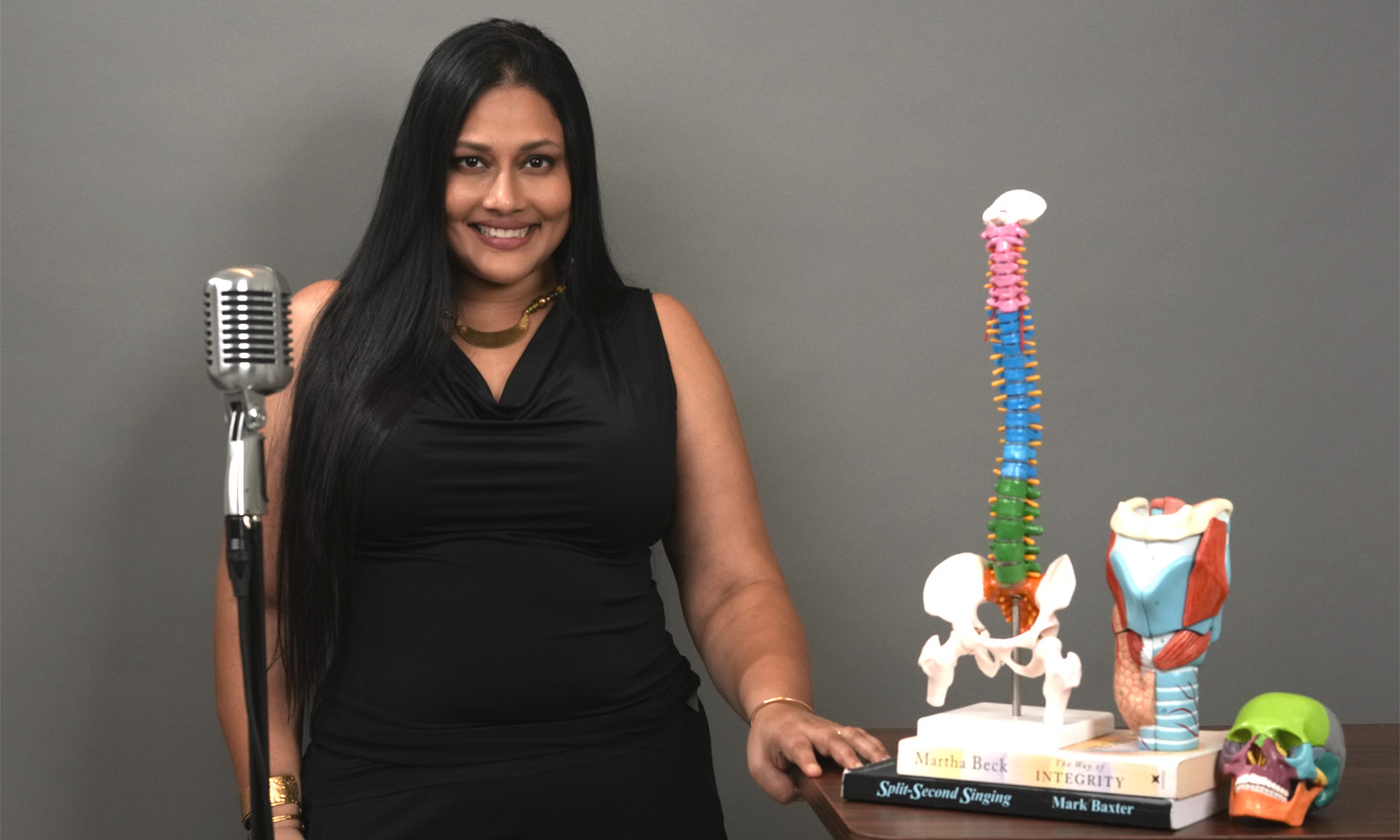
Vocal behaviourism is a new field, and distinct from voice culture, vocal therapy and singing coaching. It studies the voice through three lenses: the physiological, the neurological and the psychological. Just as a waving hand can carry different psychological meanings despite a similar physical movement, the voice demands the same layered understanding, especially when helping vocalists recover.
Vasundhara Vee, a celebrated Indian R&B, soul and jazz artist and a certified Voice Behaviourist, is one of only two such professionals in the world and is leading a movement for better vocal health in the country. In a exclusive conversation with P. Charitha of Deccan Chronicle, she explains what sets this field apart from a voice coach, its importance in the music industry and much more.
For any singer, the voice is their identity. What was the transformation you went through to become a voice behaviourist? Could you share your journey into voice wellness?
You said it exactly right: all of us singers consider singing our identity, and I had an identity breakdown when I lost my voice. I had nodules nearly 15 years ago, and they kept coming back. I was constantly at my doctor’s clinic, taking steroids to handle the inflammation. I was also at the phase of my career where I was getting booked left, right and centre, so I either had a lot of pain after singing or had to cancel performances. Eventually the doctor said I might be looking at surgery. That was a big no for me, because back then we weren’t sure whether the voice would come back the same.
I had to relearn who I was other than being a singer, and I think that made me a better singer. I tried vocal rest and went around looking for coaches across India. They all said I sounded great and must be doing everything right, but I knew that wasn’t true.
Mark Baxter | Image By Arrangement
Around eleven years ago I found my guru, Mark Baxter, based in Boston. He rehabilitated me in three weeks, and a month later my range had doubled and I had a better voice than ever. I fell in love with the subject because of the way he taught: it was scientific, deeply emotional and wholesome. He coined the term vocal behaviourist and developed this field over the last 40 years. After nearly 15 years of training with him, he has certified me to use the term, which is the biggest honour. Today his concepts are buzzwords all over the internet.
Whether its Carnatic, Hindustani, Western or folk music singers focus mostly on ‘riyaz’, with little focus on vocal wellness. Why is it important for the music industry, and what are we missing today?
I’d like to tackle this from three angles. First, my belief and my bias is that a lot of information within Indian wisdom has become foggy, because it was an oral tradition. We are the land of yoga, and I’ve started inquiring into the scriptures. When they say you have to sing with bhakti bhav, it is a neurological cue to the body to be in surrender, so you’re not in control and the voice can flow. Many protocols in a vocal behaviourist’s work lead you into that state, but it already exists in Indian singing wisdom. I want to bring those things back in a way our culture innately knows.
Second, when a voice isn’t conditioned to handle a big vocal load and the singer is already professional, it is the singer’s duty to work with a behavioural coach and have the management in the mix too. Many singers I’ve worked with are post-operative, and their management is already saying, “Come on, let’s get on the road,” because they haven’t hit their financial targets for the year. That’s when I come out with all my horns. You have to design the calendar around the singer’s ability at the moment. Management, the vocal health expert and the singer, who is the brand, need to work together to make this a safe journey for everyone.
Third, we live in a very performative world, where you edit yourself too much and control yourself too much. We have to rewire how we respond to this culture of performance, control and constant self-editing, because the art is beginning to suffer, and we should not allow that.
Some singers, like Punjabi folk singers or opera singers, sing at very high pitches. How can they sing without straining?
Falsetto is a different physiology, and so is belt. These are all different configurations of your vocal folds and vocal tract together. About 90-95% of the singers I work with now are classical singers, folk singers of different types, and Bollywood singers. I want everyone watching to take away one important distinction: there is adaptation or conditioning, and there is strain. They are very different things.
Conditioning means increasing your body’s ability to handle a vocal load gradually, like going to the gym. Do too much on day one and you get injured. Singers often load their voices before conditioning them, believing “no pain, no gain.” High notes are not meant to load the body more than your lower range, and demanding far more than the system needs becomes abrasive to it.
Vasundhara Vee | Image Source: Instagram
What is the first warning sign of strain that a singer should take note of?
The first red flag comes while warming up or doing practise and you feel a little tired and want a break. That is already your voice saying it’s at its limit, but most of us are blind to it and only react when the voice sounds bad. Later it turns damp or hoarse, and then it expresses pain, by which time we’ve gone well past the point where it wanted to rest.
With singers, I first make them sensitive to that early signal. If it arrives at 10 minutes, we stretch it to 20, then 30, and eventually to the length of the show, so a two-hour show means the signal appears only after two hours. When it does arrive, the body is saying you’ve loaded it too much, so ease off and look at what you did just before.
Such issues often resolve in a couple of days with rest, sleep and hydration. But if a change in tone, range or comfort lingers for more than two weeks, see an ENT, because the voice isn’t bouncing back on its own. Except for cancers and a few other conditions, most vocal lesions come from bad vocal behaviour.
For singers as well as speakers and anchors, health issues like hormonal issues, acidity reflux and laryngitis affect the voice. What is the one step a singer should take first thing in the morning?
First up, singing and speaking are not different. The voice that sings is the voice that speaks; it’s the same physiology. In singing we just have a slightly larger variation in pitch, but if you’re a very expressive person, you’ll have large variations in pitch too. The way the body translates high, low, fast, slow, loud and soft is the same in speech and in singing.
For professional voice users like actors, singers and compères, I feel restoring gut health is the one-stop shop for everything. Once your gut is doing better, you won’t have hyperacidity or acid reflux problems, and you won’t have hormonal issues. That directly affects the amount of energy you have for your activities, and it changes your metabolic health too. Down to the cellular level, you have much more energy. Tiredness, dehydration, lack of sleep and a lack of control over dietary choices when you’re travelling all put our gut health out of skew, and that’s when it becomes harder for a voice to operate optimally in an unhealthy body.
So the job of a vocal behaviourist is this: on a day your voice is scratchy or damp, what do you do to not hurt the voice and still deliver your optimal performance? There is an entire way to handle the voice when it’s not at its best on stage and still make it sound optimal, because at the end of the day you have to give a consistent performance. That’s another very interesting way to look at the voice in this field.
Most music schools teach practical performance, theory and history, with a little on voice culture, but no syllabus on voice wellness. Should it be part of the music curriculum?
I think it’s deeply needed. What was understood as voice culture came largely from the Bel Canto tradition, the operatic tradition of medieval Europe. A lot has changed over the last many decades, since the 1950s and 60s, when science developed and we could look at the voice much more closely, through many different lenses. Because knowledge is changing, curriculums need to change.
I’m on the Board of Studies at NMIMS SoPA, which is the only bachelor’s in Western music in India right now, and we included vocal health, so we’re making small moves in that direction. I also worked with Global Music Institute, the Berkeley affiliate in India, which was working with the Delhi government on the Ambedkar Schools of Specialised Excellence. They made music a core subject, like science and humanities, alongside STEM subjects and design, over four years of study. This was the Delhi government doing it at government school level, with GMI as knowledge partner, and they got me on board to design the Western vocal technique curriculum for all four years.
We’ve just barely scratched the surface, and we all need to become a little more open-minded. Nobody is going against tradition, though people in the West ask that when they believe in the operatic, pedagogic style, and the same happens out here. One needs to see this as protection for your body. If you’re a dancer, you need to be friends with the physiotherapist, because you need to protect your body to deliver your art. Vocal wellness should be seen as a friend to all the arts, because it is genre agnostic.
Vasundhara Vee | Image by Arrangement
Looking ahead, what is your dream for vocal wellness in the Indian music industry?
Once we tap into vocal wellness, our voices become so free that we make bolder artistic choices. We grow more creative and more able, and through this behavioural study of the voice we know ourselves better. Artists become more courageous and more skilled at the same time, and the arts need that to move forward.
I deeply believe an artist is the emotional regulation engine of any population. We chronicle our times and give words to what others cannot articulate, helping people reach catharsis and processing. Neurologically, we are co-regulating animals: through the mammalian social engagement system, my nervous system directly affects yours as you read my face and hear my voice. In an age of mental health crises, this is the time for artists to step up and free body and mind together. That is the seed for opening up the entire population.
We are all just people who are discovering our voices…
Disclaimer : This story is auto aggregated by a computer programme and has not been created or edited by DOWNTHENEWS. Publisher: deccanchronicle.com