
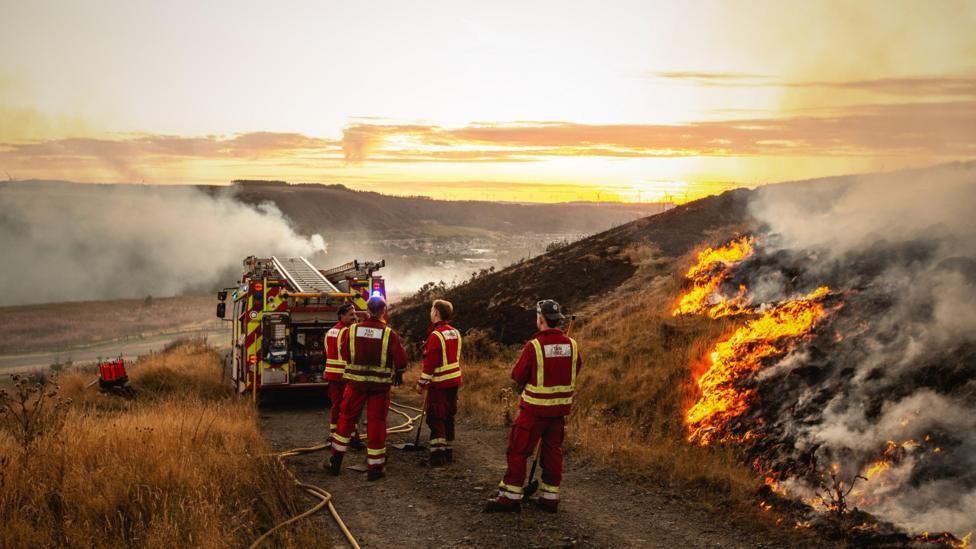
Firefighters and public ‘knowingly put at risk’ during summer wildfires
-
Published
Firefighters and the public were knowingly put at risk during this year’s wildfires due to chronic underfunding, a union has said.
Those working on the ground and in the South Wales control centre said the fires were relentless with injuries “commonplace” for crews.
The Fire Brigades Union (FBU) said firefighters were climbing hills in unsuitable boots and non-breathable layers used for house fires due to not having enough kit, and there is a “real risk to the public” if immediate action isn’t taken.
The Welsh government said it doesn’t provide the core funding but “recognise the concerns raised and are clear that we need to do all we can to reduce the risk of wildfires”.

Sean Cayford, a firefighter in Bridgend, said crews were told in mid August that there were no pumps or fire appliances available across the brigade’s entire region.
“I’ve never heard that before but that was heard again later in the wildfire season. That was startling,” he said.
“One particular day we were at an incident on top of Tredegar mountain and as we looked around the landscape we could see in the region of six or seven other category three wildfires, the most serious type of wildfires, on the horizon in every direction you looked.”
Sean said even with help from other brigades from all over the UK, they “still didn’t have enough” firefighters.
“We were stretched so thinly,” he said. “It has an increasingly destructive affect on the morale of our firefighters.
“It’s very difficult to be at a wildfire incident in excess for eight or 10 or 12 hours and not get injured to some degree.”
He said colleagues sustained lower limb injuries and heat illness, with many still unable to work.

Gemma Thomas, who works in the control centre, said the average number of calls is usually 200-300 but on their busiest day this summer they had almost 2,000.
“It was just relentless in there,” she said.
“There were times where we were unable to fulfil the requests that were coming from the incidents.
“We are the first point of contact for somebody who is having potentially the worst day of their life.
“It was so stressful, mentally draining, that you’re getting home from work absolutely shattered to think right I’ve got to back and do it all again tomorrow.”
Gemma said there were times when staff needed to take breaks “one at a time for 10 minutes just to get people out of the room”.
“People were getting to the point where they were just shattered in work, shattered at home,” she said, adding there was no work-life balance because they needed to use free time to rest.
Gemma says the support from management within the team was “phenomenal” and “even the firefighters on the ground were understanding how stretched we were in the control room”.
But she doesn’t believe they could sustain it long term and wants to see an increase in numbers of firefighters.
 Image source, Helen Davies
First Minister Rhun ap Iorwerth is hosting a climate change and resilience summit in Merthyr Tydfil on Thursday, which will “bring key partners together to develop future actions”.
It will host representatives from the fire services and police, local government, farmers and climate change organisations.
“There was poor preparation,” said Gareth Tovey, executive council member for Wales, explaining they redirected specialist crews such as water teams to the wildfires.
“At some stages there was zero crew back up for vast parts of south Wales,” he said.
“Firefighters were injured because they didn’t have the right kit to fight wildfires.”
The FBU says there’s a shortfall of 400 firefighters in Wales.
Tovey said the union had been warning “for years” that authorities needed to do something and there was a “real risk to the public” if immediate action isn’t taken.
Tovey said bringing in the army, while helpful, “is not a silver bullet” as they do not have the firefighting skills needed.
An FBU survey following the fires found 69% of firefighters felt significantly under-equipped, with just 8% feeling fully equipped.
Nearly half reported welfare facilities during wildfire deployment were insufficient.
Firefighters are funded by the public but through a levy decided by the local authority for the area. This is part of their budget, which is in turn set by the Welsh government.
North Wales Fire and Rescue Service is applying to the Welsh government’s emergency assistance scheme to cover the additional £500,000 the wildfires this summer cost.
At one point firefighters in north Wales were managing six wildfires at once – more than ever before.
It comes as a new report from the UK’s Environment, Food and Rural Affairs Committee said the wildfires left firefighters working in extreme conditions and exposed weaknesses in the UK’s resilience and preparation.
They called for a UK government-funded “national wildfire prevention campaign” with clear and consistent messaging, along with wildfire risk indicators in weather forecasts.
The Welsh government said individual fire and rescue authorities determine how many firefighters they need and set their budgets accordingly.
“They should take this summer’s wildfires into account when doing so,” a spokesperson said.
Ahead of the summit, ap Iorwerth said: “What we saw this summer was much more dangerous than fires in other years.
“While we cannot reverse climate change, we can take practical steps to keep the risk of wildfire as low as possible and ensure a swift and effective response to incidents.”
South Wales Fire and Rescue Service said: “We are incredibly proud of the professionalism, resilience and commitment shown by our firefighters, control colleagues and everyone who supported the response, often in extremely challenging conditions.”
“We recognise that the changing climate and evolving risks facing fire and rescue services mean we must continue to learn, adapt and strengthen our ability to respond when demand rises sharply.”
It said it was engaging with unions about the investment needed and would be a key voice at the summit.
Mid and West Wales Fire and Rescue Service’s chief fire officer Craig Flanney added climate-related emergencies are having a real impact on communities, environment and public services, and require a collective effort.
More top stories
-
-
Published11 hours ago

-
-
-
Published16 hours ago

-
-
-
Published11 hours ago

-
Disclaimer : This story is auto aggregated by a computer programme and has not been created or edited by DOWNTHENEWS. Publisher: BBC




