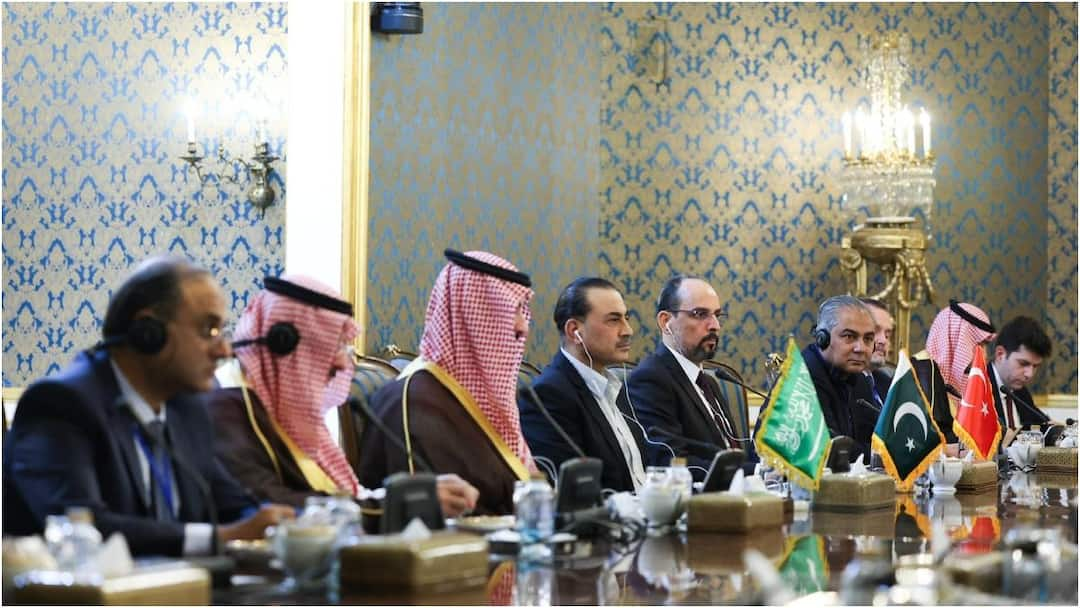
- Pakistan, Saudi, Turkiye officials met in Tehran for regional security.
- Discussions focused on US-Iran tensions and Houthi attacks on Saudi Arabia.
- Analysts doubt talks’ effectiveness given deep US-Iran demands.
Ministers and senior security officials from Pakistan, Saudi Arabia and Turkey are in Tehran for talks on regional security amid the threat of fresh US strikes on Iran. The three countries are signatories to the Mecca Joint Defence Agreement.
Saudi Defence Minister Khalid bin Salman Al Saud, Pakistan’s military chief Asim Munir and Turkish intelligence chief Ibrahim Kalin met Iranian President Masoud Pezeshkian. They are also scheduled to discuss regional tensions with security chief Mohsen Rezaei.
The meetings are among the highest-profile diplomatic engagements held in Tehran in recent months, taking place amid renewed efforts to prevent another escalation between Washington and Tehran, Aljazeera .
Can Mecca Pact Signatories Prevent Fresh Conflict?
Although details of the discussions remain limited, analysts believe the visit could help strengthen diplomatic efforts to avert a fresh outbreak of violence between the US and Iran.
Ali Vaez, deputy director of the Middle East and North Africa Programme at the International Crisis Group, said the visit was an attempt to strengthen the position of those seeking a compromise before fighting resumed. However, he warned that without a credible proposal to bridge the divide between Washington and Tehran, the talks could achieve little.
Yemen’s Houthi Attacks On Saudi Arabia On Agenda
The discussions are also expected to address missile and drone attacks by Yemen’s Houthi rebels, who are allied with Iran, on Saudi Arabia, which backs Yemen’s internationally recognised government.
Ayesha Siddiqa, a senior research fellow in the Department of War Studies at King’s College London, said the countries involved in the Mecca agreement had limited options for military engagement with the Houthis. However, she noted that Riyadh was pressing for greater support as the offensive from Yemen intensified.
Siddiqa added that neither Turkey nor Pakistan could afford to commit troops on the ground in Yemen despite the collective security arrangement under the defence pact.
She also linked the latest diplomatic initiative to Pakistani army chief Asim Munir’s visits to Saudi Arabia and Iran the previous week. The talks come as Islamabad has imposed restrictions on overland border trade with Tehran amid the US blockade of Iran.
Iranian authorities have said they favour a regional approach to security as the meetings get under way.
Talks Unlikely To Avert US-Iran War, Analysts Say
Umer Karim, a researcher on Saudi foreign policy and regional security, said the Tehran meetings were unlikely to reduce the risk of renewed war between Iran and the US, which could trigger further regional instability.
He suggested that the discussions were more focused on safeguarding Saudi Arabia’s security, with Turkey and Pakistan attempting to persuade Iran to reach a compromise.
US, Iran Remain Far Apart On Key Demands
US President Donald Trump is reportedly considering fresh attacks to break the diplomatic deadlock, as Iran has refused to agree to a peace deal unless several of its demands are met.
The US and regional powers want international shipping through the Strait of Hormuz to resume without disruption or attacks. Washington also wants to curb Iran’s nuclear programme and allow international inspectors to assess its highly enriched uranium stockpile. Israel, meanwhile, has said it wants to overthrow the Islamic Republic.
Tehran wants the US naval blockade of its southern ports lifted. The blockade has halted crude oil exports and disrupted much of Iran’s trade. Iran also wants a return to a memorandum of understanding agreed with Washington in June.
The US has rejected these demands. Trump has said he faces a choice of “finish[ing] the job” through major strikes on Iranian civilian infrastructure. Such action could prompt Tehran to retaliate against neighbouring countries, as it did earlier in the war by targeting US bases and infrastructure in Arab states.
Saudi Arabia Faces Wider Security Risks
The regional security concerns have also prompted the US Department of State to order non-emergency US government employees and their family members to leave Saudi Arabia on October 21, citing the threat posed by the Houthis.
As talks continue in Tehran, analysts believe the three signatories of the Mecca Joint Defence Agreement will seek to limit the impact on Saudi Arabia if fighting resumes.
However, Karim warned that the negotiations were unlikely to produce significant results, arguing that Iran’s strategic calculations had changed little and the countries involved lacked sufficient leverage to influence Tehran’s position.
Disclaimer : This story is auto aggregated by a computer programme and has not been created or edited by DOWNTHENEWS. Publisher: abplive.com