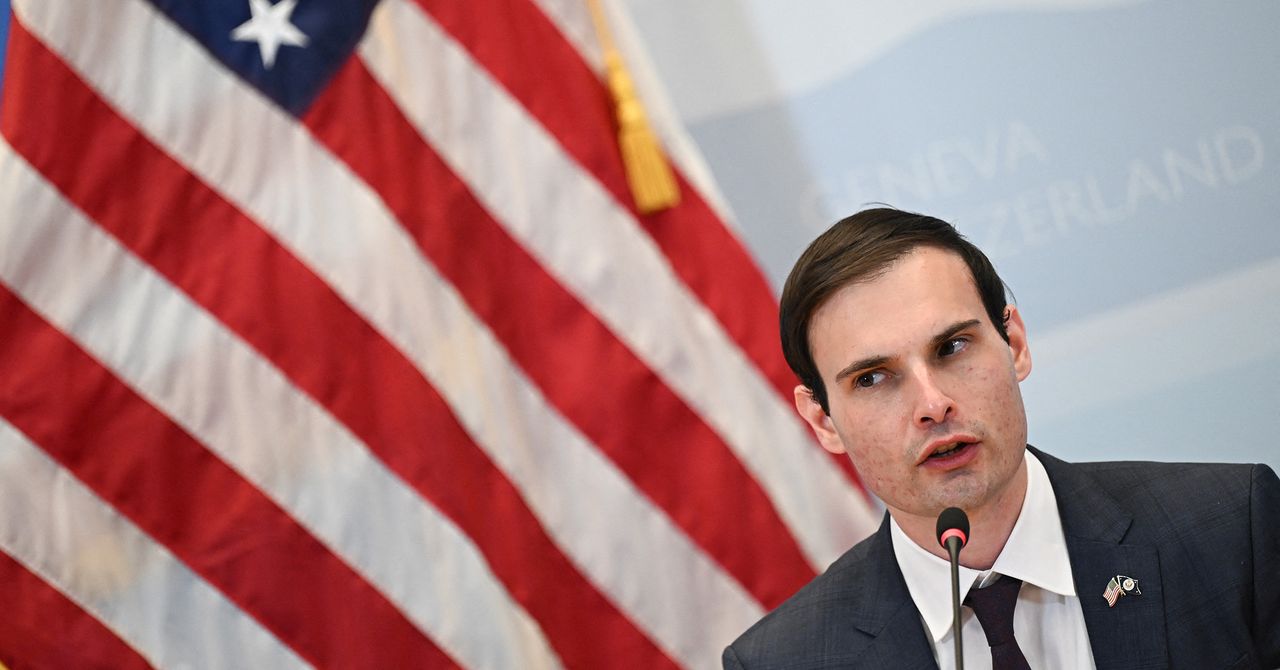
On March 18, 2025, Secretary of State Marco Rubio handed the reins of the US Agency for International Development to Jeremy Lewin, a 28-year-old graduate of Harvard Law School, former investment banker, and affiliate of Elon Musk’s so-called Department of Government Efficiency. At the time, Lewin’s appointment drew criticism because of his lack of experience in government, diplomacy, or foreign assistance. But for career staff inside the agency, the issues surrounding Lewin’s new role were much more alarming than his thin résumé.
For at least two months, USAID senior staff had no knowledge of how Lewin, who appeared at the agency one day as a policymaker on an obscure detail from the General Services Administration, could have suddenly begun wielding the powers of the agency’s top official.
Internal USAID emails reviewed by WIRED reveal that during the three-week period of March 18 to April 4, during which Lewin began canceling lifesaving aid programs and personally signed off on the termination of thousands of USAID employees, he did not sign the paperwork typically required by law to begin work at the agency, despite repeated requests. In fact, his appointment was so mysterious that USAID security was unable to issue him an ID card because they had no records of his employment.
Lewin, currently director of policy planning at the State Department, tells WIRED that prior to Rubio delegating powers to him, he was “both detailed and dual appointed to work at USAID by Secretary Rubio according to well-established authorities and with the advice of State Department and White House counsel.”
Experts, though, say that while Lewin performed the duties of a top USAID leader under the title Rubio handed to him—deputy administrator of policy and programming and chief operating officer—it isn’t clear that he had the legal authority to do so. Questions about how DOGE affiliates like Lewin stepped into top roles at many federal agencies, including USAID, remain key to dozens of active lawsuits targeting DOGE and the Trump administration over federal workforce reductions, firings, and agency dismantlings.
Lewin has said, in a declaration submitted to the court in J. Doe 4 v. U.S. DOGE Service, that he began serving at USAID as a senior adviser as well as a director for strategy and programs on January 28, 2025. On March 18, according to court filings, Rubio, in his role as USAID’s acting administrator, delegated the authority of the deputy administrator of policy and programming and chief operating officer to Lewin, and also signed a document appointing Lewin an “officer of the United States.”
According to the emails reviewed by WIRED, on March 20, two days after Rubio placed Lewin atop the USAID hierarchy, White House liaison to USAID Adam Korzeniewski notified HR to begin the process of onboarding Lewin as a senior adviser performing duties as deputy administrator. Four days later, the emails reveal, after prompting from HR, Korzeniewski provided a proposed start date—March 18—and the next day, Lewin was sent a temporary job offer.
By March 26, the emails show, Lewin still hadn’t accepted the job offer, and had not filed his OF-306, the federal government’s standard pre-employment background screening form; without this document, a federal agency cannot lawfully issue a final job offer or consummate an appointment. An HR executive noted in an email dated March 31 that Lewin had not completed the onboarding tasks required to initiate “the security reciprocity process,” which recognizes the transfer of an employees’ security clearance from one agency to another. (A detailing agreement between the GSA and USAID dated February 14—two weeks after Lewin says he began at USAID—specifes that “commencement of the detail is contingent upon the Detailee’s successful adjudication and receipt of any necessary security clearances and other pre-employment screening required by USAID.”)
On March 28, Lewin signed a letter terminating all remaining USAID staff. And as he executed sweeping powers to liquidate all 60 of USAID’s overseas missions and cancel thousands of lifesaving projects worldwide, HR repeatedly followed up with Korzeniewski.
More than a week after Lewin’s appointment, the emails show, a USAID official told Korzeniewski that the agency’s office of security was “unable to issue a USAID ID card to Jeremy Lewin as SEC [the agency’s secure database] did not have a record of Jeremy as an employee.”
“Until you’re onboarded at USAID, you aren’t even in the system,” says Natalia Machuca, a 15-year agency veteran who hired many staff. “You can’t get a badge, get into your computer, or even walk around the building.”
Lewin tells WIRED, “I was a regular government employee with a valid security clearance held by the State Department during this entire period. USAID HR was confused about this paperwork for a period of days, but this issue was cleared up once they were made aware of the dual appointment and my State Department position.”
But according to a top executive in HR, no one from their office saw any delegation documents until late April 2025. As one longtime HR executive at the agency, speaking on the condition of anonymity, said of Lewin: “He was the equivalent of an administrative ghost.”
“I think this creates a huge accountability problem if you have these actors who are making really consequential life-or-death decisions who didn’t go through any standard confirmation process,” says Don Moynihan, a public policy professor at the University of Michigan, “or in this case didn’t even complete their paperwork to become a formal employee.”
Lewin—who a White House official says submitted all the paperwork required for employment and clearance—provided WIRED with two documents, both dated March 18, 2025. One is an appointment and compensation waiver, signed by Rubio, naming Lewin director of strategy and planning, and stating that he would not be paid “pursuant to, among other provisions of law, 22 U.S.C. § 2385(b).” The other is a standard appointment affidavit naming Lewin USAID’s director of strategy and programs. A signature on the form appears to be Rubio’s, with the title given as “HRO”—usually an abbreviation for human resources officer. The State Department did not answer questions about this document.
To one former senior USAID official, Rubio’s use of 22 U.S.C. § 2385(b)—an obscure provision traditionally reserved for rapidly deploying emergency-response staff to disaster zones abroad—to appoint Lewin looks like a legal contortion.
“It is so unconventional that I’d never seen it used before I got to USAID,” the official said. “It was created for the purposes of scaling up really quickly if there was some outbreak of a virus somewhere and they needed to bring people on, then let them go.”
Brian Feinstein, a law professor at the Wharton School of Business, acknowledged that while using 22 U.S.C. § 2385(b) to appoint Lewin is complex, it appears to him to be legal. “Because Lewin’s appointment is consistent with this law regarding USAID personnel,” he says, “his unusual status should not be a factor.”
Outside of this point, legal questions also remain about Lewin’s actions at the agency before he was appointed by Rubio, and his failure to complete the onboarding required to begin his initial detail period at USAID. During this time he was part of a team that issued sweeping orders, including one to then acting administrator Jason Gray to lock all USAID staff worldwide out of email and all communication systems, which could have put many staff’s lives at risk, and to terminate 57 of the agency’s top officials.
David A. Super, professor of law and economics at Georgetown University, describes Lewin’s failure to complete his onboarding as much more than an administrative slip-up. “You can’t just walk in the door of a federal agency and become an employee,” he says. Under federal law, a cabinet secretary can only assign the authority of a Senate-confirmed position such as USAID administrator to a subordinate official—an agency employee or officer who works under the supervision of a higher-ranking officer. These regulations, Super says, are a way for Congress to guarantee that “someone walking off the street should not be given these enormous powers.”
Nina Mendelson, who teaches law at the University of Michigan, agrees. She says the administration appeared to be trying to bypass the Federal Vacancies Reform Act, a federal statute that dictates how temporary vacancies in Senate-confirmed executive branch positions are filled. “The FVRA specifies who may fill in, for a limited time, when a Senate-confirmed post is vacant,” she says. “The possibilities are a first assistant, someone holding another Senate-confirmed post, or a longtime civil servant in the particular agency. Lewin doesn’t seem to have been any one of those.”
Lewin being placed atop USAID came in a specific context. In February 2025, shortly after the arrival of Lewin and other DOGE affiliates at the agency, two dozen current and former USAID employees and contractors sued Musk and DOGE in Maryland District Court. They successfully secured a preliminary injunction on March 18, on the grounds that special government employees—temporary hires from outside USAID and the government—lacked the authority to execute sweeping federal actions. That same day, Rubio delegated powers of the agency’s top job to Lewin.
On March 28, the Fourth Circuit Court of Appeals granted the Justice Department an emergency stay, pausing the injunction based on the administration’s argument that the actions were taken by Lewin in his role as a federally appointed official. In his declaration, Lewin wrote: “I am not, and have never been, an employee of Elon Musk or USDS,” adding, “I report directly and only to Acting Administrator Rubio” in his role at USAID.
The ruling gave Lewin the green light to fire thousands of career civil service and Foreign Service staff that very day, but the legal battle didn’t end there. The district judge has since allowed thousands of affected employees to sue DOGE and the administration as a group and ordered the government to hand over a trove of internal documents.
Kevin Byrnes, a veteran federal employment law attorney representing more than 170 former and current career USAID staff in a separate suit challenging DOGE’s role in the mass firings, says the fact that Lewin had not completed mandatory onboarding paperwork raises even more questions about the authority of nonconfirmed agency leadership, and potentially exposes Lewin personally.
“If Lewin didn’t even fill out the papers and was not authorized to take these actions, then he could be exposed to personal liability,” says Byrnes, who is asking the court to reinstate all the plaintiffs to their USAID jobs, with back pay.
Disclaimer : This story is auto aggregated by a computer programme and has not been created or edited by DOWNTHENEWS. Publisher: wired.com