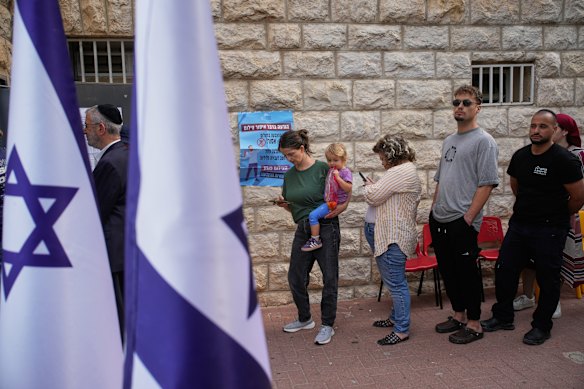
Israelis cast their votes amid intensifying war chatter
Good morning and thanks for joining our live coverage of Israel’s election, which is widely seen as a referendum on Prime Minister Benjamin Netanyahu’s almost two decades in power.
Polls close at 10pm in Israel (7am AEDT) in the first national elections since the Hamas attack on October 7, 2023, a day that shook the country and plunged the Middle East into turmoil.
By 6pm and with hours remaining until polls closed, nearly 67 per cent of eligible voters had cast a ballot, according to Israel’s central election committee, the highest since 1973.
Netanyahu’s hold on power is at stake, with the prospect of a return to war with Iran dominating the final days of the campaign.
Centrist rivals are promising to usher in a new era, but the polls have shown a close result between the two blocs, and it may take time before clear results are known.
Israeli media reports passed by the official military censor and published in the final days of the campaign have stated that Netanyahu pressured his military chief to provoke a confrontation with Iran ahead of the elections, suggesting high-level leaks from within the defence establishment. Israeli Defence Minister Israel Katz denied the reports.
US President Donald Trump told Fox News on the weekend he was deciding whether to “make a deal” with Iran or “finish it off”, adding: “It’s getting to be decision time.”
Netanyahu posted an alarming AI-generated image of a nuclear mushroom cloud over Tel Aviv and spoke about using cryptocurrency to avoid international sanctions in the final days of the campaign.
Who is Gadi Eisenkot, the man most likely to defeat Netanyahu?
Gadi Eisenkot, who served as chief of the Israeli military from 2015 to 2019, is the candidate who looks most likely to replace Benjamin Netanyahu if he is forced from office.
Earlier this year I wrote about how this political newcomer has surged to the top of the opposition bloc.
“Eisenkot is not a slick operator, nor a soaring orator. He doesn’t ooze charisma. But with many Israelis fed up with Netanyahu’s scandals and relentless politicking, Eisenkot’s more down-to-earth approach could turn out to be an advantage,” I wrote.
Eisenkot’s son, Gal, died in action during the Gaza war in 2023, showing he has a personal stake in Israel’s conflicts.
Listen: Is Netanyahu’s leadership over?
After the October 7 attacks, Benjamin Netanyahu’s prime ministership seemed in ruins. His government repeatedly looked on the verge of collapse.
Today, Israelis head to the polls for Israel’s first national election since that harrowing day three years ago. So, how are they viewing the prime minister now?
In this episode of The Morning Edition podcast, foreign affairs and national security correspondent Matthew Knott reports from Israel on the key issues tearing Israelis apart, and the surprising bloc of voters who may be the kingmakers in this election.
What an Israeli election ballot looks like
As in Australia, Israelis vote using paper ballots, but they look very different than we are used to. Instead of filling in boxes, Israelis select a single piece of paper that corresponds to the party they want to vote for.
In a quirk of the system, the ballot does not usually say the official name of the party; instead each party is represented by one to three Hebrew symbols.
For example, Netanyahu’s Likud party is represented by Mahal (מחל), containing three letters representing historical parties that merged into Likud.
How will the government be decided?
A single party has never won enough seats to govern Israel in its own right. This means governments always comprise a multi-party coalition, often made up of several parties with significant ideological differences and competing personalities.
After election day, President Isaac Herzog will hold consultations with the leaders of all the parties elected to parliament. Based on these conversations, he will choose the leader he believes is most likely to form a viable coalition government. Depending on how close the result is, the president can have significant influence over who forms government.
While the president typically gives the party with the most votes an opportunity to try to form a government, this is not always the case. For example, in 2009, former diplomat and minister Tzipi Livni’s centrist Kadima party won 28 seats compared with 27 for Netanyahu’s Likud. But then-president Shimon Peres gave Netanyahu the first chance to form a government, reflecting his view that a centre-right coalition was most likely to succeed. Netanyahu cobbled together a coalition and took Israel down a more decisively conservative path over the next two decades.
Arab Israelis ride camels, donkeys to vote as turnout surges
One of the big stories of this election looks likely to be a voting surge by Arab Israelis (also known as Palestinian citizens of Israel).
In previous elections, only half of these voters have participated but that figure is set to soar to 65 per cent, or even 70 per cent, today.
A video posted on social media has shown supporters of the Islamist Ra’am party in the Bedouin city of Nahat in southern Israel heading to vote by riding on camels and donkeys.
In pictures: Israelis head to the polls
Tel Aviv voters weigh in on the election
At Tel Aviv’s famous Carmel Market, stall owners and patrons were abuzz with chatter about whether they had voted and whom they had voted for.
Bar, a student, said, she was desperate for an end to Netanyahu’s government.
“We really want change,” she said, saying she favoured either Eisenkot or the secular right-wing Netanyahu critic Avigdor Lieberman.
Stall-owner Dudi said: “I don’t know if Netanyahu, but I want the right side to rise.”
Tiferet, visiting from the southern city of Ashkelon, near the Gaza border, said she had not decided who deserved her vote. Keeping Israel safe and animal welfare were her top priorities.
“People here don’t understand what it was like on October 7,” she said. “We need someone much more extreme, much stronger.”
Who is competing in these elections?
As is always the case in Israel, an eclectic array of parties is competing against each other. While some parties – like Netanyahu’s Likud – are mainstays of Israeli politics, it is common for parties to emerge, dissolve and merge with each other in this fluid ecosystem.
As a way to understand the election, it helps to think of three blocs.
The first is known as the pro-Netanyahu bloc. This grouping, which has been in power for the past four years, has been the most right-wing and religious government in Israel’s history. Likud is the biggest party in the bloc. It also comprises two ultra-orthodox parties (United Torah Judaism and Shas) and two ultra-nationalist parties led by Itamar Ben-Gvir and Bezalel Smotrich, both of whom have been sanctioned by Australia for inciting violence against Palestinians.
Israelis cast their votes amid intensifying war chatter
Good morning and thanks for joining our live coverage of Israel’s election, which is widely seen as a referendum on Prime Minister Benjamin Netanyahu’s almost two decades in power.
Polls close at 10pm in Israel (7am AEDT) in the first national elections since the Hamas attack on October 7, 2023, a day that shook the country and plunged the Middle East into turmoil.
By 6pm and with hours remaining until polls closed, nearly 67 per cent of eligible voters had cast a ballot, according to Israel’s central election committee, the highest since 1973.
Netanyahu’s hold on power is at stake, with the prospect of a return to war with Iran dominating the final days of the campaign.
Disclaimer : This story is auto aggregated by a computer programme and has not been created or edited by DOWNTHENEWS. Publisher: www.smh.com.au