What does a red lip have to do with fine jewellery? Or kitchen waste with art? What happens when a centuries-old embroidery motif enters a contemporary home or a costume designer decides a pair of sneakers makes just as good a canvas as anything else? Behind each of these ideas is a woman making a name for herself in the UAE’s creative scene. Some are just getting started, others are already beginning to find an audience, but all are at that exciting point where you get the sense there is much more to come. Part of the thrill of discovery is coming across great work just as things are beginning to take off. Their names may not be everywhere just yet but just give it time.
FANNY TURCOTTE
Founder & Creative Director, Victoire Fine Jewellery
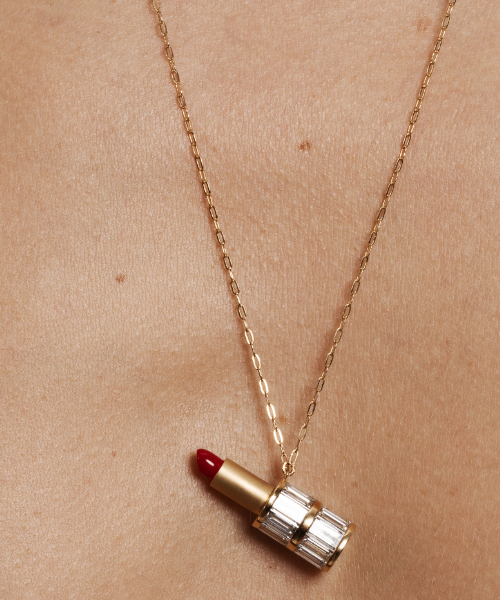
Le Rouge Colette necklace, Victoire Fine Jewellery
Fanny Turcotte knows the power of a red lip. A swipe of it can change a woman’s mood, her posture and, on the right day, her entire attitude. Fanny wanted to capture that effect in jewellery, an idea that eventually led to Le Rouge, one of the collections from her fine jewellery house, Victoire.
Jewellery has been part of Turcotte’s visual vocabulary since childhood. Her grandmother was an impeccably dressed woman who never took her diamond rings off. “I don’t remember her without them,” she recalls. Trips with her grandmother to Birks, which she considers the Canadian equivalent of Tiffany, became an early introduction to fine jewellery. Those visits stayed with her, even if designing jewellery herself wasn’t part of her life’s plan. That came much later. She spent a decade working in fashion and beauty photography and creative direction, developing an eye for light, proportion and composition that would eventually bring her back to jewellery from an entirely different perspective.
When she began designing Victoire, those two parts of her life naturally came together. The diamonds she had admired since childhood were now being viewed through a photographer’s eye, with Turcotte paying close attention to how each piece catches the light, moves against the body and changes from different angles once worn. She often looks well beyond jewellery for inspiration. Architecture, photography, fashion and beauty all find their way into her designs, sometimes in unexpected ways. The Colette necklace, for instance, brings together baguette-cut diamonds and Art Deco geometry with the vivid red enamel of Le Rouge.
Turcotte aims to move away from the idea that fine jewellery needs to be gifted by someone or reserved for birthdays, anniversaries and engagements. A woman might buy herself a diamond because she was promoted, built a business, took a risk that paid off or simply because she saw something beautiful and wanted it. “Why should we wait for someone else to celebrate us?” she says. Turcotte is still defining what makes a Victoire piece unmistakably Victoire, but she already knows she doesn’t want that recognition to depend on a brand mark. “I would love for a Victoire piece to be recognisable by its attitude before it is recognisable by a logo,” she says.
EMMA HAMSA
Founder & Creative Director, Emma Hamsa Perfumes

Emma Hamsa Perfumes
Perfumer Emma Hamsa believes scents are a way of holding onto the people who have shaped her. “My relationship with fragrance is deeply personal. From a very young age, I have always been drawn to scent and to the way certain smells can immediately take us back to a person, a place or a moment in our lives,” she shares. Hamsa lost both of her parents at a young age and was raised by her grandmother, whose recent passing prompted her to turn a lifelong relationship with scent into a fragrance house of her own. “After going through a period of grief, I felt a strong need to create something lasting, something that could preserve emotion even as memories naturally fade with time,” she explains.
That idea translated into The First Light, a debut collection of three Extrait de Parfums inspired by her mother, father and grandmother. Hamsa thinks of our “first light” as the people who give us our earliest understanding of love, strength, safety and identity. Milk of Light, inspired by her mother, explores what Hamsa describes as “femininity without fragility,” using milky notes, almond and tonka to balance softness with strength, while her father inspired Eternal Horizon, where fresh woods and mineral accords evoke the stability and confidence she associates with masculine energy. As for her grandmother’s fragrance, Desire Skin, it carries a little more friction. Their relationship was deeply loving but could also be challenging and Hamsa wanted the fragrance to acknowledge both. Spice and citrus eventually soften into woods, musk and florals, mirroring a relationship that became warmer and more tender over time.

Turning her memories into fragrances took more than a year of development with a French fragrance house. Hamsa always starts with the emotion she wants a perfume to evoke and works backwards from there, finding the notes that can give it form. It’s also why she isn’t in a rush to put the brand everywhere. She wants to build an audience around the stories first and let the fragrances find their place gradually. But the First Light is only the beginning. Hamsa is already developing a second collection of five fragrances while simultaneously writing a psychological autobiography.
HAZEL CALDER
Author
Hazel Calder was lying in bed scrolling through Instagram when she came across a post about the classic television series I Dream of Jeannie. It got her wondering why nobody had written a grown-up version of the genie concept. The idea eventually found its way into The Problem with Wishes, her latest rom-com novel centred on an ambitious, career-focused woman whose life takes an unexpected turn when a male genie enters the picture.
“I knew I wanted it to feel like a modern romantic comedy rather than a traditional genie story,” she says. “And because I love writing about women who are ambitious and very focused on their careers, my main character was always going to be that kind of woman. Which obviously meant the genie had to be a man.” The novel is part of a writing career Calder has steadily nurtured while also pursuing a career in corporate marketing. She had wanted to write fiction for years but like many would-be novelists the dream was often deferred. It wasn’t until the pandemic that she finally gave herself the challenge of completing a book. Since then, she has published two novels, all while continuing to work full time.
Her first year as a published author has been a busy one. “Hectic! I think that’s probably the best word for it,” Calder says. “There have definitely been weeks where I’ve wondered why I decided publishing two books in one year was a good idea.” Writing them turned out to be only part of the job. Self-publishing meant learning her way around covers, editing, formatting, distribution and advertising, much of which was completely new territory.
It’s worth noting that Hazel Calder is a pen name, allowing the author to keep writing separate from her corporate career, but elements of one inevitably make their way into the other. “I’ve worked in corporate marketing for 16 years, so I think there’s always a little bit of me in my characters, even if their jobs and personalities are completely different,” she says.
Calder writes about women navigating high pressure careers and relationships. Having spent much of her own life living abroad, she is also drawn to international settings. Two books in, she already knows what she wants readers to expect when they pick up one of hers. “I’d love for readers to see my name on a book and know they’re going to get a strong female lead, an ambitious career, complicated relationships and some humour,” she says. “Probably a glamorous setting too. I think that mix feels very me.” Book three is already underway, this time following a 38-year-old London divorce lawyer who is excellent at her job and considerably less successful in love. There is, Calder teases, “another slightly unusual twist,” but she’s keeping that one to herself for now.
NEETI TANDON KASHYAP
Founder, Curate Home
Neeti Tandon Kashyap can tell a lot about a piece of fabric, including spotting details that most people often overlook. She notices its weight, how it sits in the hand and the tiny irregularities most of us might dismiss as imperfections. A slightly uneven print, a knot in a hand-loomed fabric or even a fingerprint left behind in the glaze of a mug usually catches her attention. That keen eye was developed over more than a decade spent working in apparel and textile manufacturing. Kashyap worked in mills factories and sourcing rooms, learning how fabrics behave and how natural dyes settle differently from one piece to another.
When she launched Curate Home from her Dubai home in 2020, she started small with a batch of cotton throws which sold out almost overnight. A stall at Dubai Design Week later that year came close to doing the same. Then, in 2023, Curate Home won the Spinneys Local Business Incubator Programme, taking the business from Kashyap’s home to shelves across 24 Spinneys stores and Bloomingdale’s UAE.
Despite the growing retail footprint, Kashyap still makes her first judgement with her hands. “I choose pieces by touch first,” she shares. “I’d rather work on a small batch of something meaningful and intentional rather than mass produced.” Traditional techniques remain central to the brand but the artist is always looking for new ways to bring them into a contemporary home.
A block print traditionally used on a saree might find its way onto a cushion, while the same hand-casting techniques used for traditional copper vessels can produce a set of everyday tumblers. “I never ask an artisan to change their technique,” she says. “The value is in it staying exactly as it’s been passed down.” She would rather change the object than the craft behind it.
New collections usually start with a technique or material Kashyap encounters while travelling, perhaps an interesting weave, a dye process or a hand-thrown ceramic, with the idea developing from there. “I try not to force a material into a shape it was never meant for,” she says.
DIVIYA TILANI
Artist, Costume Designer & Co-Founder, Design Dome

Diviya Tilani
Painting and fashion have always existed side by side in Diviya Tilani’s work. She studied Fine Art and historical costume construction at the St. Petersburg Stieglitz State Academy of Art and Design, learning to work across oil, acrylic, watercolour and gouache while developing the technical skills required to construct garments by hand. Since then, that foundation has taken her into costume design for television and more recently, wearable art.
One place where Tilani found a home for her creativity was as a costume design assistant on the series Nevsky. It was a chance to put years spent studying historical costume construction into practice and see her work make the leap from sketches to the screen. Sneakers have since become another outlet for her artwork. Tilani designs around the shape and details already on the shoe, adapting each illustration so it works across the different panels and curves. And because these are ultimately made to be worn, she uses specialist leather paints and waterproof coatings to make sure the artwork can handle life outside the studio.
Tilani’s designs draw heavily on her interest in architecture and history, particularly the Silk Road, nomadic cultures and influences from Central Asia and the Middle East. And at Design Dome, the creative space she co-founded in City Walk, much of that work takes the form of custom pieces. It gives her the freedom to move between art and fashion and keep trying her hand at new materials.
“I don’t want to define myself through a single medium,” she affirms. “Each material gives me a different way to tell a story.”
MASARRATFATIMA SULAIMANI
Paper Artist

Paper art by Masarratfatima Sulaimani
Masarratfatima Sulaimani has made paper do things most of us would never associate with a humble sheet of A4. She has carved it into intricate hand-cut artworks, transformed it into installations large enough to occupy an entire room and more recently, turned recycled paper pulp into something she can paint with. “Paper has been a part of me for as long as I can remember,” she says. As a child, Sulaimani remembers crumpling, folding and tearing it as a way of expressing herself. That early instinct eventually led her to study Fine Arts and Graphic Design and, over time, build an entire practice around the material. “It has slowly become my language,” she says.
A residency with the Al Qasimi Foundation in Ras Al Khaimah introduced Sulaimani to papermaking and an entirely new set of possibilities. She started experimenting with plants, vegetable waste and locally sourced fibres. Making the paper herself gave her greater control over its texture and thickness, while locally sourced plants and fibres allowed her to bring something of the surrounding landscape into the finished work. Once Sulaimani learnt to make paper herself, she wanted to see how much further she could take it. Through trial and error, she developed a technique that allows her to create directly with recycled paper pulp, using it almost like paint.
“I can almost draw with the pulp, a little like icing a cake,” she says. “It also allows me to continue exploring sustainability. I can take discarded paper, turn it into pulp and then use it to create something completely new.” Currently, she fabricates pieces the size of matchboxes while continuing to investigate how waste from her own kitchen and potentially hotels, could be remade as paper and eventually sculpture. As an expat, Sulaimani also sees parallels in the way paper can be broken down, remade and given another form. Her work increasingly explores migration, journeys and the experience of adapting and finding home somewhere between different places.
“I don’t really know exactly where the material will take me,” she says. “And I quite like that.”
ZUHRIA ABU AWWAD & SUHA SALAMAIN
Founders, Ashghal El Teta Zuhria
Abu Awwad grew up watching her mother and grandmother practise Palestinian embroidery. She remembers wanting to learn the cross-stitching techniques they used and years later, began creating her own pieces inspired by the craft she had grown up around. Her daughter Suha Salamain, an interior architect, soon joined her, bringing her own design perspective to the work. By then, Abu Awwad had become a grandmother, which gave the motherdaughter project its name, Ashghal El Teta, or “Grandmother’s Work.” Their work brings traditional Palestinian embroidery into contemporary art and interiors without losing the history and meaning carried by the original motifs. Working with your mother does, of course, mean agreeing with your mother. The duo admit that they don’t always manage that, especially when colour is involved. Salamain describes herself as “a deconstructivist at heart” and favours a more muted palette. Meanwhile Abu Awwad is usually ready to add another colour to the mix. “The colour palette is probably where we struggle the most,” Salamain says.
She also knows when her mother has won the argument. “Her flair for adding the right accent is unmatched and I am always eager to learn from her.”
That push and pull has become part of Ashghal El Teta’s identity. Traditional Palestinian motifs might be enlarged, abstracted, layered or brought together with unexpected materials, but the embroidery remains closely connected to its origins. Before working with a motif, the pair research where in Palestine it originates from, what it represents, and the story attached to it. “We don’t want to modernize Palestinian embroidery to the point that it becomes unrecognizable,” Salamain says. “We want to reinterpret it in a way that makes people curious about its origins and encourages them to look deeper.” Their aim is to give Tatreez a natural place in contemporary homes and encourage younger generations to engage with the craft themselves. An idea the duo are currently exploring is an open source library of curated patterns that stitchers could download, reinterpret and use to create their own compositions.
Abu Awwad can now look at her own grandchildren and think about what her mother and grandmother once passed down to her. “We want the younger generations to pick up the needle and thread and create their own take on our traditional embroidery arts,” she says. There is plenty the pair want to do with Ashghal El Teta, from creating pieces around Palestinian places and landmarks to developing it into a wider platform for Palestinian heritage. Someday, they hope the next generation will look at what they’ve built and say, “This started with Teta.”
October’s—The Discovery Issue—Download now
– For more on luxury lifestyle, news, fashion, and beauty, follow Emirates Woman on Facebook and Instagram.
Images: Supplied
Disclaimer : This story is auto aggregated by a computer programme and has not been created or edited by DOWNTHENEWS. Publisher: emirateswoman.com