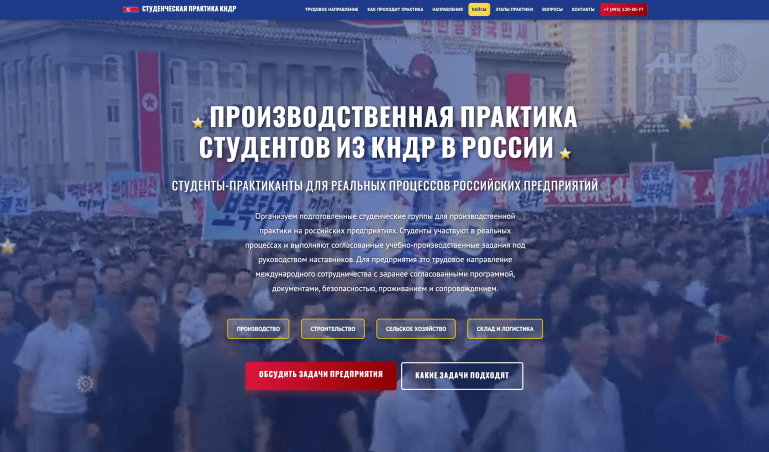
Russian broker network recruiting North Korean labourers using student visas, Global Rights Compliance report says.
North Korean workers are being recruited into forced labour in Russia by a broker network using bogus student enrolments, according to a months-long investigation by an international law foundation.
The network brings North Koreans into Russia on student visas to skirt United Nations sanctions and labour law, as part of a state-sponsored work programme that helps fund Pyongyang’s ballistic missile development, according to the Global Rights Compliance report released on Thursday.
Recommended Stories
list of 4 itemsend of list
Operated by Russian businessman Vladimir Sokolov, labour-brokering platform KNDR.su markets North Korean workers to prospective Russian employers in agriculture, construction, industry and IT, charging a commission of 100,000-150,000 roubles ($1,240-$1,860) per placement, according to the Netherlands-based nonprofit.
In conversations with Global Rights Compliance investigators posing as prospective employers, Sokolov’s operations director, Ruslan Zhukov, said North Korean workers were enrolled in colleges they did not attend “to avoid the application of labour law”, the law foundation said.
Zhukov also described the workers being required to work 12 hours a day, six days a week, according to the report.
UN member states are prohibited from hosting North Korean workers under a 2017 UN Security Council resolution intended to deprive Pyongyang of funds for its nuclear weapons and missile programmes.
Despite UN sanctions, between 35,600 and 101,280 North Korean workers were based overseas in 2025, generating an estimated $450m-$800m for Pyongyang, according to an 11-country team that monitors sanctions enforcement.
Advertisement
Russia granted more than 36,000 visas to North Koreans in 2025, a fourfold increase from the previous year, almost all of which were officially for educational purposes.
Global Rights Compliance said the network also helped support Russia’s war effort in Ukraine, with Sokolov publicising at least two work sites with links to Moscow’s military-industrial complex.
Sokolov and Zhukov did not respond to requests for comment sent to Sokolov’s holding company, Black Horse, and KNDR.su.
Global Rights Compliance said Zhukov denied the report’s allegations, calling them “false, fabricated, and categorically rejected in their entirety”.
“The matter concerns exclusively students of a specialised college, sent to Russia within the framework of an intergovernmental agreement on the exchange of experience and the provision of venues for educational and industrial practical training,” a statement attributed to Zhukov said.
Lara Strangways, head of business and human rights at Global Rights Compliance, said the broker network pointed to deepening ties between North Korea and Russia.
“North Korean workers are being sent to Russian factories through a network that serves both states at once: Their labour props up Russian industry, including sites linked to the war in Ukraine, while the revenue they generate helps fund North Korea’s military programme,” Strangways said in a statement.
“What we are seeing is a clear exploitation of these workers as part of a cross-border system. If governments are serious about responding to this deepening alliance, they need to understand the role that forced labour is playing in sustaining it.”
North Korea and Russia have ramped up cooperation across various fields in recent years as Moscow became increasingly isolated on the international stage in the wake of its 2022 full-scale invasion of Ukraine.
The Cold War-era allies ratified a landmark mutual defence treaty in 2024, with Pyongyang deploying thousands of North Korean soldiers to fight alongside Russian troops in the war on Ukraine.
Disclaimer : This story is auto aggregated by a computer programme and has not been created or edited by DOWNTHENEWS. Publisher: aljazeera.com