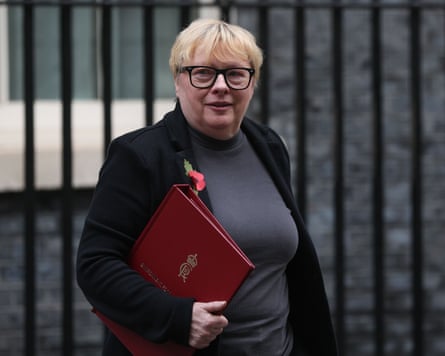
Angela Eagle, the environment secretary, has summoned water industry bosses to Whitehall after a report found that the environmental performance of the big companies has worsened despite investment.
“People are sick of excuses,” Dame Angela said, after the Environment Agency joined the Drinking Water Inspectorate, Natural Resources Wales and Ofwat for a joint report that rated eight of the nine water companies in England as “poor” or “requiring improvement”.
There were 74 serious pollution incidents, the category that causes significant harm to the environment, the report said. That was just one fewer than the previous year, despite billions of pounds of investment, bans on bosses’ bonuses and a public outcry. The watchdog’s environmental performance assessment ratings of water companies added up to 16 “stars” out of a possible 36, a fall from 19 the previous year, and the lowest score since the process began.
Changes could be imposed on the industry, Eagle warned: “Water companies have let the public down time and time again, and today’s report is further proof that root-and-branch reform cannot wait.”
The UK is one of only two countries in the world where the provision of water is fully privatised. The other is Chile, where water privatisation was imposed in the 1980s by a military dictatorship.
Overall, there were 2,666 pollution incidents in England in 2025 – a 40% increase on 2016, the EA said. Thames Water had the most, followed by Anglian Water, United Utilities, Yorkshire Water and Southern Water.
The Department for the Environment, Food and Rural Affairs (Defra) said Eagle was preparing to take “further action”, with “tougher consequences” for executives at failing companies.
Defra said it would “set out a clear set of improvement actions”, such as “tackling leakage”, “reductions in pollution incidents” and “improving customer satisfaction”. Rules that took effect last year would block bonuses for executives at companies receiving a one-star rating.
Environmental campaigners called for stronger action. “This is a system that rewards shareholders and creditors while our rivers, wildlife and bill payers lose out,” said James Wallace, the chief executive of River Action.
Thames Water, the worst offender, ought to go into special administration immediately, he said. “Ministers must end the failed privatisation experiment, review alternative models including public ownership, and give regulators the power to make polluters pay not the public.”
The four agencies have pooled their data in a joint report for the first time – a step towards combining currently fragmented regulatory responsibilities under a single watchdog. But Richard Benwell, the chief executive of Wildlife and Countryside Link, said a new regulator “must be more than a merger of existing institutions”.
“It needs a clear legal duty to restore nature, strong environmental targets and the powers and resources to enforce the law across the water industry, industrial agriculture, and chemical companies,” he said.
Water UK, the industry trade body, said: “Today’s report shows the lowest level of leakage in history, as well as other areas of good performance. However, the fact remains that the environmental performance of some water companies is not good enough.
“While more than half of all pollution incidents last year were caused by blockages or vandalism, which are not in the direct control of the water companies, there is clearly more work to do.
“It will take time, but record investment will help secure water supplies, support growth and end sewage entering rivers and seas.”
Disclaimer : This story is auto aggregated by a computer programme and has not been created or edited by DOWNTHENEWS. Publisher: theguardian.com