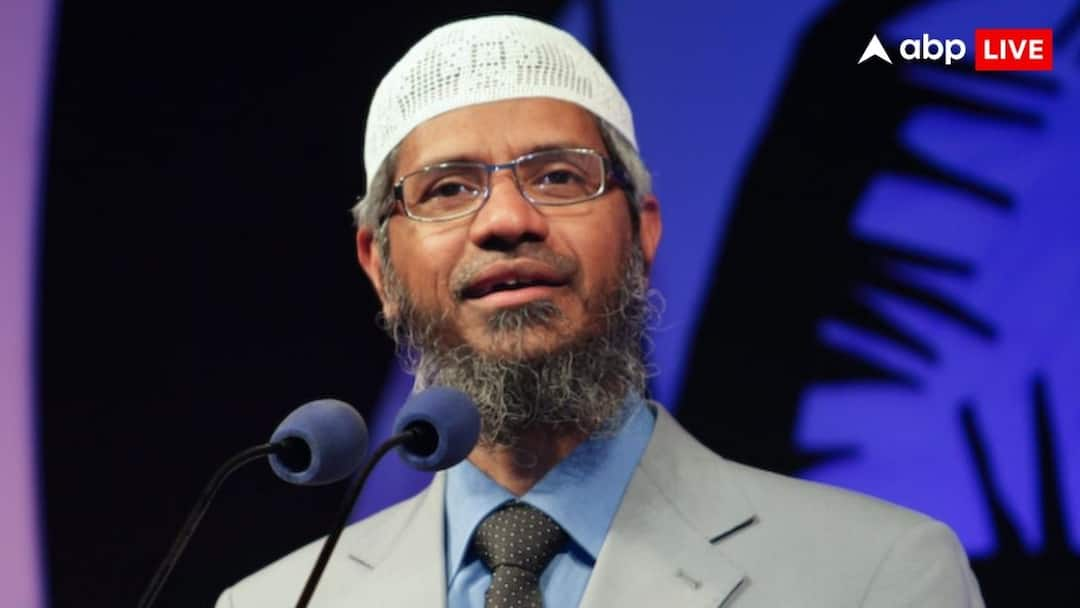
- Zakir Naik defended Taliban’s education curbs as temporary, citing safety.
- He claimed teacher shortage; women continue advanced Islamic studies.
- Activists, scholars criticized Naik’s remarks as deeply troubling, disappointing.
- UN reports contradict Naik, highlighting widespread girls’ education denial.
Fugitive Islamic preacher Zakir Naik has come under criticism from journalists, academics and activists in India, Pakistan and Afghanistan after defending the Taliban’s restrictions on girls’ education in Afghanistan. In a video circulating online, Naik argued that the restrictions on secondary and higher education were temporary measures linked to security concerns and a shortage of female teachers.
He also claimed that Afghan women continued to pursue advanced degrees, including master’s programmes and PhDs in Islamic studies. His remarks have triggered criticism, with opponents accusing him of downplaying the Taliban’s restrictions and offering a justification for the exclusion of girls from education.
What Zakir Naik Said About Taliban’s Education Policy
Naik, who is wanted by Indian agencies in cases involving alleged money laundering and incitement, claimed that he had personally spoken to representatives of the Taliban about the restrictions.
“Everything that comes in the media is not true,” he said, arguing that the authorities were waiting for suitable conditions before allowing girls to resume higher education. “So if someone delays the education till they have the right teacher, there is no problem at all.”
He maintained that girls were permitted to study until Class 6, while further education had been put on hold because of security concerns.
“Only the higher education, because the environment is not safe, they are waiting till the safety is secure,” he said, as per reports.
Naik also argued that Afghanistan had a shortage of female teachers for secondary education. He claimed that women could still pursue advanced studies in subjects such as Sharia, Arabic and the Quran.
“So to say that they don’t have higher education is wrong. It’s misinformation,” he said.
ALSO READ: ‘Makes Our Nation Proud’: PM Modi Congratulates ISRO On Successful NVS-03 Satellite Launch
Malala Yousafzai’s Father, Indian Scholars Criticise Remarks
The comments drew a sharp response from UK-based Pakistani activist Ziauddin Yousafzai, father of Nobel Peace Prize laureate Malala Yousafzai.
Describing Naik’s justification as “deeply troubling and disappointing”, Yousafzai argued that describing an indefinite ban as a delay did not make the restrictions acceptable. He also questioned the argument about a shortage of female teachers, saying that citing the problem without explaining how it would be addressed was misleading.
He warned that such arguments risk providing religious justification for the Taliban’s policy of denying Afghan girls access to education.
Indian Islamic scholar A Faizur Rahman also criticised Naik and tagged Malaysian Prime Minister Anwar Ibrahim, questioning why the preacher was being allowed to remain in Malaysia.
Historian S Irfan Habib also commented on the Malaysian Prime Minister, while YouTuber and historian Ruchika Sharma questioned the silence of religious leaders over the restrictions on women’s education in Afghanistan.
What UN Reports Say About Girls’ Education In Afghanistan
Naik’s assertions contrast with findings published by United Nations agencies on the state of education in Afghanistan.
According to a UNICEF report released in August, more than 2.6 million Afghan girls have been denied access to secondary education since the Taliban returned to power on August 15, 2021.
The restrictions were introduced in September 2021, effectively barring girls from formal education beyond Class 6. Women were subsequently excluded from universities in December 2022.
In December 2024, the Taliban further restricted women’s access to education by barring them from medical training institutions, including nursing and midwifery programmes.
UNICEF has described Afghanistan as the only country where secondary and higher education remain effectively inaccessible to girls and women.
After taking power in 2021, the Taliban introduced gender-segregation measures in educational institutions and mandated female teachers for girls’ schools. Plans to reopen secondary schools for girls in March 2022 were subsequently withdrawn.
ALSO READ: Haryana Class 3 Student Attacks KG Student With Stones, Flowerpot Inside School; Child Hospitalised
Who Is Zakir Naik And Why Is He Wanted In India?
Naik left India in 2016 following allegations that his speeches had inspired one of the attackers involved in the Dhaka cafe attack in Bangladesh.
He has faced allegations involving the promotion of religious hatred, unlawful activities and money laundering, all of which he has denied.
In 2017, Naik sought refuge in Malaysia and obtained permanent residency. India’s attempts to secure his extradition have so far remained unsuccessful.
Disclaimer : This story is auto aggregated by a computer programme and has not been created or edited by DOWNTHENEWS. Publisher: abplive.com