
TEHRAN – America’s military supremacy apparently comes with a new logistical priority: making sure there are enough graves when the bombs stop falling. As Washington continues to promise victory in its next great confrontation, the US Army is busy rehearsing how to bury the casualties. One wonders whether Americans were ever told this was part of the plan.
Washington has spent years assuring the world that the United States possesses the most powerful military on earth. Its aircraft carriers, stealth bombers, precision missiles and global network of bases are routinely presented as proof that no adversary could seriously challenge American power. Now, however, the US Army is rehearsing a rather less glamorous capability: digging temporary graves for large numbers of its own dead.
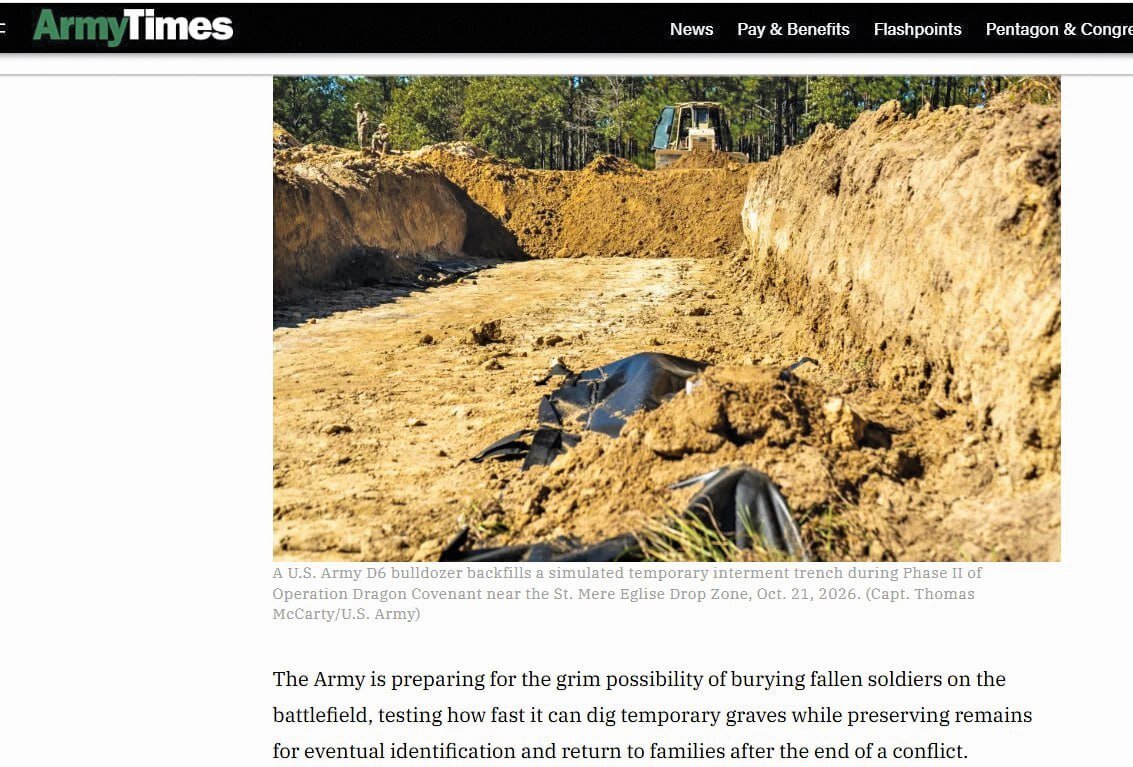
According to an October 26 report by Army Times, American soldiers recently took part in an exercise in North Carolina to test how quickly battlefield burial trenches could be excavated and filled while preserving remains for later identification and repatriation. The exercise, known as Phase II of Operation Dragon Covenant, brought together engineers, medical personnel, chaplains and specialists in fatality management. It was not a routine lesson in cemetery maintenance. It was preparation for a future high-intensity conflict in which the United States might be unable to retrieve its fallen.
The figures are especially difficult to ignore. Army doctrine envisages temporary interment plots consisting of five parallel trenches, each designed to accommodate 100 bodies. During the latest exercise, D6 bulldozers were used to excavate a trench for 20 remains in an average of one hour and 15 minutes. Based on the results, the Army said an appropriately equipped engineer company could dig and cover trenches for as many as 2,400 bodies in 24 hours—provided it operated nonstop.
Two thousand four hundred. In a single day. One hopes the Pentagon’s public-relations department will forgive the observation that this is an unusually grim performance metric for an institution supposedly dedicated to winning wars.
The Army says air superiority in Iraq and Afghanistan allowed fallen personnel to be transported home through established channels. A future conflict against a capable adversary may look different: airfields, transport routes and evacuation networks could be contested or destroyed, making temporary burial unavoidable until the dead can be recovered.
That is a sober logistical assessment, but it exposes the gap between Washington’s rhetoric of power and the realities its military is preparing to face. The question is not only whether the United States can strike thousands of miles away, but whether it can protect its forces and bring them home when the other side fights back.
American interventions have often been sold through images of technological superiority and promises of swift outcomes. Their human costs have fallen on service members, their families and civilians in the countries where wars were fought. A large-scale conflict with a peer adversary, however, could mean sustained fighting, disrupted logistics and casualties on a scale unseen in the post-2001 American experience.
The Army Times report does not predict that 2,400 Americans will die in a day, nor does the exercise prove that such a war is imminent. The number is a planning capacity, not a casualty forecast. But planning for a contingency is itself revealing: military institutions devote resources to scenarios they consider serious enough to prepare for. And the Army is not merely discussing how to evacuate the wounded. It is testing how to bury the dead when evacuation is impossible.
Even the details are chilling. Existing guidance on the spacing between trenches proved too narrow for bulldozers to pass without disturbing them, requiring changes to doctrine. Chaplains also considered how to consecrate a site when individual services cannot be provided and the dead people’s identities or faiths may be unknown. Ensuring dignity is humane; the conditions being anticipated are not.
American families should ask how their country arrived at a point where the Army is refining the geometry and operating speed of temporary mass burial sites. What political decisions could produce a war in which air superiority is no longer assured, evacuation routes are vulnerable and thousands of casualties must be managed near the battlefield? Who would explain to parents, spouses and children that the return of a loved one has been postponed because the war planners failed to anticipate the enemy’s ability to strike back?
The bitter irony is that a political culture treating military force as an instrument of limitless influence can be casual about its limits. A powerful military can destroy infrastructure and project power across oceans; it cannot guarantee victory against an adversary able to impose costs or deny it freedom of action. Superior weapons do not abolish geography, logistics or human vulnerability.
Perhaps the most important message of Operation Dragon Covenant is not about bulldozers or burial procedures. It is that the Pentagon is planning for a future in which the United States may not control the skies, the routes or the pace of escalation. Before Washington contemplates another confrontation, Americans might reasonably ask their leaders a simple question: if the Army is already calculating how to bury thousands, what exactly are the politicians calculating about the cost of the war?
Disclaimer : This story is auto aggregated by a computer programme and has not been created or edited by DOWNTHENEWS. Publisher: tehrantimes.com




