
In Alaska, a controversy is unfolding over whether two Senate candidates with roughly the same name will cancel each other out.
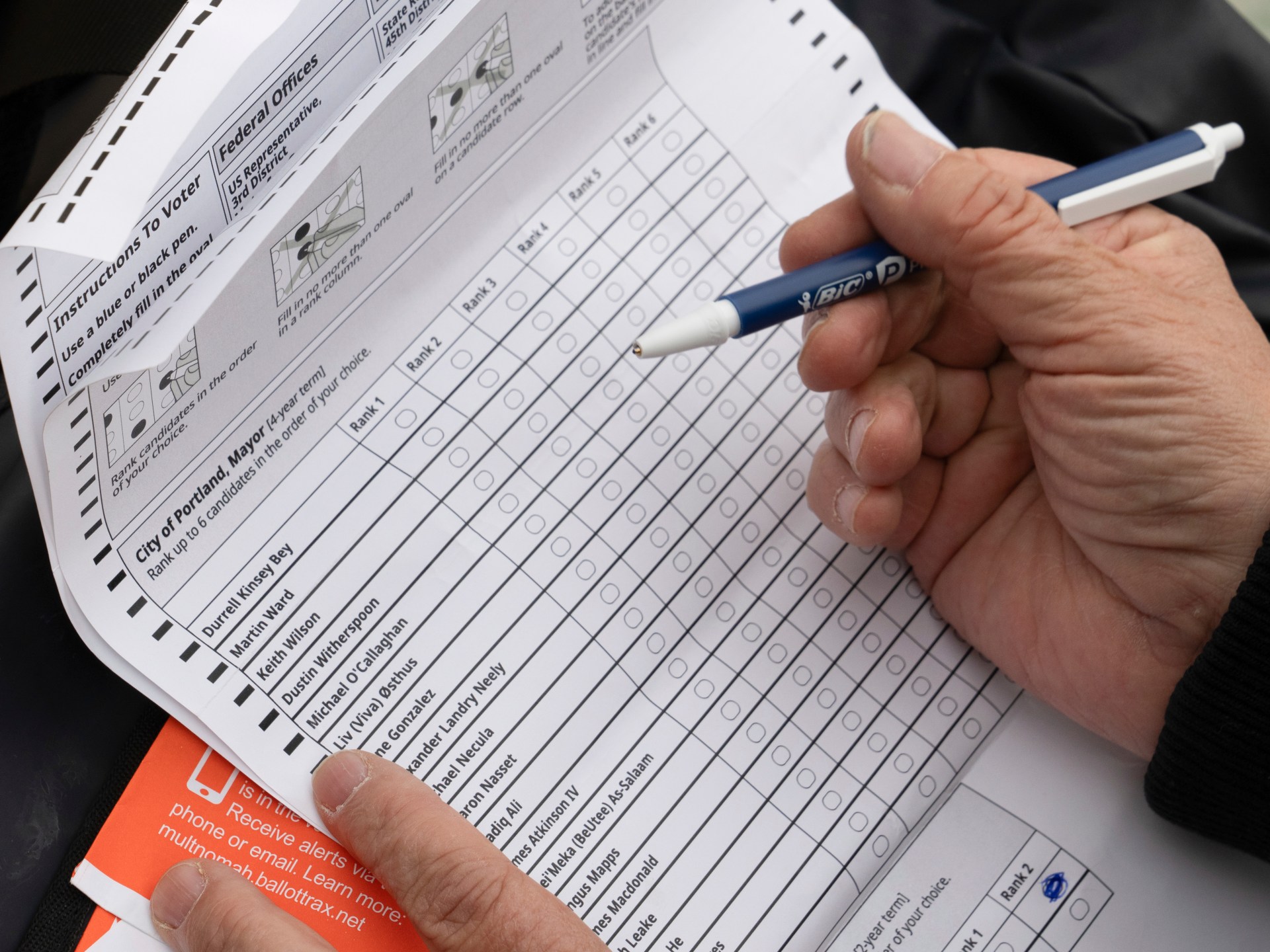
The debate has shone a spotlight on a relatively uncommon style of voting in the United States: a system known as “ranked choice”.
Recommended Stories
list of 3 itemsend of list
Only two states in the United States — Alaska and Maine — employ ranked-choice voting throughout their territory, though major cities like New York have also embraced the practice.
Ranked-choice ballots allow voters to rank candidates in order of preference, rather than choosing just one. If a voter’s first choice does not win a majority, their vote can be transferred to their second pick.
With US midterm elections set for November 3, ranked-choice voting could play a role in closely watched races, including the Alaska Senate battle.
Here’s a guide on how ranked-choice voting works in the US:
What are the benefits of ranked-choice voting?
Proponents of ranked-choice voting believe the practice frees voters from the pressure of having to vote pragmatically. They no longer have to cast their ballot based on the candidate most likely to win.
Instead, supporters say that ranked-choice voting allows people to support the candidate they prefer the most, without the fear of “wasting” their vote should that candidate prove to be unpopular.
Advocates for ranked-choice voting also argue that the system reduces the spoiler effect, whereby a third-party or lesser-known candidate draws votes from a similar major-party candidate.
They also frame the system as a boon for democracy, by encouraging more diverse viewpoints to compete in elections and offering an incentive for candidates to work together.
Advertisement
What are the downsides?
Critics argue that ranked-choice ballots make voting and vote-counting more complicated.
They also fear it could slow down the tallying of election results, undermining confidence in the outcome.
A 2025 study published in the journal Political Behavior cited data suggesting that 4.8 percent of ranked-choice ballots are “improperly marked” — though it clarified that not all of those ballots are invalidated as a result.
How does ranked-choice voting work?
On a ranked-choice ballot, voters get to number their candidates in order of preference. If their first choice doesn’t win, their vote automatically counts for their next choice instead.
If one candidate receives more than 50 percent of first-choice votes, that candidate wins.
If no candidate secures a majority, the candidate with the fewest votes is eliminated. Ballots for that candidate are redistributed to voters’ next-ranked choices, and the votes are tallied again.
This continues until a candidate wins a majority of votes still counted in the final round.
If a voter ranks only one candidate and that candidate is eliminated, their ballot cannot transfer to another candidate.
Unlike a traditional runoff election, which requires voters to return to the polls, ranked-choice voting can determine a winner through successive rounds of counting in a single election.
Why do Alaska and Maine use ranked-choice voting?
Maine adopted ranked-choice voting in 2016 after concerns emerged about candidates winning elections without majority support. It first used the system in congressional elections in 2018.
Alaska voters approved the system through a 2020 ballot initiative. The state uses open primaries in which all candidates compete, with the top four advancing to a general election decided by ranked-choice voting.
Will ranked-choice voting affect Alaska’s Senate race?
Alaska’s ranked-choice voting system could come under scrutiny in this year’s Senate race, where two candidates named Dan Sullivan appear on the ballot.
The potential for voter confusion raises questions about whether some voters could accidentally rank the wrong candidate, potentially affecting how votes are distributed in successive rounds of ballot-counting.
State officials have taken steps to differentiate the two Sullivans on the ballot.
The incumbent, Senator Dan S Sullivan, is listed as a registered Republican and the incumbent, while his challenger, retired teacher Daniel J Sullivan Jr, has no party identification next to his name.
Still, the teacher’s inclusion has been the source of ongoing controversy, particularly in the wake of a New York Times report signalling he may have been recruited by Democrats as a spoiler candidate.
Advertisement
Republicans have raised concerns that having two Sullivans on the ballot could confuse voters and draw support away from the senator.
The teacher, meanwhile, has said his candidacy is genuine. In June, the Alaska Supreme Court allowed the vote to proceed with the participation of both Sullivans.
But the controversy has prompted US President Donald Trump to sue Alaska, seeking to block certification of the Senate election results if the incumbent Dan S Sullivan loses.
The lawsuit argues that confusion over the two candidates’ names could affect the outcome, but Alaska officials and Democrats are challenging the case.
Under the US Constitution, election administration falls to the states, and the lawsuit has raised concerns that the federal government might seek to meddle in Alaska’s vote count.
What other states have considered ranked-choice voting?
Ranked-choice voting is used in various local elections nationwide, including in New York City and San Francisco. Hawaii also uses it for certain special elections, while Washington, DC, adopted it for federal and local elections beginning in 2026.
Earlier this year, Virginia approved legislation expanding the use of ranked-choice voting.
But the system remains contested by some states. An estimated 19 states have laws prohibiting or restricting ranked-choice voting, according to the National Conference of State Legislatures.
Disclaimer : This story is auto aggregated by a computer programme and has not been created or edited by DOWNTHENEWS. Publisher: aljazeera.com








