
Atlanta: Foreign Minister Penny Wong has urged the United States not to resume strikes on Iran after the midterm elections, warning it would worsen economic pressures that are driving the protests and social instability in France, Spain and elsewhere around the world.
Wong said her counterparts in the G20 group of nations were increasingly concerned that the Middle East conflict, as well as the ongoing war between Russia and Ukraine, were translating into political and economic disorder, primarily manifesting in youth-led protests in Europe.
Expectations are growing that US President Donald Trump will order new strikes against Iran as soon as this week, possibly the day after Americans go to the polls on November 3.
Asked if she had reiterated Australia’s opposition to more strikes, Wong said she had consistently made that view clear at the G20 in Atlanta, including during a meeting with US Secretary of State Marco Rubio.
“What we have articulated privately and publicly are the same,” she said in Atlanta. “We want to see an end to the escalation, we want to see de-escalation, and we want to see negotiations – and for the conflict to be resolved and for the Strait of Hormuz to be opened.”
The G20 took place on Friday and Saturday (Atlanta time) just as Qatar was holding talks in Doha with Iranian negotiators aimed at avoiding a re-escalation of the war, which began eight months ago when the US and Israel launched strikes against the Islamic regime in Tehran.
Trump has pledged not to attack Iran again before the midterms. The Wall Street Journal reported that he was briefed last week on fresh military options by America’s top Middle East commander, and that the US had told Arab allies to be prepared for a “short, intense military campaign” after the election.
Speaking to reporters in Atlanta, Rubio would not characterise the progress of the Qatari-mediated talks, nor give them a timeframe, but said Trump’s preference was always to find a diplomatic solution.
“He recognises there are some issues in the world that cannot be solved peacefully, unfortunately,” Rubio said. “Iran is blowing up ships … including ships that have energy that’s destined for countries represented at that [G20] table.”
A communique issued by the US after the summit noted the world had felt the impacts of global energy disruptions and the weaponisation of food supply chains. But there were no specific initiatives to emerge from the meeting that would counter those threats.
The protests raging in France, Spain, Germany and elsewhere are multifactorial, but are rooted in concerns about economics, education and immigration. The Israel/Palestine issue has also featured. Hundreds of thousands of people participated in authorised protests across France again at the weekend, some in Halloween-themed gear.
Wong argued there was a growing relationship between the large-scale unrest and hardships faced by ordinary people due to higher fuel, grocery and transport prices caused by the ongoing wars, but particularly the closure of the Strait of Hormuz.
“If you look at what’s happening in France, Germany, Italy and a couple of other countries where we’ve already seen protests, the pressure on people’s cost of living – the cost pressure of the inflation that’s in the global economy – is manifesting not just in prices but also in social and economic instability,” Wong said.
Australia has already revised its travel advice for some European countries, although it has not yet changed the advice levels.
Energy insecurity had also hit hardest those who could least afford it, Wong said, noting she had raised this point in one of the G20 sessions.
Rubio began the summit by outlining a series of “interconnected economic and geopolitical crises” plaguing the world, including freedom of navigation, supply chain blockages and energy insecurity, and called on the G20 to help solve them.
Asked whether those contemporary problems were substantially of America’s own making, Wong said: “That’s an opinion. My view is I have to advocate for our national interest, and our national interest is for de-escalation and for the strait to be open.”
Wong declined to comment on the imminent US midterm elections and how the government would navigate the looming post-Trump era, other than to say Australia worked with the US regardless of its political make-up.
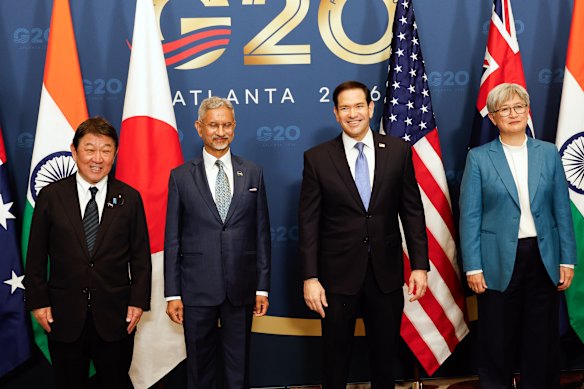
In Atlanta, Wong also attended a meeting of the Quad group of nations: Australia, the US, Japan and India. A statement on the meeting issued by the US hosts referred to SI or “super intelligence”, but noted Australia, Japan and India had not joined the US in rebranding artificial intelligence, as Trump advocates.
Get a note directly from our foreign correspondents on what’s making headlines around the world. Sign up for our weekly What in the World newsletter.
 Michael Koziol is the North America correspondent for The Age and Sydney Morning Herald. He is a former Sydney editor, Sun-Herald deputy editor and a federal political reporter in Canberra.Connect via X or email.
From our partners
Disclaimer : This story is auto aggregated by a computer programme and has not been created or edited by DOWNTHENEWS. Publisher: www.smh.com.au