
Updated ,first published
St John’s, Antigua and Barbuda: Prime Minister Anthony Albanese has hit back at critics of his overseas travel as he joked with King Charles about the number of times he was asked why he was attending this week’s Commonwealth summit in the Caribbean.
With the Coalition arguing he should not be overseas, Albanese acknowledged the economic pressures at home and insisted the government was working “each and every day” to lift living standards.
But Albanese also shared a light-hearted exchange with the King about the political attacks.
The prime minister responded to media questions on Monday morning by arguing it was in Australia’s interest to be at the Antigua summit, before adding: “At the personal invitation of King Charles, of His Majesty, I agreed to come to this meeting.”
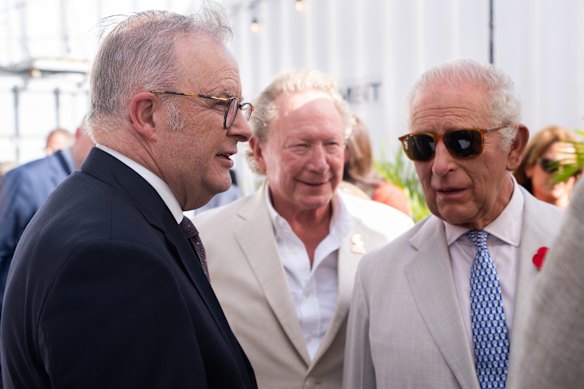
A few hours later, Albanese met the King and told him that he had been asked “why are you here?” and chosen to name the King as one of the reasons. The remark was caught on video and microphone as the two spoke at the launch of an environmental initiative.
“I said because His Majesty invited me,” Albanese told the King about his remark to the media.
The King replied: “Oh God, so it’s all my fault – oh, no.” He made the remark with a smile.
While he joked with the King about the political dispute, Albanese sharply rebuked Opposition Leader Angus Taylor and others in the Coalition for saying he should not go to the summit – known as the Commonwealth Heads of Government Meeting (CHOGM) – because of economic news at home.
“They often quote John Howard as their oracle, and on this John Howard is right,” Albanese said.
“Australia is a participant in the Commonwealth, and at the personal invitation of King Charles, of His Majesty, I agreed to come to this meeting.
“And it’s important that we engage in the world. The world is complicated, is complex, is turbulent, and in these uncertain times, it’s important [to be here] for Australia’s national interest.”
Albanese has met British counterpart Andy Burnham and will tomorrow talk with Canadian leader Mark Carney at the summit, discussing how national economies deal with the energy price shocks from the wars in the Middle East and Ukraine.
At a press conference in Antigua on Monday, Albanese spoke of “middle powers” working together – a major theme in an address by Carney to the World Economic Forum in Davos. Switzerland earlier this year.
While Carney argued that middle powers needed to help each other when US President Donald Trump was imposing tariffs and other penalties on allies, Albanese used the term without any direct criticism of the US.
“This is an opportunity to engage with the countries in our region to show leadership on behalf of the Pacific, but also to engage with middle powers and to strengthen Australia’s economic position,” he said.
“And it’s never been more important to connect with the world because the world has never been more interconnected.”
He named trade, the global economy and the development of artificial intelligence as some of the issues to be discussed with other world leaders.
Howard attended each meeting of the Commonwealth Heads of Government during his time as prime minister.
Taylor argued on Sunday that Albanese should not go to CHOGM because of the economic conditions at home, despite Howard’s example.
“The reality is in a normal set of circumstances, of course, the prime minister should go to CHOGM – and John Howard is right on that,” Taylor said on 2GB on Sunday.
“The problem is this is not a normal set of circumstances. We are going to have the seventeenth interest rate rise under Labor if the Reserve Bank moves on Tuesday, as is widely expected, and this is on the government’s watch.”
Taylor argued the government did not have spending under control and was not putting downward pressure on inflation and interest rates.
The federal government’s gross debt is forecast to surpass $1 trillion this financial year. The budget papers do not forecast a surplus or specify a timeframe to paying off the debt, while interest payments continue to rise.
While Treasurer Jim Chalmers claimed the budget in May delivered $26.1 billion in savings over several years, the budget deficit is tipped to deteriorate. It is forecast to be $28.2 billion this year and $31.5 billion next year.
Asked whether the government was making enough savings in the budget to ease pressure on inflation, Albanese insisted he and the cabinet were acting on the economy.
“My message to Australians is that we’ll continue to work each and every day to keep our economy stronger, and that includes engaging in global trade and engaging in the world,” Albanese said.
British Prime Minister Andy Burnham raised the prospect of more international travel for Albanese next year when the UK hosts the G20 summit in Manchester.
“We’ve got the chance, you and I, to cut the first steel on the first AUKUS sub sometime next year,” Burnham told Albanese when they meet on Monday night (about 11am on Tuesday, AEDT).
The AUKUS submarine will be built to a design being used by the UK and Australia for a new fleet for the long-term, with the first of them to be made in Barrow-in-Furness, north of Liverpool.
Albanese and Burnham also discussed Australia’s proposal for changes to the visa rules for young British working holiday makers so that more of them are required to work in regional areas to continue their visas. There was no announcement of any change.
Burnham prefaced his remarks to Albanese with words of sympathy for Victorian MP Helen Haines, who is recovering from an attack last month that forced surgeons to amputate both her legs.
“We send our thoughts to Helen Haines,” Burnham said. He added that the attack on Haines raised broader questions about violence against politicians on all sides.
Cut through the noise of federal politics with news, views and expert analysis. Subscribers can sign up to our weekly Inside Politics newsletter here.
 David Crowe is Europe correspondent for The Sydney Morning Herald and The Age.Connect via X or email.
From our partners
Disclaimer : This story is auto aggregated by a computer programme and has not been created or edited by DOWNTHENEWS. Publisher: www.smh.com.au