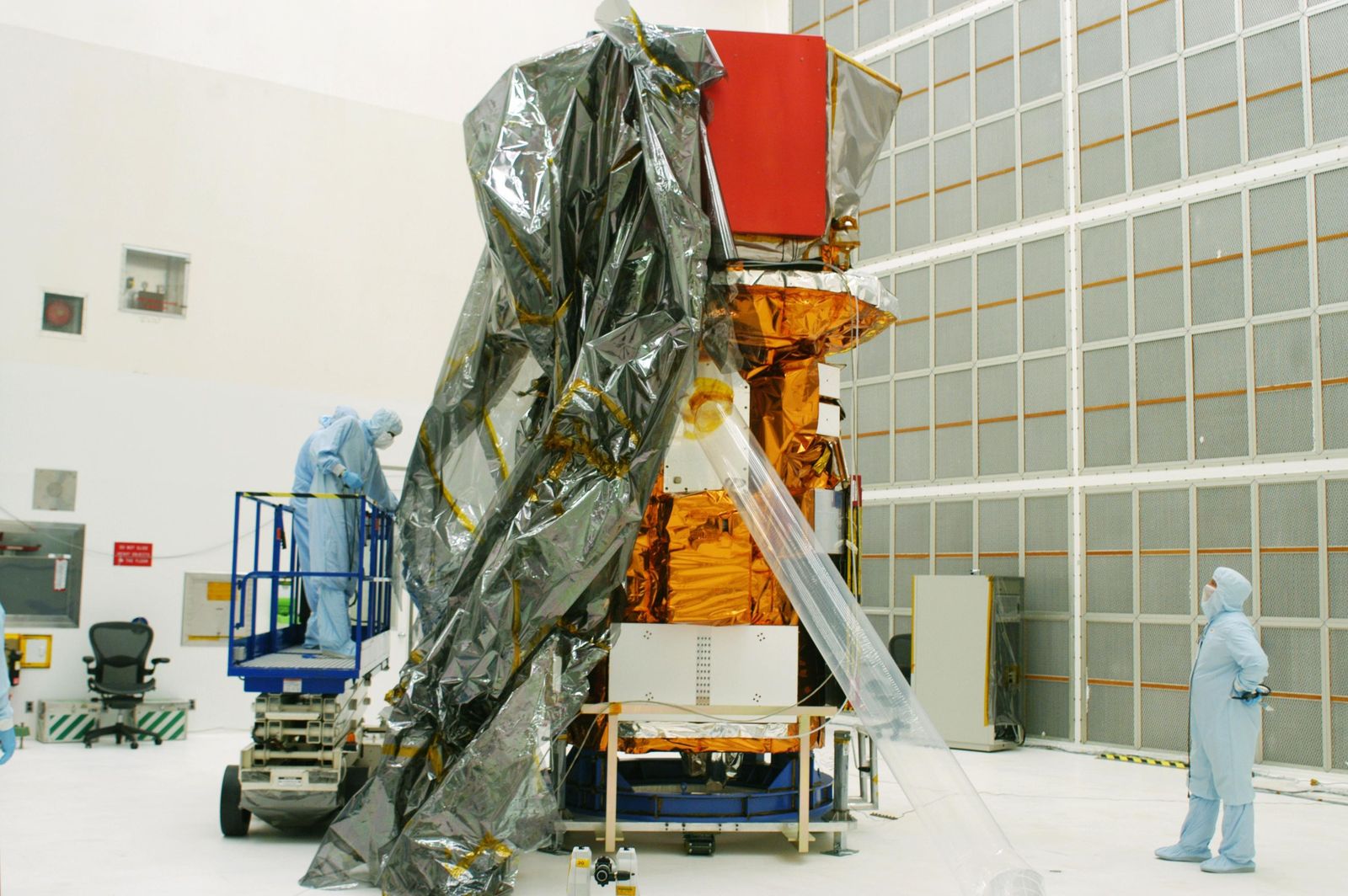
After 22 years in orbit and a failed rescue mission this summer, it is highly likely that the Neil Gehrels Swift Observatory will crash into Earth sometime next week. It is not known where on the planet the spacecraft—which is roughly as big as a large elevator—will fall. Despite its size, experts say the risk to the public is relatively low.
What is now a useless piece of space junk was for a long time extraordinarily valuable to the scientific community. Launched on November 20, 2004, Swift was a space observatory equipped with three telescopes. It was designed primarily to detect and study gamma-ray bursts, which are among the most energetic explosions in the universe. Swift would locate these events and transmit their positions to observatories around the world for further study.
The observatory was designed to operate for a few years in low Earth orbit, but it far exceeded its expected lifespan, helping to make many important discoveries about the evolution of the cosmos, including the study of supernovas and the destruction of stars by black holes. However, in 2024, increased solar activity heated and expanded the upper layers of Earth’s atmosphere, increasing the drag on the satellite and accelerating its descent. Without a propulsion system capable of correcting its orbit, its days were numbered.
In July 2026, NASA launched a special $30 million mission to rescue Swift. A robotic spacecraft called LINK was supposed to drag Swift away from Earth by 150 miles, giving it a higher orbit and thus extending its operational life. Unfortunately, LINK failed. In August, NASA administrator Jared Isaacman explained that the difficulties that led to the mission’s cancellation were due to problems with the spacecraft’s control system, which made it impossible to keep it properly oriented and stable in space.
On October 26, NASA announced that Swift was less than 170 miles from Earth’s surface—a very low orbit for a satellite. According to the agency, the telescopes on board could no longer maintain stable observations of their astronomical targets. Swift conducted its final observation on October 20, then the operations team based at Pennsylvania State University terminated its operational status.
“Swift delivered an incredible, lasting return on investment for the nation, designed for a two-year primary mission but productive for more than 10 times as long,” Shawn Domagal-Goldman, director of the Astrophysics Division at NASA headquarters in Washington, said in a statement. “In that time, Swift played a major role in advancing our understanding of the changing universe and was part of a revolution in astrophysics that showed how critical rapid-response observations are to the entire community.”
In its lifetime, the satellite observed over 2,000 gamma-ray bursts and nearly as many supernovas, data from which contributed to more than 7,000 research papers. And its contributions are far from over. “Swift leaves us with an extraordinary archive of multiwavelength observations that will fuel new discoveries for decades more,” Domagal-Goldman added.
What to Expect From the Reentry?
The US Space Force estimates Swift is likely to crash on or around Friday, November 6—or at least whatever remains of the satellite will. Most of the space observatory is expected to disintegrate as it reenters the atmosphere. However, some pieces made of tungsten and parts of the mirrors could survive that chaotic process, Brad Cenko, NASA’s chief scientist for the mission, told the Associated Press.
“The most likely survivors are its six heavy reaction wheels, the spinning flywheels it used to aim itself, along with tougher telescope parts such as lenses and mirrors,” Dean Sladen, a quality manager and aerospace engineer at Accu Components, said to Space.com. “Only a handful of small, scorched fragments are expected to make it down—nothing recognizable as a telescope.”
Where exactly will that debris fall? Large areas of Africa, Australia, India, Southeast Asia, and Central and South America fall within the reentry zone monitored by the Space Force. If there is a more precise calculation, that information has not been made public, but it’s most likely that all Swift’s remaining pieces will end up in the ocean.
“NASA’s own orbital debris requirements state that the risk of human casualty from surviving debris shall not exceed one in 10,000, so it is highly likely this work has been completed but not published,” Sladen said regarding the risk assessment. “Personally, I believe it should be published, as NASA has done with previous satellites. The risk is almost certainly very small, but it would give people a clear, factual picture rather than guesswork.”
This story originally appeared on WIRED en Español and has been translated from Spanish.
Disclaimer : This story is auto aggregated by a computer programme and has not been created or edited by DOWNTHENEWS. Publisher: wired.com