Two years after a French couple bought an old rural house in Germany, they now have four usable rooms – and plenty of lessons to share about mortgages, tradespeople and expecting the unexpected.
When Mazir first saw the house, he knew there was one detail that would make it impossible for his wife to resist – the pond.
“I knew if I showed it to her, we’d have to buy it,” he told The Local.
His prediction proved correct. For Mona, who is involved in protecting amphibians and other wildlife, the pond was the deciding factor. And the old house beside it also appeared to have what English speakers might call “good bones”.
The French couple had lived in Germany for around a decade, mostly based in Darmstadt in Hesse. They enjoyed life there, but buying the kind of home they wanted in or near the city – a property with a garden and some land – seemed financially unrealistic.
So they widened their search and eventually found an affordable older property in the countryside. A relative with construction experience accompanied them on the viewing and helped assess its condition.
They knew it needed a lot of work. But what they didn’t anticipate was how often their relatively modest, hands-on project would fail to fit the standard expectations of banks and businesses in Germany.
‘You aren’t asking for enough money’
The first surprise arrived before they bought the house.
The couple have a stable income and assumed their relatively modest borrowing requirements would make it straightforward to get a mortgage. Instead, it was the small size of the loan that became the problem.
The couple approached several banks and also worked with financial advisers. “The problem was that we weren’t asking for enough money,” said Mona.
Mazir and Mona were told by an employee at one bank that it wouldn’t consider a mortgage of less than €100,000.
They also struggled to find a lender willing to give them a combined loan covering both the purchase and enough money to complete the first major repairs.
READ ALSO: Seven questions foreign residents should ask before buying property in Germany
The alternative appeared to be a second, separate loan for the renovation. Mazir and Mona were told they would first have to pay for materials or work, submit the invoices and then be reimbursed. They also understood that the renovation funds would need to be spent within six months, with additional interest payable on money not used by the deadline.
Finally, after several months of unsuccessful applications, the couple ultimately had to ask a family member to lend them the money they needed to complete the purchase – not because their needs were risky or extravagant but seemingly because they were too modest.
The lesson, for anyone thinking of buying cheaper rural property, appears to be that affordability does not necessarily mean easier financing.
Before making an offer, in other words, it may be worth asking whether a loan falls below a lender’s minimum, whether purchase and renovation costs can be combined and how renovation funds are released.
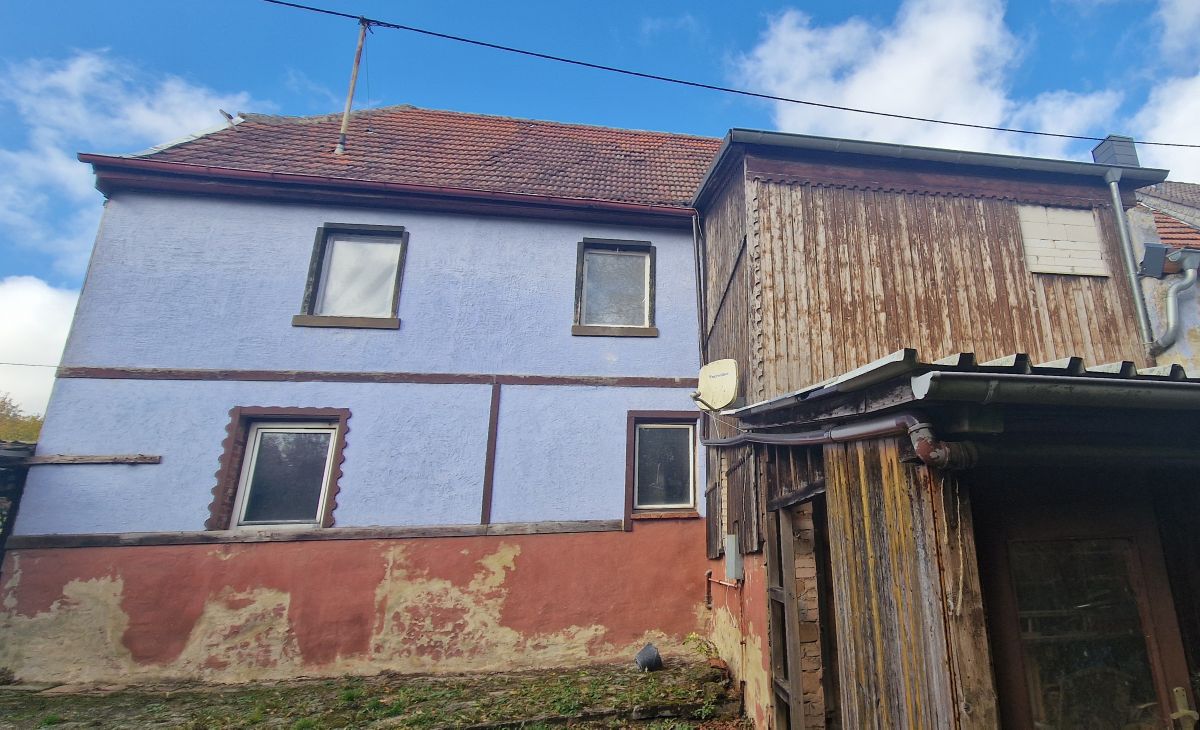
A view of the house about an hour and a half away from Darmstadt. Photo provided by Mazir
Six months becomes more than a year
Then came the smell.
The previous occupants had smoked heavily, but Mazir and Mona imagined that simply airing the house would solve the problem.
“It never went away,” said Mona.
Despite cleaning every surface in every room, the smell lingered. When they removed the wallpaper, the couple discovered that the walls were crumbling. Eventually, they had to apply three coats of plaster in almost every room before repainting – mostly by themselves, with occasional help from friends and family.
“But it was very satisfying finishing the rooms ourselves,” Mazir said, going on to describe the pleasure of choosing their own colours and decorations.
Contractors
Finding contractors presented a different challenge. While Mazir and Mona completed much of the cosmetic work themselves, there were certain tasks that required specialist knowledge and tools.
But the couple said it sometimes took months to persuade contractors to visit the property or to get quotes for urgent work. Again, the couple believes the relatively modest scale of the project was part of the problem.
According to Mazir, a building inspector had estimated that one urgent reinforcement job should cost roughly €5,000 to €7,000. Yet the quotes the couple later received were between €15,000 and €20,000.
Some of the quotes felt like “science fiction”, Mona said.
The couple suspected that some firms were concentrating on larger new-build projects, while busy local tradespeople had little incentive to accept a smaller job.
READ ALSO: What Germany’s rising mortgage rates mean for home owners and buyers
Waste disposal
Disposing of waste created another obstacle. Before dismantling a chimney, the couple tried to establish where the old bricks could be taken. They said the waste companies they called declined to take the bricks because the soot residue required special handling.
“I spent a whole afternoon calling five or six companies,” Mazir said.
The couple also contacted the local authority, which directed them back towards businesses they’d already tried. What had initially appeared to be the simplest part of the job – getting rid of a pile of bricks – became another extended exercise in trying to find the right provider.
The experience wasn’t uniformly negative, however. When a damaged gutter threatened a wall, a carpenter from a nearby village arrived promptly, completed the repairs in half a day and charged what the couple considered a reasonable price.
“That was super-efficient,” said Mona.
But the contrast became one of the defining features of the renovation. Jobs which the couple expected to be simple could take months to organise, while something that looked complicated might be resolved in an afternoon.
READ ALSO: Will baby boomer homes soon flood the German property market?
Cultural differences
Some of the most persistent surprises were less serious.
The couple repeatedly struggled to find the specific products they were familiar with from France.
One apparently simple search was for a door lock with a key on the outside and a thumb-turn on the inside – a fitting they regarded as completely ordinary in France. After trying several German shops and struggling to explain what they wanted, they eventually bought what they needed across the border.
“We thought the two countries were culturally much closer,” said Mazir.
A house of their own
Two years into the project, four rooms are now more or less liveable. While the property remains a long-term undertaking rather than their permanent home, it has already become a retreat from city heat and noise.
Mazir and Mona’s happiest memory is the first night they slept there, waking to birdsong the following morning and an unfamiliar stillness.
Another milestone came when they finished the fourth room on the first floor. After removing the masking tape and protective sheets, they could finally see a usable home emerging.
“It took us about two years, but now we have a very good place to live,” Mona said.
Building the house may not have followed their original schedule, but doing so has given them a garden, quiet, the security they were seeking – and a crash course in how differently even neighbouring countries approach the business of making a home.
The couple’s names have been changed to protect their privacy.
READ ALSO: The words German estate agents use when they want to rip you off
Disclaimer : This story is auto aggregated by a computer programme and has not been created or edited by DOWNTHENEWS. Publisher: thelocal.de