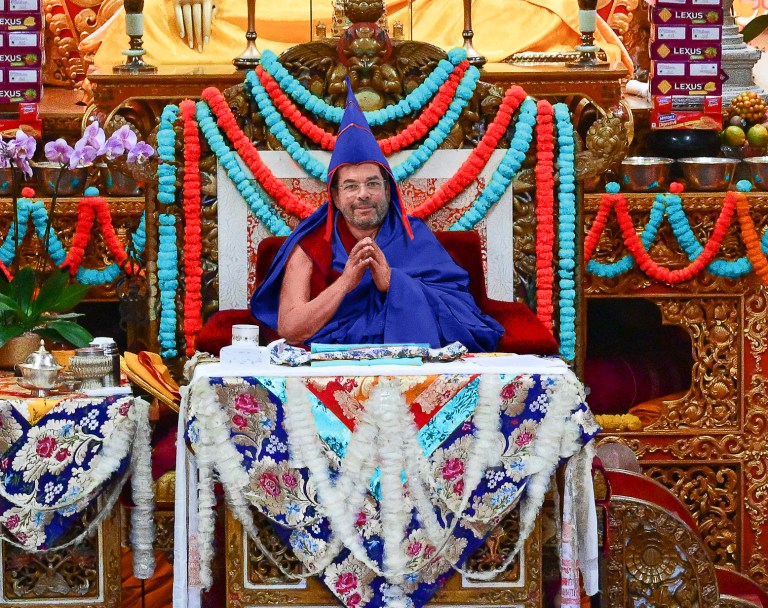
DHARAMSHALA, INDIA—In a move that adds diverse value to the global investment firm’s holdings, Bain Capital announced Thursday the acquisition of Tibetan Buddhism, financing a $35 million deal for a controlling stake in the religion.
Bain corporate officers said they believe Tibetan Buddhism has the fundamentals to be a leader in the dharmic space, but claimed the religion has languished for the last thousand years under complacent management and suboptimal capital allocation. The Boston-based private equity firm confirmed chairman John P. Connaughton would serve as interim Dalai Lama to shepherd the legacy institution through its next phase of development.
“For centuries, this organization has been guided by outdated principles that are antithetical to investor and shareholder concerns, prioritizing incentives like wisdom, mental discipline, and the Four Noble Truths over margin expansion and top-line growth,” said Harvard Business School alum and new spiritual leader of the Tibetan people Connaughton, citing the former leadership’s outright renunciation of material gains as a major contributor to the religion’s negative asset valuation. “Bain’s extensive resources will allow us to make operational and strategic improvements to the Mahayana tradition that will maximize revenue and increase market position.”
“I plan to implement a viable eightfold path to profitability,” the executive bodhisattva added.
According to Connaughton, Bain plans to reduce the religion’s archive-maintenance costs by transferring its teachings to a digital database so that the antiquated Edgeworthia-fiber papers they were written on—some of which date back more than 1,000 years—can be destroyed. Other overdue upgrades to the “seemingly ancient systems” the company inherited will include an expansion of brand awareness through targeted online shentong believer outreach and executive training for all monastic talent level gelong and above.
In addition, Connaughton stated that Bain’s in-house marketing team was working to “refresh” the visual design assets of Tibetan Buddhism, employing state-of-the-art generative AI graphics capabilities to create “sleek, modern redesigns of obsolete Kalachakra mandalas.”
As part of the terms of sale, Bain will also take control of a number of tantric and esoteric intellectual properties, including the Dzogchen, or Great Perfection, tradition, which officials said they intend to leverage into a profitable subscription model. On the B2B side, Bain will license a scalable version of the samsara cycle directly to other religions, while individual practitioners will be able to access the extinguishment of desire, the eventual attainment of nirvana, and all the sacred texts of the Tibetan Buddhism canon for a renewable $100 monthly fee.
“Tibetan Buddhism is one of the longest-running reincarnation platforms in Asia, with industry-
recognized spiritual advisors and a highly respected regional brand,” said Bain Capital public affairs liaison Ernie Anguilla, claiming the Eastern religion’s reputation as a premier enlightenment service provider has set it apart from its Vedic competitors. “The enterprise is underpinned by a devoted client base that has helped it remain karmically solvent through several major recessions and changes in dynasty.”
“Our goal is to maintain and grow our customer base and keep them coming back lifetime after lifetime,” Anguilla added.
In a leaked internal memo concerning “workforce optimization,” Connaughton announced the redundancy of more than 45,000 roles, including senior monks, mid-level yogis, and all non-celibate ngakpas, effective immediately. The memo went on to inform any retained staff that free room and board and company-
issued kasaya workwear would no longer be provided at Bain’s expense.
Citing “unnecessary overhead” from running thousands of satellite temples worldwide, the new owners also confirmed the immediate consolidation of operations currently spanning Tibet, China, India, and the Himalayas to a 5,000-square-foot office space in the Dallas metro area, where it has already filed for tax status as a limited liability company under the name Vajrayāna Holdings LLC.
“Through a combination of aggressive cutbacks and rapid expansion, Mongol-Tibetan Buddhism could be in the black by the end of Q4 next year,” said Bain managing partner David Gross, using projections based on a similar acquisition of Mormonism the company took on in 1987. “Bain Capital is proud to bring its deep religious-sector expertise, assertive buy-and-build mentality, and wide support network to that effort.”
“I obviously can’t say which Indo-Buddhist philosophical traditions we are currently in talks with,” Gross continued, “but the plan is to amass a portfolio of smaller complementary fringe indigenous religions to capture market share.”
When reached for comment, former Dalai Lama Lhamo Thondup confirmed he had accepted a generous buyout package for the remainder of his lifetime contract but would stay on part-time in a consultancy role for three additional incarnations.
Disclaimer : This story is auto aggregated by a computer programme and has not been created or edited by DOWNTHENEWS. Publisher: theonion.com