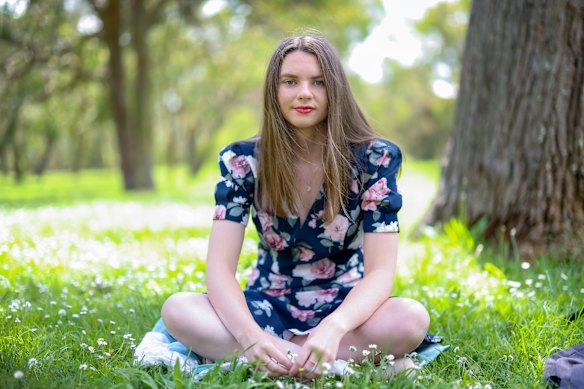

Maddie Taylor was 15 when her mother Julie died of stage four bowel cancer in October 2019.
Months later, amidst her initial intense grief, Maddie became completely isolated from her support network as Melbourne entered lockdown.
“I was very unsettled,” says the now 22-year-old. “The world was changing around us, and my world had also changed. I don’t know how I got through that first year.”
Julie has always taken such pride in her job as a teacher at Maddie’s primary school. And when Maddie graduated from her nursing degree, it stung. “Another milestone,” she says. “It hurts that she’s not here to see my progress.”
Since her mum’s death, Maddie has moved to Perth, then back to Melbourne, got a job as a carer at a retirement village and started volunteering regularly with the Central Ambulance.
Much of this success, she says, has been motivated by her grief: “I feel like I’ve skipped my teenage years,” she says. “I’ve gone from a child where everything was done for me to suddenly doing everything myself: cooking, cleaning, washing, managing my own funds and schedule, booking medical appointments, working. It’s definitely had a big impact.”
Part of what Maddie’s experiencing is “post-traumatic growth”, which can happen when a distressing event pushes you towards achievement and ambition – the opposite of post-traumatic stress, which can be debilitating.
The person is still in pain, but their pain is a propeller.
A pattern of high achievers
Amanda Lambros, a Perth-based therapist, says that while all grievers are unique, common patterns emerge among her clients whose mothers died when they were young.
“Fierce independence is common because they learnt early on they couldn’t rely on anyone else,” she says. “They’re most likely to say, ‘Don’t worry, I got this.’”
Through running the Grief Recovery Method, a program designed to guide people through loss, Amanda has also noticed a greater number of high achievers in her work with those who grieved over the death of their mother early in life. “[Their] mum wasn’t around when they wanted to be seen, to say ‘Great job! I’m so proud of you,’” she says. “So this high achiever persona can emerge.”
Achievement as an avoidance strategy
It’s more complicated than just ambition and drive, though.
Other patterns Lambros has noticed include “fear of abandonment, perfectionism, people-pleasing and carrying a deep sense of responsibility for everyone around them”.
Many young people struggle with identity questions, she says. “Wondering who they might’ve become – in their jobs and relationships – had their mothers lived.”
Paul Bennell’s mother died by suicide when he was 10. Now 38, he works for Feel The Magic in Sydney, a charity which creates a space for kids to grieve. He often reflects on the striving for achievement that formed part of his grief.
“My brother and I actually achieved more in sport and more academically after my mother passed away and on reflection, it was us trying to ensure: everything’s fine, we’re all good. We’re trying to do the best for our dad as well,” he says.
“I think it was a deliberate avoidance strategy – grades look good, the future looks bright – but at aged 10, I thought I might’ve done something that caused my mother to pass away, and could I also do this to Dad?”
Maddie’s life after her mother’s death has also been complicated.
“In the first year after Mum died, I didn’t have much of a relationship with her side of the family, while they were settling the will and finances,” she says.
Today, however, that has flipped. Maddie now lives with her mum’s “supportive” sister, but has become estranged from her dad.
“Watching him repartner was hard. I’d just turned 18, so was in that weird, newly adult phase. It really threw me.”
Caring for motherless children
Just one charity in Australia specifically supports people like Maddie, and was founded after a similar tragedy.
Danielle Snelling co-founded Motherless Daughters Australia following her mother’s death when she was 23: “I was still in that carefree, going-out phase. That all changed when she was diagnosed with cancer when I was 21, then died two years later,” she says.
The 37-year-old from Phillip Island, Victoria, says her experience of grief was isolating. “People misunderstood that it shapes you and impacts you forever. We don’t know how to deal with ongoing grief because that’s a sad thing, and we want to fix people,” she says. “It was really lonely. Anyone who loses their mother aged 25 or under will see the biggest developmental impact. It’s a void that never disappears.”
This loss shows up uniquely throughout girls’ lives, she says. “Graduation, marriage, pregnancy, milestone birthdays – all things at which girls want their mums.”
Even psychologists misunderstood her, misdiagnosing her with depression, which, she says, was wrong: “Grief isn’t mental illness.”
In 2012, Snelling posted on Facebook asking to connect with others who had lost their mothers at a young age. One responder was Eloise Baker from Melbourne, who was 13 when her mum died of heart attack, and the two set up the charity knowing that others could benefit from the validation and reassurance they found in each other.
Their peer support programs now reach 15,000 women.
Maddie attended support groups run by the charity and was helped by a mentor. Now she meets up with motherless daughters for dinners. “That human interaction helps on my down days,” she says.
Losing your ‘biggest cheerleader’
Gemma Kyriakou, 45, was 20 when her mum died. It drove her to train as a grief counsellor – she now helps others through what she’d experienced, primarily helping women aged 40 to 50 with young children who’ve found not having their mother around to help them parent “extremely emotional and challenging”.
“It’s life altering, to lose your biggest cheerleader,” she says. “Some only truly grieve the loss when another minor loss happens, pushing everything submerged to the surface, sometimes years later. The grief just comes right back at you.”
Today, Maddie’s life is by no means easy. But the grief also hasn’t debilitated her.
“I’ve got back on my feet again. My health challenges are now under control, and with my job and volunteering, I’ve really made a life for myself,” she says. “I hope I’ve made Mum proud. There are still days when I just cry, I just really wish she was here.”
But Maddie’s coping mechanisms enable her to move forward.
“I’ve learnt to self-regulate; have my cry, pick myself up and continue on,” she says. “I’m grateful for the journey I’ve been on … it’s taught me life skills that’ve made me a stronger person.”
Make the most of your health, relationships, fitness and nutrition with our Live Well newsletter. Get it in your inbox every Monday.

From our partners
Disclaimer : This story is auto aggregated by a computer programme and has not been created or edited by DOWNTHENEWS. Publisher: www.smh.com.au