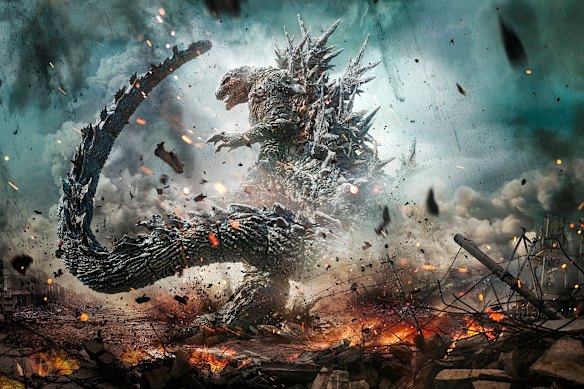

There was a point in 2023 when Godzilla Minus One was potentially not going to show in Australian cinemas. Takashi Yamazaki’s film, the first live-action Japanese-produced Godzilla movie in nearly a decade, was set for a quiet run, more or less confined to Japan and the US. Then people started seeing it.
The film quickly picked up steam, becoming the highest-grossing Japanese live-action movie in North America. Made by a team of just 35 visual effects artists for $US15 million ($21 million), the kaiju production wowed audiences, earning a broader global release and winning an Academy Award for visual effects – a first for the 70-year-old franchise.
It was an unexpected triumph that breathed credibility into an increasingly derided franchise, inspiring a wide-release sequel. But could lightning strike twice?
Set two years after Minus One, in 1949 Japan, Godzilla Minus Zero revisits a former kamikaze pilot as he attempts to rebuild his life after the war. He’s lured back into battle when a regenerated Godzilla and a new monster, King Ghidorah, threaten whatever safety they’d managed to reclaim.
“There was a massive amount of pressure in trying to go above and beyond what we achieved in Minus One,” says VFX artist Takayuki Ueki via a translator. “But that pressure didn’t affect us negatively at all, largely because we were still working with the same team.”
While winning an Oscar comes with benefits, such as the opportunity to film with IMAX cameras (Minus Zero is the first Japanese feature filmed this way) and the ability to expand their team, Yamazaki acknowledged how much they achieved with so few in Minus One. He therefore decided to keep it intimate, adding only six VFX artists to the existing 35. Recreating a similar team – and mindset – for the sequel was key.
“We weren’t thinking about awards and accolades … The goal was very simple: make the best work possible and showcase our skills. Working with the same friends/team in the same environment helped us tremendously.”
It appears this paid off. A Hollywood Reporter critic said the film contains “some of the most impressively seamless integration of major-scale CGI in recent memory”. This is evident from the first scene, in which a fierce, dragon-like creature wreaks havoc on Matsumoto City, indiscriminately spewing fire rays on passers-by. It’s Ueki’s favourite moment, largely because it required only five people to create, demonstrating the crew’s immense talent.
However, scenes like this presented a new challenge for the filmmakers: shifting attention skywards. Much of the action in Minus One took place in the ocean, where Godzilla terrorised army ships and sailboats. In Minus Zero, Godzilla re-emerges from the sea to battle a three-headed creature high above, one that can fire both electrical beams and antigravity lasers powerful enough to lift entire buildings into the stratosphere.
“When you think about the sky, it’s a 360-degree environment. How do we simulate this? Until now, we would shoot something that’s in the sky, such as an aircraft. But we didn’t have the freedom and flexibility to work on the shot we really wanted to get,” Ueki says.
So they developed a custom drone that, when paired with digitally produced clouds, could capture height, speed and direction in a 360-degree sphere. With this they conquered the sky.
Since Godzilla’s first deafening roar in 1954’s Gojira to his battles with King Kong in the more recent Hollywood iterations, Godzilla films have long been known for bringing gargantuan monsters to life through visuals and sound. For many, especially the US-produced films, this was all they really delivered. Yamazaki’s films, conversely, embed epic monster action within deeply human stories.
“Often, the kaiju and high action parts are almost separated from the human element or storytelling. You feel like they’re far removed. We try to weave these two [together],” says co-producer Kazuaki Kishida. “From a technical aspect, the VFX team was able to achieve very high quality [designs], and then from a storytelling point of view, the kaiju’s existence would somehow affect the human’s existence, and the humans’ existence would affect the actions of the kaiju.”
This loop remained front-of-mind throughout the filmmaking process, Kishida says, making it more impactful for the audience.
In one scene, for instance, King Ghidorah uses its antigravity powers to levitate a town.
In another, a grieving biologist recalls the 1945 nuclear bombing of Hiroshima, envisioning the charred bodies of his family members. There’s wild monster-on-monster fighting and mass destruction but it’s all pinned to the backdrop of postwar trauma and the pains of societal reconsolidation.
This, Kishida says, was possible thanks to their small team – and one meticulous leader. “Director Yamazaki was responsible for directing, the storytelling and the VFX. It’s all held together by one person.”
Godzilla Minus Zero is in cinemas now.
Must-see movies, interviews and all the latest from the world of film delivered to your inbox. Sign up for our Screening Room newsletter.
 Nell Geraets is a Culture reporter at The Age and The Sydney Morning Herald.Connect via X or email.
From our partners
Disclaimer : This story is auto aggregated by a computer programme and has not been created or edited by DOWNTHENEWS. Publisher: www.smh.com.au