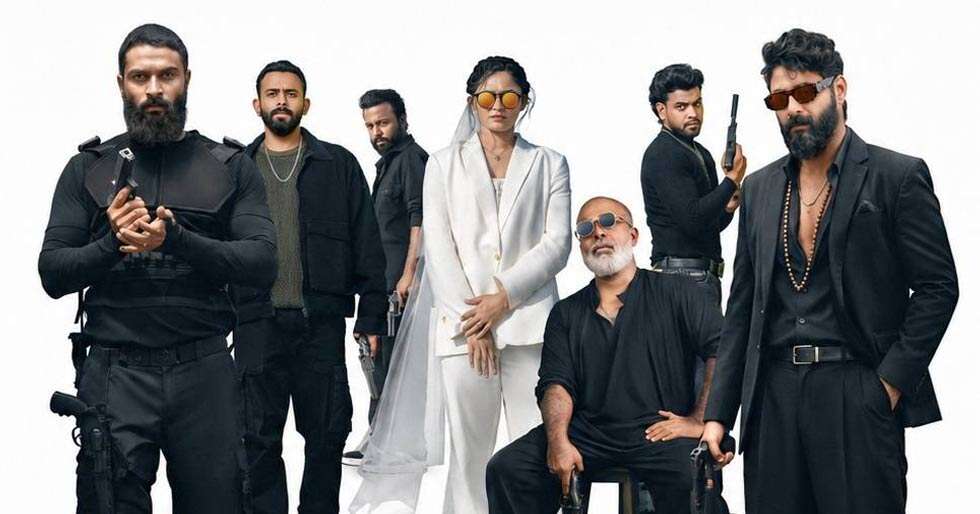
Gangster films have always offered Malayalam filmmakers an opportunity to experiment with visual style, characterisation and violence. From the colourful chaos of Angamaly Diaries to the stylised action of Thallumaala, the genre has evolved beyond conventional tales of rivalry and revenge. Ullas Chemban, who made his directorial debut with Anchakkallakokkan (2024), attempts to create his own space with Disco. Set in a fictional coastal town populated by gangsters and criminals, the film brings together competing gangs, an ambitious robbery and several characters with conflicting interests. There is an evident attempt to build an elaborate underworld with its own eccentric personalities and shifting loyalties. However, while the filmmaker demonstrates an instinct for visual presentation and action choreography, the screenplay struggles to give this world a compelling narrative identity.
The story revolves around a gang war that takes shape following the death of the brother of Yoyaki (Antony Varghese). Meanwhile, Vethiyamo (Chemban Vinod Jose), a seasoned gangster recently released from prison, has plans of his own. Hoping to get his hands on money associated with a previous robbery, he brings together two rival groups led by Ousu (Dev Mohan) and Darling Marty (Lukman Avaran). What begins as an ambitious operation soon develops into a dangerous confrontation involving several competing interests. The police, too, have their own agenda, while other characters enter the conflict with personal scores to settle. Employing a nonlinear narrative, the film gradually reveals the connections between these individuals and the circumstances that bring them together.
Style and attitude take precedence over storytelling
One of Disco’s more interesting aspects is its attempt to create an entire criminal ecosystem rather than confining itself to a straightforward conflict between two gangs. The fictional setting has its own identity, with characters sporting distinctive appearances, unusual names and varying degrees of criminal ambition. The initial portions establish some intrigue around their relationships and competing interests, allowing the film to introduce its numerous players before bringing their storylines together.
Unfortunately, the nonlinear structure becomes more of an obstacle than an effective storytelling device. The constant shifts between characters and timelines make it difficult to understand the motivations behind certain developments. Withholding information can be an effective way of building suspense, but the screenplay occasionally confuses mystery with a lack of context. By the time the different threads begin to connect, considerable time has been spent moving between confrontations without establishing a strong emotional foundation. The large ensemble also works against the film, as several potentially interesting characters receive little opportunity to develop beyond their immediate involvement in the gang war.
This weakness becomes particularly evident in the film’s treatment of violence. Disco has no shortage of elaborate fights, brutal killings and confrontations. Stunt choreographer Kalai Kingson approaches the action with considerable imagination, staging encounters with a physical intensity that suits the setting. However, the repeated emphasis on graphic violence eventually becomes exhausting. Violence can be an effective storytelling tool when it reveals something about a character, advances the conflict or establishes the consequences of an action. Here, several sequences appear to exist primarily to push the boundaries of brutality. The issue is not the film’s willingness to be violent, but its inability to make that violence consistently meaningful.
The writing also has limited room for its female characters. In a narrative dominated by male aggression and gang rivalries, they are largely positioned around the consequences of the men’s actions. Their perspectives could have added another dimension to the story, but the screenplay rarely explores those possibilities.
A technically accomplished film that needed a stronger screenplay
Despite its narrative shortcomings, Disco has some notable technical strengths. Armo’s cinematography captures the coastal setting and its nocturnal underworld with a distinctive visual sensibility. The framing, lighting and production design contribute to the atmosphere, while the costumes help establish the film’s retro-inspired aesthetic. There are stretches where the visual treatment creates an identity that the screenplay struggles to provide. Rohit VS Variyath’s editing attempts to maintain the pace through the numerous narrative shifts, although the transitions do not always make the storyline easier to follow.
Manikandan Ayyappa’s music and background score contribute to the film’s energetic presentation. The song ‘Ithinno Aadame’ is among its more memorable musical elements. However, the background score can become excessive, with the constant musical emphasis leaving little room for quieter moments. A more measured approach would have helped, particularly during scenes that required emotional weight rather than another burst of intensity.
The performances are a mixed bag. Chemban Vinod Jose brings personality to Vethiyamo, making the veteran gangster an engaging presence despite the limitations of the writing. Dev Mohan and Lukman Avaran fit the film’s stylised world, bringing the necessary attitude and physicality to their respective roles. Antony Varghese has the imposing screen presence expected of Yoyaki, although the writing does not give him enough material to make the character particularly memorable. Arjun Ashokan and Vishnu Unnikrishnan are part of an ensemble that feels considerably larger than the narrative can accommodate. Femina George, Meera Vasudevan and the other female performers also have limited opportunities to make a lasting impression.
Ultimately, Disco is caught between its technical ambitions and narrative limitations. Ullas Chemban clearly wants to create a distinctive cinematic world, and the cinematography, production design and action choreography demonstrate an understanding of how to make a gangster drama visually engaging. There are moments when the film’s energy and presentation come together effectively. However, the convoluted screenplay, underdeveloped characters and excessive violence prevent it from becoming a consistently compelling experience. Following Anchakkallakokkan, which demonstrated a more purposeful approach to its subject, this feels like a step back in terms of storytelling. Disco has style, attitude and occasional flashes of cinematic flair, but it needed considerably more substance to make its violent underworld worth exploring.
Also Read: Filmfare recommends: Ten best films of Mithun Chakraborty
Disclaimer : This story is auto aggregated by a computer programme and has not been created or edited by DOWNTHENEWS. Publisher: filmfare.com