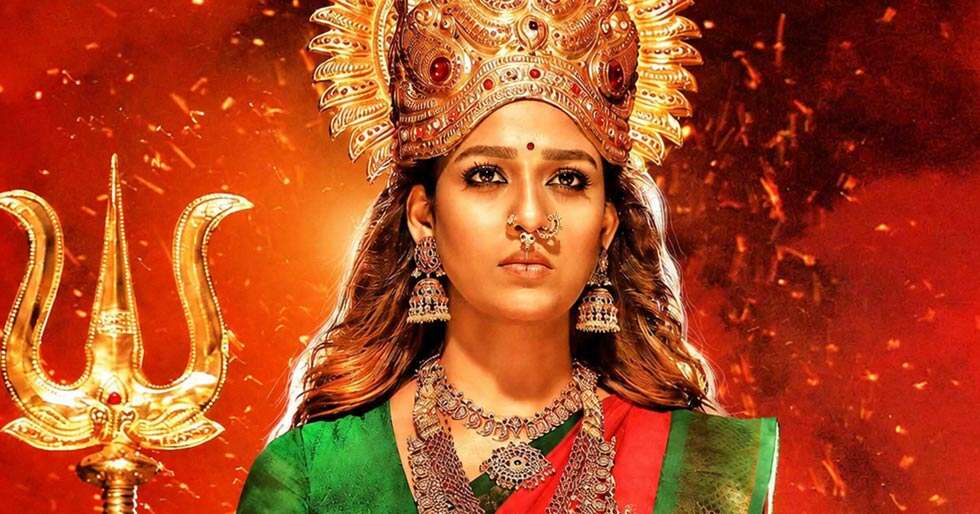
Revisiting a successful film with a sequel presents a particular challenge, especially when the original has established a distinct identity. The 2020 Mookuthi Amman, directed by RJ Balaji, used its devotional premise to explore religious exploitation, blind faith and the commercialisation of spirituality. Its combination of humour, social commentary and fantasy gave it a personality beyond the familiar conflict between good and evil. Mookuthi Amman 2, directed by Sundar C, takes a considerably different approach. Instead of returning to the contemporary concerns that shaped its predecessor, the sequel ventures into a supernatural conflict involving an ancient rivalry and a battle with origins nearly 2,000 years ago. While the change in direction offers an opportunity to explore a different cinematic space, the execution is considerably less convincing.
The narrative follows Shakti (Nayanthara), a police constable who begins experiencing recurring nightmares about a mysterious village called Mailanji. The visions eventually lead her there, where she starts uncovering the connection between her present life and events from the distant past. What initially appears to be an unexplained series of dreams develops into a supernatural conflict. An ancient evil is preparing to resurface, bringing with it a threat that only Mookuthi Amman can confront. The film moves between the present and the historical events that shaped this conflict, attempting to build an elaborate mythology around its central characters.
A formidable cast, but characters without enough depth
Nayanthara is the film’s most recognisable strength. The actor possesses the screen presence required for a role that depends considerably on visual authority and divine imagery. There is conviction in the way she approaches Mookuthi Amman, and the film understands the importance of presenting her as a powerful central figure. However, the characterisation leaves much to be desired. The original film gave its goddess a playful personality and allowed her to engage with ordinary people in ways that generated humour and emotional connection. Here, the emphasis is largely on establishing her divine identity and positioning her at the centre of the supernatural conflict. The film gives Nayanthara several opportunities for hero elevation, but comparatively little material with which to develop the character beyond those moments.
Regina Cassandra makes a spirited effort as the antagonist. Her character has the potential to be an effective counterpoint to Mookuthi Amman, particularly given the historical dimensions of their conflict. Regina brings physical intensity and commitment to the role, making her presence felt whenever the narrative places her opposite Nayanthara. However, the writing does not provide sufficient emotional or psychological depth to make the rivalry compelling. She delivers the required menace, but the character remains more of a narrative necessity than a fully realised antagonist.
Urvashi is a welcome presence, although the film does not make the most of her considerable comic abilities. Yogi Babu, meanwhile, is entrusted with an extended comedy track that frequently interrupts the central narrative. Sundar C has demonstrated an understanding of commercial comedy in his earlier work, but the humour here rarely finds the right rhythm. Several sequences feel disconnected from the main storyline, and their placement becomes increasingly distracting as the conflict gathers momentum. Duniya Vijay, Iniya, Abhinaya and Garuda Ram contribute to the ensemble, but the large cast comes at the expense of meaningful character development. The special appearances by Sneha and Khushbu Sundar add to the film’s star presence without significantly strengthening its dramatic structure.
Bigger ambitions, but an uneven cinematic experience
Sundar C approaches the material with an evident interest in taking the Amman genre into more expansive territory. The period portions, supernatural elements and elaborate confrontations offer opportunities for visual spectacle. There are flashes of ambition, particularly in the sequences establishing the historical conflict and the mythology surrounding the central characters. However, these moments never develop into a cohesive cinematic experience.
The screenplay is the film’s biggest obstacle. The historical backstory is intended to give the present-day conflict emotional significance, but the connection between the two timelines is not always convincing. The mythology becomes increasingly elaborate without necessarily becoming more interesting. Characters and subplots are introduced to expand the conflict, yet several feel unnecessary. The narrative also struggles to maintain a consistent tone, moving between devotional drama, broad comedy, fantasy and action without allowing any one element to develop sufficiently. Consequently, the film feels overextended despite having a relatively straightforward central conflict.
The departure from the original’s satirical approach is another missed opportunity. A devotional fantasy does not necessarily need social commentary to work, but the first film demonstrated how effectively the genre could examine contemporary issues. The sequel opts for a conventional battle between divine and demonic forces. That is a legitimate creative choice, but the writing needed to offer something distinctive in return. Instead, much of the conflict relies on familiar genre conventions, with predictable developments and motivations that are never explored in sufficient detail.
The technical execution is similarly inconsistent. Gopi Amarnath’s cinematography helps establish the fantasy setting, while the period portions offer some visual variety. Hip Hop Tamizha Aadhi’s background score adds devotional intensity to several sequences, although its frequent emphasis can become overpowering. The visual effects are a more significant weakness. For a film that depends heavily on supernatural imagery and large-scale confrontations, the CGI needed to be considerably more convincing. While some visuals communicate the intended scale, several effects-heavy sequences look artificial, drawing attention away from the drama. The climax, in particular, needed a stronger technical finish to deliver the impact the screenplay seeks.
Ultimately, Mookuthi Amman 2 is an ambitious sequel that mistakes expansion for improvement. Sundar C has a sizeable ensemble, an interesting mythology and Nayanthara in a role that naturally lends itself to cinematic spectacle. Regina Cassandra also brings energy to the central conflict. Yet, the screenplay never finds the narrative discipline to bring these elements together. The misplaced comedy, underwritten characters and inconsistent visual effects further diminish the experience. There are occasional moments of entertainment, but they are not enough to make the film a satisfying devotional fantasy. It may have a larger canvas than its predecessor, but it lacks the storytelling clarity and distinctive identity that made the original work.
Also Read: Nayanthara Makes A Divine Return in Mookuthi Amman 2 First Look
Disclaimer : This story is auto aggregated by a computer programme and has not been created or edited by DOWNTHENEWS. Publisher: filmfare.com