
Blinkers On is a weekly column covering the biggest issues of the spring racing carnival.
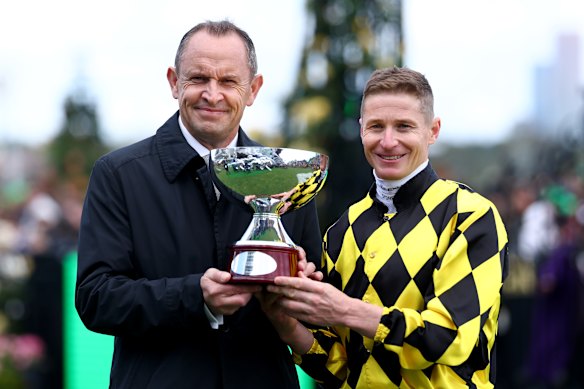
On face value, Chris Waller’s $50,000 fine for a Melbourne Cup day indiscretion is a sizable whack.
Not only did the owners of his stayer Asterix miss out on a guaranteed $100,000 in prize money for taking part in the race, the trainer flew out of Melbourne with a lighter wallet.
But even in racing, there are accidents and then there are accidents.
Waller’s large fine was the Freedman stable’s one-month ban. Here’s why.
Asterix was scratched on the morning of the Cup because it was treated with medication by a staff member on a race day; a forbidden practice, even though the anti-inflammatory oil rubbed onto the gelding’s front legs is available over the counter and not considered performance enhancing.
Waller was charged and fined by stewards with breaching racing rule AR 227 (a) – engaging in conduct that has led to a breach of the rules.
“I respect the decision,” Waller said on Thursday. “I think everyone will have a review of their systems post-carnival. Everyone’s doing their job, everyone’s under pressure.”
In comparison, Anthony and Sam Freedman were disqualified for a month earlier this year after breaching race-day treatment rules.
Similar to Waller, they also blamed the mistake on staff.
But they were charged by stewards with breaching a more serious charge, AR 249 – administration of medication on race day, which comes with a mandatory six-month ban except in mitigating circumstances.
Two Freedman horses were found to be treated with nebulizers – a prescription-only medication allowed to be administered on non-race days via a breathing apparatus to help horses with breathing issues.
So, were the Freedmans harshly done by in comparison to Waller? We’ll let Racing Victoria explain.
“It is important that the stewards approach each inquiry through its own lens and maintain an open mind,” a Racing Victoria spokesperson told this column.
“The stewards noted some important differences between the two cases in question.
“These differences included the circumstances in which the breach was detected, the number of horses involved, the routes of administration, the products used and the potential to affect performance.”
Staff, the collateral damage
Trainer Nick Ryan faces years on the sidelines if found guilty of a more serious breach.
Stewards charged Ryan after allegedly discovering syringes of man-made EPO in the glove box of his car outside his Flemington stables at the start of Derby Day.
The substance, Darbepoetin Alfa, is performance enhancing.
While Ryan was charged with AR 250 (a) – possession of a prohibited substance – the case has been deferred until the end of this month after a legal application on behalf of Ryan, who has reserved his plea.
But there have already been serious ramifications. Ryan has been stood down from training until the case is heard, and his horses sent to other stables.
Further to that, stewards took evidence from Flemington vet Dr Luke Campbell, following “his conduct at the time” of their raid.
Campbell has not been charged, and can continue working with racing stables. He did not respond to this masthead’s request for comment.
But when asked if the investigation would spread any wider, a Racing Victorian spokesperson told this masthead they would not comment on “matters our integrity team may or may not be investigating”
“What we will say is that the inquiries involving trainer Nick Ryan and permitted veterinarian Dr Luke Campbell remain active, with both adjourned at this time,” the spokesperson said.
“If, during the course of those inquiries or through any other means, any other licensed, registered or relevant person is found to have breached the rules of racing then we will communicate that with a stewards report announcing the charge(s) at that time, which is standard practice.”
There is already considerable collateral damage in this case. Ryan’s stable staff all find themselves out of work.
But stewards have to be commended for their actions over Cup week. They acted quickly and decisively in both the Ryan and Waller cases, all while keeping the public well-informed about matters of integrity.
Mega stables take control
Among the back-slapping and admiration for Ciaron Maher’s record-breaking ability to train the first three horses home in the Melbourne Cup, a number of concerns were flagged.
Have the mega-stables become too dominant, and can it lead to team riding in big races – a prospect allowed but frowned upon by fans in sports such as cycling and F1, but banned in horse racing because of gambling outcomes?
First to the Cup. Maher had seven horses in Tuesday’s 3200m staying test and filled five of the first six placings, including running the trifecta.
He did so after one of his less-fancied Cup runners, Royal Supremacy, bolted to the lead and bowled along in front. Visually, it raised eyebrows, especially considering the results.
But did it set the race up for Maher?
Stewards questioned Royal Supremacy’s jockey Ben Allen, but did not have an issue. After rewatching replays of the Cup, they were right.
Allen set a solid tempo, but he did not cook his horse. They still held on for fifth, and he should be commended for the ride.
If anyone were to blame, it was the rival jockeys. None of them reacted in time. Even the best of the best James McDonald tended to agree.
“I was on a back marker (Trustyourinstincts), so I could say I was disappointed in myself for not making a move, but that’s the situation you’re in,” he said on Thursday.
“You’re not relying on others to make luck for you. You have to make your own luck sometimes, and it’s just the way the race was run.”
The biggest tactical blunder was committed by Beau Mertens on Joseph O’Brien’s dour stayer Kizlyar.
He led the trailing pack and should have set off earlier in pursuit of Royal Supremacy to make the race a true staying test.
Waller, Maher reign supreme
The continued dominance of Maher and Waller is a worrying trend for smaller stables trying to compete, or even survive.
The pair won six of the eight group 1 on offer during Melbourne Cup week – three each. Both trained trifectas in two of these events – Maher in the Cup, Waller in the Champions Mile.
The two remaining group 1s were won by David Payne in the VRC Oaks, and the Freedmans in the Champions Sprint.
So, is it healthy for racing? I guess it depends on who you own your horses with.
But while it becomes a monotonous storyline, the sport has a history of levelling itself out. It would be a dangerous precedent, and perhaps a breach of fair trade rules, to start imposing limits.
The Coffey Cup dilemma
Harry Coffey’s ability to ride Shockletz in the Melbourne Cup two days after surgery to repair a broken collarbone illustrated his bravery as well as his physical and mental toughness.
It must have also tested the resolve of the horse’s owners and trainer Ciaron Maher.
Heading into a $10.2 million group 1 race, even with a highly fancied lightweight runner, you need everything to go right.
Sweating on a jockey’s fitness, while having concerns for his wellbeing, is not part of a usual Cup preparation. Especially when a worthy replacement, Michael Dee, is waiting in the wings.
It is safe to say not all trainers and owners would have shown such faith, or taken the risk.
Unfortunately for Coffey, Shockletz never had a winning chance considering the way the Cup was run – she had to drop back from a wide gate in a slowly run race.
Fortunately for the connections, trainer and medical staff who cleared him to compete, Coffey delivered on his promise to ride Shockletz well. She ran home strongly to finish fifth.
Valley of dreams for Dees
Melbourne Football Club has all but abandoned plans to relocate to Caulfield, but maybe it should not give up on racing.
Moonee Valley Racing Club is willing to have discussions with the Demons about sharing a home base.
The Valley venue ticks a lot of boxes.
The club owns its land, is undergoing a mega rebuild, has room for two ovals on its infield, scope to incorporate offices and training facilities, and is open to business partnerships such as opening an on-site medical centre.
Moonee Valley originally reached out to Paul Guerra when he was the Demons CEO, but did not gain any traction, considering Caulfield was the main focus. Guerra’s dismissal by Melbourne is currently before the courts.
“We have previously had discussions with the AFL about incorporating ovals in our infield,” Valley chair Adam Lennen told this column.
“We are open to having further discussions with them that could involve Melbourne Football Club.”
Moonee Valley is still three years away from building a new grandstand and is under pressure to host the return of the Cox Plate next year if it can’t efficiently host a 15,000-strong crowd using temporary infrastructure.
But the biggest obstacle to Melbourne considering such a move is the north-western location. It is not always palatable to cross the Yarra River from the eastern suburbs.
Melbourne has been contacted for comment.
Racing publican linked to election
Another interesting name has popped up in the looming Victoria Racing Club election fight – popular publican Andrew Lewis.
For more than 30 years, his family ran racing’s “local”, The Emerald hotel at South Melbourne, before stepping away from the pub game three months ago.
Whether Lewis stands this year, or more likely next, those close to him say he has a lot to offer a race club committee such as Flemington, considering his years of experience in the hospitality world.
Those who have nominated this year for a seat on the VRC board include Bill Guest, Nick Tzaferis, John Kanga, Justin O’Kane and Claire Ewart-Kennedy. All potential candidates have to be vetted before being cleared to run. The election will open later this month.
Read more from our racing coverage
From our partners
Disclaimer : This story is auto aggregated by a computer programme and has not been created or edited by DOWNTHENEWS. Publisher: www.smh.com.au