

The U.S. economy grew at a 3.4% annualized pace in the third quarter, the Bureau of Economic Analysis said Thursday, up from 2.2% in the second quarter and above the 3.2% median forecast. Consumer spending rose 3.8%, and Goldman Sachs economists called the makeup of the quarter “strong.”
Look underneath, though, and much of the growth came from a few places, and some of it had slowed by the end of the quarter. Spending on information-processing equipment, the computers and peripherals going into the AI buildout, jumped 37.4%, and industrial equipment surged 24.7%, according to BEA data broken out by Goldman.
But housing investment fell 3.3%. Inventories, which companies build up and then sell down, added 1.6 percentage points to the headline GDP gain, or nearly half of it. And in September, the last month of the quarter, real consumer spending was flat, according to the personal consumption and expenditures report.
Goldman expects consumer spending to slow from here as the boost from fiscal stimulus earlier in the year “fades completely.” It already has fourth-quarter growth tracking at 1.8%, with consumer spending slowing to 1.8%.
Two economies in one number
BEA’s own release credits the gain to investment, consumer spending and government spending, partly offset by a decrease in exports. Within investment, it says the increase “primarily reflected increases in private inventory investment and in equipment,” led by information processing equipment.
The other economy in the number is housing.
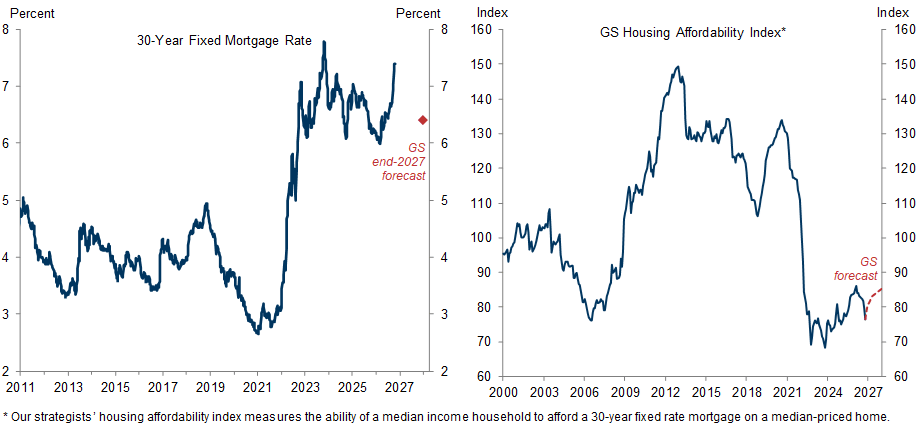
David Kelly, chief global strategist at J.P. Morgan Asset Management, opened his weekly note this week by saying “the housing market is haunted.” The National Association of Home Builders’ gauge of buyer traffic fell to 18 in early October, its lowest in almost 15 years, Kelly wrote. He estimates 2026 housing starts at 1.32 million units, the weakest since 2019. The homeownership rate has slipped to 65.2% from 66.0% in 2022, “with a much sharper recent decline for those under age 35.”
Goldman expects housing investment to fall 5.0% annualized in the fourth quarter, while business investment, driven by AI, rises 8.2%.
Kelly sees “a silver lining” for markets: weak housing restrains growth and inflation “in the face of the AI boom.” For the rest of the country, he called it “only a silver lining in a generally gloomy sky,” with homeownership falling and young people’s plans to “marry, settle down and build a family in their own home” pushed back.
What the headline understates
BEA’s numbers cut the other way, too. Real final sales to private domestic purchasers, which strips out inventories, trade and government to show what American consumers and businesses actually bought, rose 4.9%, faster than the headline and up from 4.6% in the second quarter. Net trade subtracted 3.3 percentage points, on stronger imports and lower exports, so the headline also hides some domestic demand. Some of those imports are the AI equipment itself; BEA built its information-processing estimate mainly from import data.
The labor market is holding up, too. The four-week average of initial jobless claims fell to 197,000, the lowest since 1969, Goldman noted. Core PCE inflation ran 3.12% year over year in September, though Goldman’s estimate of the Dallas Fed’s trimmed-mean measure, which it treats as a better read on the underlying trend, was 2.27%.
The Fed held rates steady this week, and Goldman still expects it to raise them another quarter point in December.
“That being said, it should be noted that the current rate on a 30-year fixed rate mortgage, at 7.32% last week, is not particularly high by historical standards,” Kelly wrote. “It has actually averaged 7.68% over the past 50 years and 7.60% in the 20 years before the Great Financial Crisis.”
Past the peak
Goldman’s global economists think the lift from AI is already easing. “We are passing the peak impulse from the AI boom,” they wrote Thursday, and they expect AI investment as a share of U.S. GDP to shrink in the coming quarters, along with the boost to consumer spending from rising asset prices.
Meanwhile, don’t expect a boost from housing, which will remain in a slump. Residential construction was $1.182 trillion in the second quarter, or 3.6% of nominal GDP, according to Kelly. He expects housing starts to fall again, to 1.24 million in 2027, and “lower still in 2028.”
Generative AI was used for research assistance and/or transcription of this article. The reporter independently reported and verified the factual claims in this article, and a human editor reviewed it before publication.
Disclaimer : This story is auto aggregated by a computer programme and has not been created or edited by DOWNTHENEWS. Publisher: fortune.com




