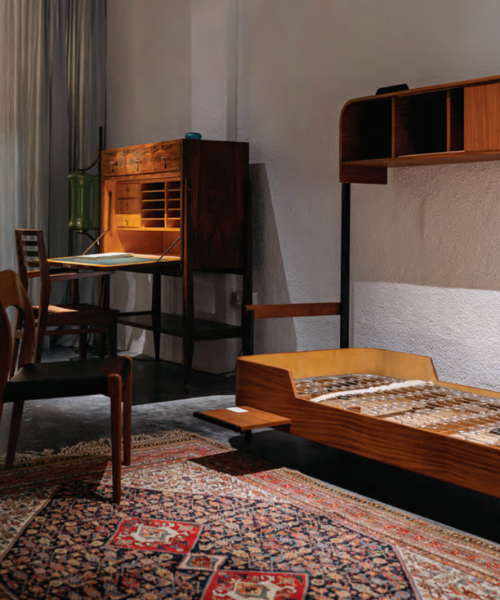
Halfway through our conversation, Nader Gammas reaches for a cabinet made in 1955. Rather than telling me about its provenance or who designed it, he points to its legs. The cabinet itself is almost monolithic, with a square, solid form that is distinctly masculine. He gestures towards the slender, tapered legs supporting it. “It’s very masculine,” he says, “but it’s also very feminine at the same time if you look at the legs.”
Gammas is drawn to objects that balance seemingly opposing qualities, whether that’s function and sculpture, weight and delicacy, or restraint and expression. It’s an aesthetic instinct that surfaces throughout our conversation. Discussing several insect-inspired works in the gallery, the designer talks about their anatomy with the same enthusiasm, interested in the innate equilibrium of strength and grace in the pieces. It’s that tension that captures his attention and ultimately determines whether an object earns a place in his collection. And it’s an instinct that has shaped every chapter of his career. Trained as an architect before specialising in lighting design, Gammas has gradually expanded his practice from bespoke lighting into collectible furniture and most recently, Gradient, his newly opened gallery at Alserkal Avenue.
Gradient brings together Gammas’ own designs, vintage furniture, contemporary objects and artworks spanning decades. They’re connected less by period or geography and more by instinct. “If there’s a clear enough taste palette,” he says, “everything falls into place.” Long before Gradient took shape, the designer found himself at a crossroads. During his final year at university, he watched a fellow architecture student present their graduation project and realised he needed to rethink his own future. “I knew that I wouldn’t be able to achieve that level of perfection,” he recalls. “I thought ‘If I can’t excel in architecture, then I have to find another field to pursue.’”
That field became lighting, almost by elimination. As the discipline closest to architecture, it felt like a natural next step, but it soon opened the door to furniture, sculpture, interiors and eventually the objects themselves. And as his practice evolved, labels became increasingly meaningless. “Whether they’re collectibles or not is irrelevant,” he says. “As long as the object is compelling to me.”
Gammas isn’t interested in collecting objects because they’re rare or valuable. For the designer labels are irrelevant – it is the qualities of an object that matter most in his eyes. When asked what makes a piece memorable, he talks about proportion, materiality, texture, scale and patina. Each aspect matters in isolation but it’s the interplay between contrasting elements that gives an object its character. He believes a beautifully resolved piece is not one-dimensional. It contains a juxtaposition of opposing forces that create a unique symmetry of tension.
The same thinking informs his relationship with lighting, a discipline he still considers the foundation of everything he creates. When talking about lighting Gammas isn’t referring to brightness or illumination in the practical sense. Instead, he speaks about light as something that articulates volume, reveals texture and introduces nuance to a space. Two identical interiors can evoke entirely different emotions simply because one has been thoughtfully lit while the other has not. Architecture provides the structure, but lighting determines how that structure is experienced. “Lighting is always magical,” he says. “Nobody ever looks at lighting and says, ‘That’s boring.’”

That architectonic way of thinking extends naturally to Gradient. Rather than treating it as a showroom, Gammas has approached it as an exercise in curatorship. Vintage furniture, contemporary lighting, art and collectible design occupy the same vernacular, even when separated by decades. The common thread between objects isn’t a period or movement. It’s a curatorial instinct that trusts compelling objects to converse with one another.
However, the confidence to open a gallery didn’t come overnight. “There are things that I was doing three years ago that I wouldn’t have been confident enough to show,” he admits. Years spent designing lighting, sourcing furniture and refining his own aesthetic gradually gave him the conviction to stand behind his choices. Gradient became the natural culmination of that process rather than a sudden business decision.
Gammas is refreshingly resistant to overcomplicated narratives. The gallery’s name reflects that philosophy as well. He laughs at the suggestion that there might be an elaborate backstory behind “Gradient”. To him, the word simply captures the spectrum of aesthetics, periods and design movements that interest him. At the same time, it carries an obvious reference to light.
A gradient guides the eye from brightness to shadow, revealing form through subtle shifts instead of abrupt contrast. That’s exactly how he hopes visitors will experience the gallery, moving organically between different zones and discovering unexpected connections along the way.

If opening Gradient is a personal milestone, the designer hopes it also signals something larger for Dubai’s design landscape. Pieces are often judged by their visual impact before anything else, a tendency Gammas neither criticises nor romanticises. To him, it’s simply a reflection of a market that’s still evolving. Provenance has traditionally carried less weight here than it does in more established collecting circles, where the story behind an object can be just as significant as the object itself.
But he believes that’s beginning to change. Pointing to a growing appreciation for aged craftsmanship and patina, qualities that were once overshadowed by immaculate finishes and pristine surfaces. “Dubai is ready for patina,” he says without hesitation. Gammas’ fascination with design has never been confined to aesthetics. He is equally interested in the process that precedes the finished object, the decisions and experimentation that gradually give form to an idea. Every chair, cabinet or light carries traces of that journey, whether immediately visible at first glance or not.
When the conversation turns to the future of design in the UAE, Gammas spends surprisingly little time talking about designers. Instead, he talks about local, under-the-radar artisans. The region, he explains, has no shortage of creative talent or ambitious ideas. What remains difficult is finding the network of specialist workshops capable of translating those ideas into reality. That ecosystem is still developing, particularly when it comes to highly skilled makers working across different materials and techniques. “We need artisans,” he says plainly. “We need people who can customise things.” It’s the least glamorous part of the design world, but in his view it is also the most fundamental.
Before we finish speaking, my mind returns to the cabinet from early on in our conversation. It would have been easy for Gammas to describe who designed it or why it mattered. Instead, he noticed the way its slender legs transformed an otherwise solid, geometric form. His attention is drawn to the details that most people overlook, because, in his words, those are the details that stay with you.
– For more on how to look smart and live smarter, follow Emirates Man on Facebook and Instagram
Images: Supplied
Disclaimer : This story is auto aggregated by a computer programme and has not been created or edited by DOWNTHENEWS. Publisher: emirateswoman.com