Have you ever wondered what the drivers of the past would think of today’s racing cars? Imagine Jackie Stewart or Bruce McLaren discovering the aerodynamic downforce and complexity of modern Formula 1 machinery. Or picture Olivier Gendebien or Henri Pescarolo climbing into the cockpit of a modern Hypercar prototype, having come from an era when endurance racing rewarded mechanical sympathy just as much as human endurance.
Usually, this kind of journey through time exists only in the imagination of motorsport fans. But Genesis Magma Racing decided to make it real.
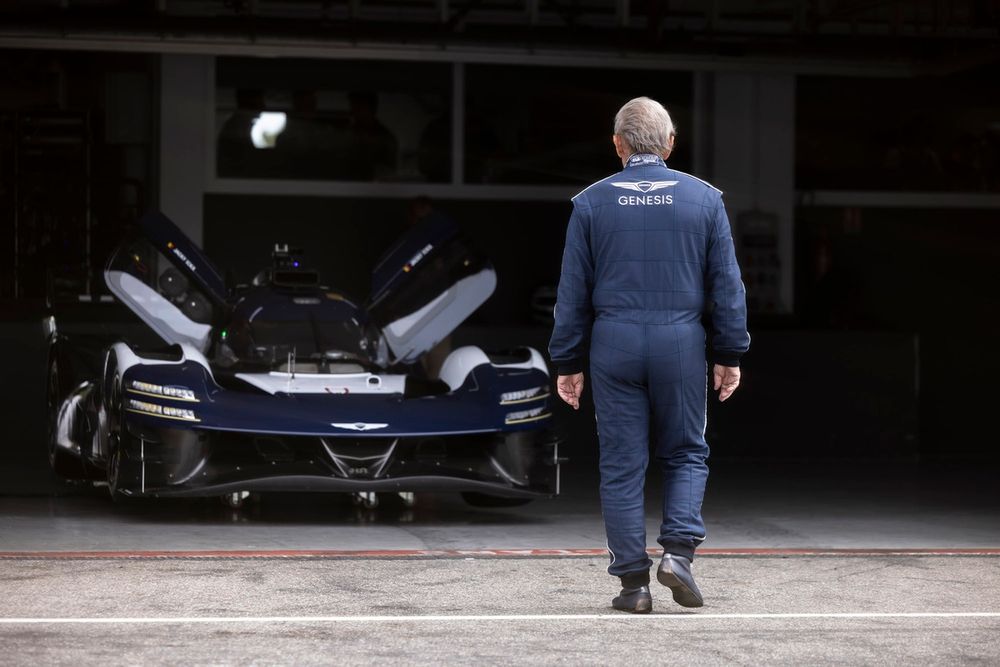
Having entered the World Endurance Championship this year and still discovering the realities of its Hypercar programme, the South Korean outfit handed its GMR-001 over to a driver from another era: Jacky Ickx.
A six-time winner of the 24 Hours of Le Mans, twice runner-up in Formula 1 and a Paris-Dakar winner, Ickx embodies a generation that raced without power steering, without simulators and with a far smaller margin for error. For a few laps, the Belgian found himself propelled several decades into the future – a rare meeting between two visions of motorsport: instinct and technology.
Jacky Ickx has been involved with Genesis since the earliest stages of the project as a sporting advisor. A universally respected figure across motorsport, the Belgian has made no secret of his desire to pass on not only his extraordinary experience, but also, in his own words, “his mindset and his mistakes”, so that the next generation can benefit from them.
He describes his involvement as being like “a parent watching their child grow”: offering guidance, sharing values, and then letting the project develop its own identity.
Jacky Ickx, Genesis Magma Racing Genesis
Photo by: Genesis
A GMR-001 fit for “Monsieur Le Mans”
The meeting point was Circuit Paul Ricard in Le Castellet. The sun beat down on the asphalt while the mistral swept through the pine trees of southern France. It was there that Jacky Ickx first laid eyes on the car he was about to drive. And Genesis did not do things by halves.
For the occasion, the GMR-001’s traditional grey and orange livery was replaced by a one-off design created as a tribute to the Belgian driver.
Waiting for him was a blue-and-white Hypercar, covered in subtle references to his endurance racing legacy and, above all, his six victories at the 24 Hours of Le Mans. Another detail had also found its way onto the bodywork: a nod to Genesis’ first points finish in the WEC just a few days earlier, thanks to the #17 car’s eighth-place finish at the 6 Hours of Spa-Francorchamps.
Part of the team’s senior management had made the trip to witness these symbolic laps. After a few installation runs completed by Andre Lotterer, Ickx was about to get behind the wheel.
The day before, the Belgian had already climbed into the cockpit for the final adjustments. A first immersion that gave him an early sense of just how much these cars belong to another world: a steering wheel covered in controls, a dashboard overloaded with information, and connections everywhere.
Faced with all of this, Ickx had only one comment, delivered with his trademark humour: “I know where the peddles are, that’s all I need. Don’t tell me anything else.”

Jacky Ickx, Genesis Magma Racing Genesis
Photo by: Genesis
Helmet on and strapped in, Ickx headed out for three laps at the wheel of the GMR-001. Just three laps, yet enough to bring two eras together under the attentive eyes of Genesis’ engineers and mechanics.
“There’s only one way I can answer: it’s like day and night,” said Ickx when asked to compare the Hypercar with the prototypes he raced during his career. “There’s nothing in common. Racing today has nothing in common. It’s still competition, but the vehicles we see today have nothing to do with the world I came from.
“Everything impressed me. Because when you have a steering wheel in front of you with 18 buttons on the front and probably another four behind, when everywhere you look there are connections, switches to change the behaviour of the car, adjust the torsion bars, and so on and so on… If you were listening to me, you would have heard me tell the engineers: ‘Please, simplify my life.'”
Even the most basic driving habits had to be relearned: “I’m a right-foot braker. I’ve never known anything else. Here, I found myself braking with my left foot. It sounds insignificant, but it’s not the same feeling at all. So I had to rethink everything and stay mentally clear so I wouldn’t get mixed up. And then, it’s very narrow – you almost become claustrophobic because the space is so limited.”
But beyond the technology, it was also the way others looked at him that amused Ickx. At 81 years old, the Belgian knew he was not simply discovering a modern Hypercar: for a few laps, he also embodied another era in front of a team looking toward the future.
He then began imagining what might have been going through the minds of Genesis’ engineers and mechanics as they handed over their Hypercar to a man who had already raced at Le Mans before most of them were born.

Jacky Ickx, Genesis Magma Racing Genesis
Photo by: Genesis
“I did alright,” he smiled. “Yesterday was the appetiser. Today was the main course. The question was: how was I going to manage in there? And the group probably asked themselves the same thing: ‘How is this antique, getting behind the wheel of our Hypercar, going to bring it back?’
“They told me it was magical to have me here, but honestly… he’s 81 years old, is he really going to drive that thing? Well… yes.
“Compared to the cars I’ve driven – and I’ve driven a lot of cars – two questions came to mind when I wanted to drive this Hypercar,” Jacky Ickx explained. “The first was this: I thought it was a unique opportunity to understand how a modern racing car behaves and how difficult it really is.
“Compared to what I knew, it’s much, much more complicated. The steering wheel with its 18 buttons and 18 settings, managing the radio, activating controls while driving… and all of this while wearing ski gloves – well, they’re not ski gloves, but almost. You have to know how to do everything at the same time in a discipline that is still called endurance racing, but in reality has become a permanent sprint. It’s flat out.
“There’s no room left for improvisation. Everything has to be planned and precise. And the level is incredibly high – not only between manufacturers, but also between drivers. Many come from a generation that grew up with computers. For me, it’s more complicated.
“The second thing is a question I asked myself 15 days ago. I got back into a Formula 1 car that I used to drive 58 years ago. It was at the Historic Grand Prix with a Ferrari powered by a V12 engine that we call ‘spaghetti’, because it’s painted white and it’s a true sculpture.

Jacky Ickx, Genesis Magma Racing Genesis
Photo by: Genesis
“I went to drive that car in Monaco – the same one I won the French Grand Prix with back then. And already there, there was a question: will I be able to get into it? And I could. But then there’s another difficulty: will I be able to get out? That’s the real challenge.
“With the Hypercar, it was the same thing. OK, I braked with my left foot, not with the same feeling, but I managed to get in and out of the car. Seriously, it’s not easy. Because I don’t have the same flexibility I had back then anymore. It’s a lot harder.”
Ickx’s key takeaway: Experience over anything
But when Ickx looked back on the day, it was not technology or driving that dominated his reflections – it was the experience.
When the Belgian took off his helmet, the garage applauded. He took a few moments to thank the team and acknowledge the work that had been done, sharing a few words of encouragement for the road ahead. His eyes still sparkling after driving this Hypercar from another era – 60 years after taking the start of his very first 24 Hours of Le Mans in 1966.
“It was a ray of sunshine,” he said. “All these moments from yesterday and today – all of it is a ray of sunshine. There’s a group, we all enjoyed ourselves. The principles of cohesion, of being together, of sharing your passion together – nothing has changed in today’s philosophy of motor racing. In my opinion, it has existed since the beginning.
“But back then, in the beginning, it was also a matter of survival. Today, unfortunately, individualism makes things a little more complicated, I think. What I love about the group you saw here is cohesion. We are together, we do things we love together. And we understood that this is what works.

Jacky Ickx, Genesis Magma Racing Genesis
Photo by: Genesis
“You must not make the mistake of thinking that you achieve things alone in this world,” he insisted, returning to an idea clearly close to his heart: nobody succeeds alone.
“Even those who say, ‘I wanted it, I achieved it’ – it’s not true. It’s a group. It’s encounters, people who reach out to you, who lift you up. And that, for me, is magic. That’s the only thing that’s real.”
We want your opinion!
What would you like to see on Motorsport.com?
– The Motorsport.com Team
Disclaimer : This story is auto aggregated by a computer programme and has not been created or edited by DOWNTHENEWS. Publisher: motorsport.com