By Prime Minister Narendra Modi
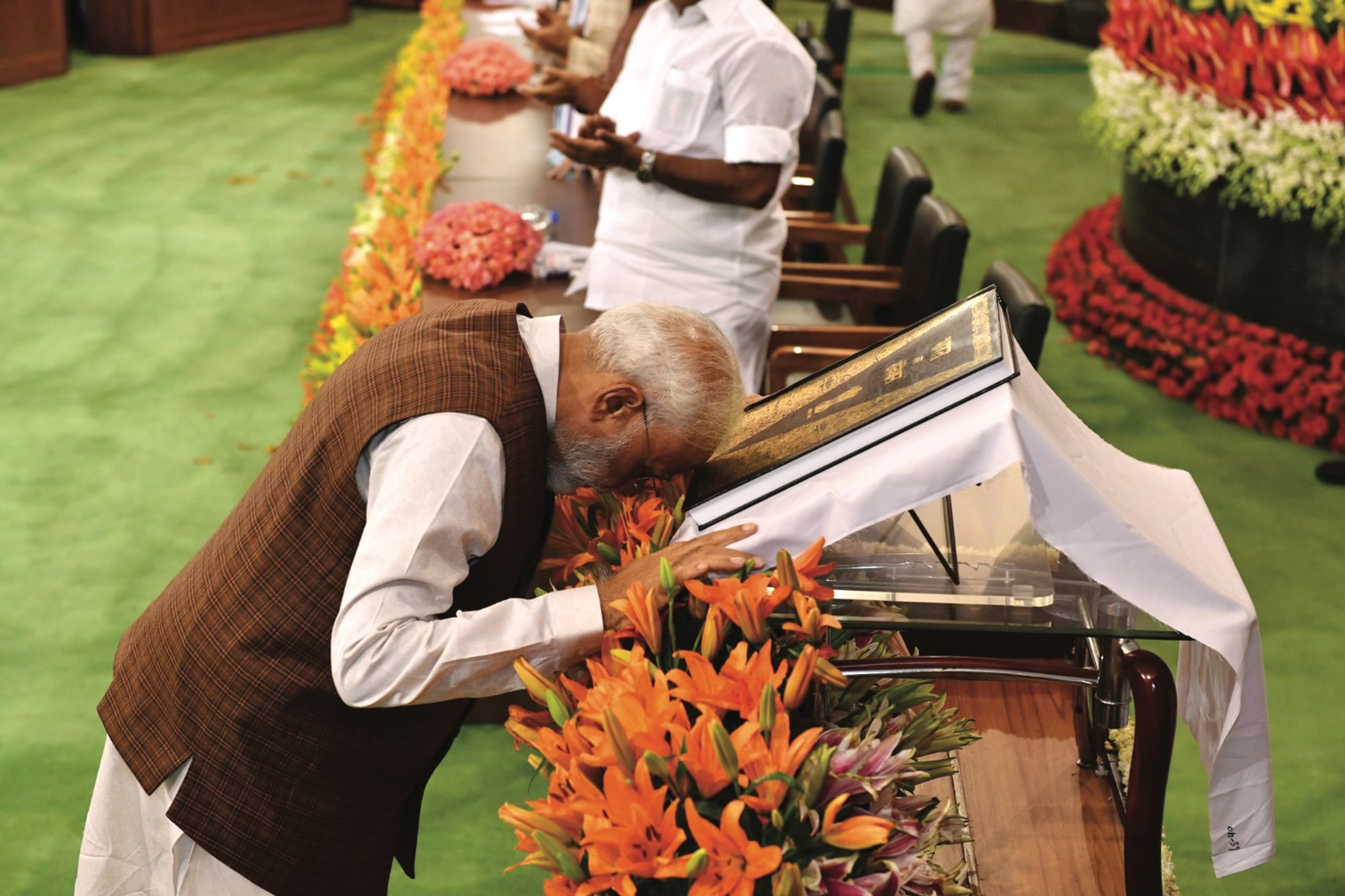
On 26th November 1949, the Constituent Assembly adopted our Constitution. Today, we remember Dr Rajendra Prasad, Dr Babasaheb Ambedkar and every member of the Constituent Assembly. Their greatness lay in drawing extensively from the rich traditions and civilisational wisdom of Bharat while framing a modern Constitution.
For a nation as diverse as Bharat, with its numerous faiths, languages, customs and schools of thought, it is important that the Constitution have a resonance far beyond the precincts of Parliament and the courts. Our endeavour has been to deepen its connect with the collective consciousness of our people, especially our youth and strengthen the spirit of unity essential to India’s bright future. That is why over a decade ago, our Government decided to mark 26th November as Constitution Day.
For crores of Indians, including me, the Constitution of India is an inseparable part of our life journeys. Whenever I look back at my childhood, the humble circumstances in which I grew up, the struggles that were a part of everyday life, I am filled with an overwhelming sense of gratitude towards our Constitution. That a child born into a family of modest means, with no privileges or advantages of birth, could one day be entrusted with the responsibility of serving the world’s largest democracy speaks volumes about how extraordinary our Constitution is. It is due to our Constitution that circumstances of one’s birth no longer determine the limits of one’s future.
In our own humble way, we have sought to repay this debt of gratitude by strengthening our Constitution.
The distinguished constitutional scholar Granville Austin described our Constitution as “first and foremost a social document.” The quest for social and economic justice runs through the very fabric of our Constitution. Thus, what can be more satisfying than working towards the realisation of this cherished vision of the makers of our Constitution?
A recent World Bank report highlights that nearly 50 crore Indians have moved out of poverty. Breaking free from generations of deprivation, crores of parents can now dream of a better future for their children.
When PM Awas Yojana ensures a family moves from a thatched roof to a pucca home, the constitutional promise of dignity acquires meaning.
When Ujjwala Yojana frees a mother from the hardships of a smoke-filled kitchen, we advance the ideals of equality and well-being.
When Ayushman Bharat enables a poor family to access quality healthcare without the fear of debt, social justice becomes a lived reality.
When MUDRA and PM-SVANidhi provide collateral-free credit to small entrepreneurs and street vendors, economic justice finds expression.
When digital technology and platforms like UPI transcend all divides and place opportunities once available to a privileged few within the reach of every citizen, we advance the constitutional ideal of inclusivity.
There are many more manifestations of this constitutional vision.
The list of amendments we brought can be viewed through the same prism. The 101st Amendment ushered in GST, a long-awaited reform. The 102nd Amendment granted constitutional status to the National Commission for Backward Classes, fulfilling a long-standing dream of the marginalised sections of society.
The 103rd Amendment received broad social acceptance. By providing reservation to Economically Weaker Sections, it addressed the long-overlooked aspirations of economically disadvantaged families from communities outside the existing reservation framework.
For the first time since 1950, an updated version of our Constitution is now available in all 22 languages of the Eighth Schedule. This has brought our Constitution closer to the people.
Even after our Constitution came into force in 1950, we continued to be governed by the colonial penal code dating back to the 1860s. With the Bharatiya Nyaya Sanhita, we have sought to bring about a fundamental shift in our criminal justice system, moving from the colonial emphasis on punishment (Dand) to a citizen-centric pursuit of justice (Nyay).
Over the past decade, we have laid special emphasis on Kartavya, or the duties of a citizen. Our civilisation has always emphasised the responsibilities that accompany every role in society. The spirit of Kartavya has found expression in several mass movements, from Swachh Bharat to water conservation and environmental protection.
However, there is another reality that I feel compelled to share. There have been occasions in our history when those entrusted with upholding the Constitution chose to weaken it. Ironically, they are the same people who had the opportunity to govern India for five decades.
This year marks 75 years since the First Amendment of 1951, when a government that was not popularly elected used its majority in the Provisional Parliament to restrict fundamental freedoms. Its timing, barely months before India’s first general election, proves that it was intended to influence the electoral process and stifle public opposition. It is also 50 years since the 42nd Amendment at the height of the Emergency. This curtailed judicial review and fundamentally altered the balance of institutional powers. I would also urge youngsters to study the 38th and 39th Amendments to know what a power-hungry and anti-constitutional leadership can do.
The repeated misuse of Article 356 to dismiss elected state governments presents another troubling chapter. One party has the dubious record of imposing Article 356 almost a hundred times and one former Prime Minister has scored a half-century in this field.
The makers of our Constitution had hoped that it would be implemented in letter and spirit across India. But, for over 70 years, Articles 370 and 35A did not allow the full Constitution to be implemented in Jammu and Kashmir, thus trampling over the rights of SC, ST, OBC communities and women. It was only in 2019 that this historical wrong was corrected.
For decades, in several parts of India, particularly in tribal areas, Naxalites used the might of the gun to deny the poorest people the rights guaranteed to them by our Constitution. The successful elimination of Naxalism this year is particularly heartwarming because it has ensured that the poorest of the poor can finally exercise their constitutional rights without fear. Now, we are left only with ‘Dimagi Naxals’, far removed from the realities of our times but persistent in their efforts to derail our growth trajectory.
It is most appalling that the biggest party in the Opposition wants to reduce OBC reservation and bring Muslim reservations, something the makers of our Constitution, notably Dr. Babasaheb Ambedkar, were totally against.
The journey of our Constitution would be incomplete without recognising the remarkable women who helped shape it. But what happened earlier this year should fill our hearts with shame. A legislation aimed at giving women adequate representation in legislative bodies was disallowed from being passed by the one Opposition party, once again showing its disdain for constitutional values. I assure the Nari Shakti of India that no force can prevent us from ensuring that justice is done to them.
Our constitutional democracy has a clearly defined role for the Opposition. Sadly, the leading Opposition party seems to have become more of an Avrodh Paksh (obstructionist) than a Virodh Paksh (opposition). They should know that disrupting democratic processes is no substitute for discharging constitutional responsibilities.
Today, India stands at a defining moment. As we work towards Viksit Bharat by 2047, two simple yet powerful principles can guide our collective endeavours: India First in our thinking and Kartavya (Duties) in our actions. With these as our guiding principles and the Constitution as our source of strength, we can secure a bright future for generations to come.
Disclaimer : This story is auto aggregated by a computer programme and has not been created or edited by DOWNTHENEWS. Publisher: deccanchronicle.com