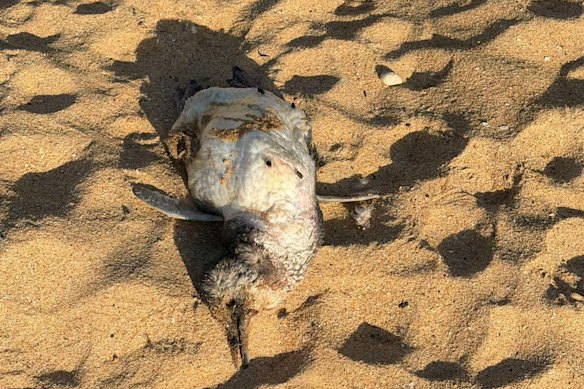

An off-leash dog is the likely killer of a little penguin found dead on Warriewood Beach last week, in the latest blow to Sydney’s struggling penguin colony.
Manly is the site of the only breeding colony of little penguins, also known as fairy penguins, on mainland NSW. The local population has declined precipitously from 70 pairs of little penguins in 2013-2014 to 15 pairs in 2024-2025, based on National Parks and Wildlife Service surveys.
“They’re on the front line of climate change through water temperature changes, through food resource availability, and then on top of that, impacts by foxes, cats, dogs, so the poor little buggers are really up against it,” said Australian Wildlife Conservancy chief executive Tim Allard.
The dead penguin was taken to Taronga Zoo where staff at the Australian Registry of Wildlife Health performed a necropsy. The results suggested the bird suffered a fatal puncture wound to its neck from a suspected dog attack.
The registry processed 11 dead little penguins last year, four of them from suspected dog bites, three with boat or propeller injuries, three that were young and emaciated, and one where the cause of death is yet to be determined.
Libby Hall, wildlife rehab coordinator from the Taronga Wildlife Hospital, said the zoo ran Project Penguin with local schools and Northern Beaches Council to try to educate the public about responsible dog ownership and wildlife protection.
Hall said the penguin killed on Warriewood Beach was emaciated and possibly sick, but “either way, the dog shouldn’t have been off leash”.
It is not known why the bird was at Warriewood, but the flightless seabirds spend most of their lives in the ocean and travel large distances up and down the coast, coming ashore occasionally to rest.
Sydney’s penguins are particularly vulnerable to predators when they return to rocky outcrops around North Head for extended periods to breed or moult. In 2015, NPWS figures show, foxes killed 27 penguins on Collins Beach at Manly. In 2011, a dog killed seven penguins near Manly Wharf.
The Northern Beaches Council area has about 60,000 registered dogs and there is strong demand from the community for open space and off-leash areas to exercise their pets. While dogs are not permitted on most beaches, the council is partway through a 12-month off-leash dog trial at the southern end of Mona Vale Beach, which started last October.
A council spokesperson said council rangers and parks staff regularly patrolled the area and found people were generally adhering to the times and area permitted, but members of the public could submit feedback online.
The spokesperson said council understood the community’s concern about the recent penguin death, noting that it was aware of the incident only through social media as it had not been formally reported to council.
“Northern Beaches Council rangers undertake regular proactive patrols of beaches and public spaces to ensure responsible use of public spaces by dog owners and their pets, and enforcement action to address any concerns,” the spokesperson said.
“Recognising that enforcement alone is not enough to change community behaviour, Council appointed a companion animal education officer in October 2025 to enhance education efforts, engage with residents, and promote responsible pet ownership.”
NPWS oversees the little penguins at Manly, which was listed as an endangered population in 2002, with its critical habitat designated an area of outstanding biodiversity value.
A spokesperson for the Department of Climate Change, Energy, the Environment and Water said it worked with council on pet management, while using daily camera checks and fox baiting to control foxes on North Head.
NPWS also manages more than 50 volunteer penguin wardens who support education, habitat maintenance and issue reporting. More than a decade ago, this group actively guarded a small group of penguins that nested under Manly Wharf from off-leash dogs, but the birds no longer use the site.
Little penguins are doing relatively better in the southern states. The colony at St Kilda in Melbourne has about 1400 penguins, Parks Victoria says, and the area is fenced off.
Hall said the Warriewood penguin could have been thin because it had just finished moulting, an annual event that typically occurs in March for the Sydney colony. The bird was an adult with no longstanding injuries.
During moulting, the penguins sit still on a rocky outcrop for three weeks and shed and replace all their feathers. They do not eat, and they can lose up to half their body weight.
Hall said the penguins were especially vulnerable to predators while moulting because they were out of the water, trying to hide in the rocks, while “quite a mess” of feathers and droppings built up around them.
“They’re easy to find if you’re a fox or a dog because it becomes very smelly and they’re just sitting there,” Hall said. “They’re totally exposed and vulnerable during that time. It’s a very stressful time for a penguin in the penguin year.”
Hall said people who find moulting penguins at Manly could bring them to Taronga, where they could moult safely and then be released.
Taronga Zoo took in six little penguins for rehabilitation last year, mostly for moulting but also injuries from boat strikes. The birds attacked by dogs and foxes usually did not survive, Hall said, though adult penguins could sometimes withstand a cat attack.
The team is now looking after a juvenile penguin, which still had some of its baby fluff, that was found at North Steyne.
The zoo releases the little penguins back to the wild at Curl Curl Beach because it is relatively quiet with direct access to the ocean and in the middle of two known breeding and foraging colonies, both Manly and Lion Island in Pittwater, as well as other offshore islands.
Get to the heart of what’s happening with climate change and the environment. Sign up for our fortnightly Environment newsletter.
 Caitlin Fitzsimmons is the environment and climate reporter for The Sydney Morning Herald. She was previously the social affairs reporter and the Money editor.Connect via email.
From our partners
Disclaimer : This story is auto aggregated by a computer programme and has not been created or edited by DOWNTHENEWS. Publisher: www.smh.com.au