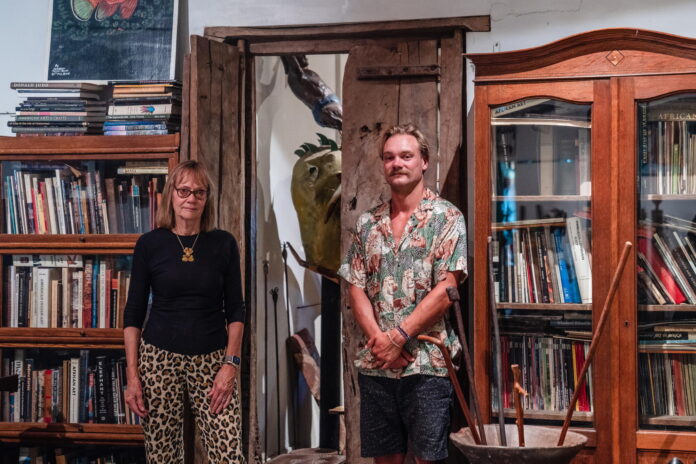
Known in Los Angeles art circles for his vast collection of African art and legendary dinner parties, Ernest “Ernie” Wolfe III has spent a lifetime accumulating art, friends and stories.
Now, as Wolfe, 75, suffers from a traumatic brain injury that has left him unable to move or speak, his family is trying to find homes for the collection that has defined him: about 15,000 works of African art of undetermined value. Some fill his namesake gallery (also known as Turkana) on Sawtelle Boulevard; others are kept in a warehouse whose rent has become difficult to sustain, said his eldest son, Ernest Wolfe IV, 34.
The collection’s history also includes longstanding questions about Wolfe’s collecting and sale of vigango, ancestral memorial sculptures made by Mijikenda peoples along Kenya’s coast that researchers later found to have been stolen before being sold — a situation Wolfe once said “horrified and deeply saddened” him.
“My first choice would be to find that one person who might exist on the planet who would love to have all of it,” said Wolfe’s wife, Diane Wolfe, 72, while acknowledging that keeping the collection intact “is not necessarily realistic.”
Diane Wolfe and her son Russell Wolfe in the Ernie Wolfe Gallery of African Art in Los Angeles. The family is looking for a home for the gallery’s more than 15,000 objects.
(Ariana Drehsler / For The Times)
A Santa Monica native who grew up in Sherman Oaks, Wolfe first traveled to Kenya in 1973, shortly after graduating from Williams College. He soon began teaching scuba diving there and started the field-collecting that ultimately led to his career in African art.
Friends and family describe Wolfe as a force of nature, often dressed in camouflage shorts and ready with stories of his travels, fishing expeditions and the objects surrounding him. His place in the Los Angeles art world was defined as much by his dinner parties as by the art he housed.
He began with Kenyan utilitarian objects and commemorative sculptures before expanding into whatever captured his attention. According to his wife, the collection includes more than 800 hand-painted Ghanaian movie posters; 30 large papier-mâché masks from Guinea-Bissau; nearly 300 paintings by Joseph Bertiers; and works by Isaac Azey and Kwame Akoto, known as Almighty God.

A photo of a young Ernie Wolfe hangs on the wall in the kitchen at the Ernie Wolfe Gallery of African Art in Los Angeles.
(Ariana Drehsler / For The Times)
Wolfe also acquired more than 100 Ghanaian fantasy coffins — figurative sculptures, some stretching 10 to 12 feet long, also known as Fantastic Afterlife Vehicles. Rooted in a Ghanaian funerary tradition, they have been exhibited as contemporary art.
Gabriel Florenz, founding artistic and executive director of the Brooklyn cultural center Pioneer Works, considers Wolfe’s holdings the most important collection of Ghanaian fantasy coffins in the world.
Florenz plans to exhibit about 40 coffins by acclaimed Ghanaian artists, including Kane Kwei and Paa Joe, at Pioneer Works beginning in June. He is also arranging a presentation at the Chicago Cultural Center in September.
“The idea became: Can I show these works and establish this as a real cultural tradition?” Florenz said.
He sees Wolfe as a benefactor as much as a collector. “It is rare to see collectors who really develop as patrons,” Florenz said. “A lot of these artists were his sincere friends.” Wolfe, he added, helped establish the field of Ghanaian movie-poster collecting.
Some of the posters hang alongside many other pieces in the 4,200-square-foot West Los Angeles gallery. Among the objects are a car door by American artist Edward Kienholz, a group of vigango sculptures, portions of a Ghanaian barbershop, and life-size sculptures of Michael Jordan and Michael Jackson.

A book written by Ernie Wolfe and shown at his L.A. gallery.
(Ariana Drehsler / For The Times)
“It wasn’t just about him collecting it,” said Wolfe’s younger son, Russell Wolfe, 32. “It was [also] about him … sharing it.”
The Wolfes’ gatherings, where Wolfe served lobsters he caught, were chronicled by the New York Times and Wall Street Journal. Entertainment and business figures such as actor Alfre Woodard and lawyer Skip Brittenham mingled with prominent L.A. artists, including Ed Moses, Chris Burden and Lita Albuquerque.
Albuquerque’s husband, writer Carey Peck, who has known Wolfe since high school, said of the gallerist’s eclectic circle: “Those worlds don’t go together on paper, but Ernie made the relationships, and he made that happen.”
“An image I had of Ernie was Peter Pan,” Peck said, describing him as someone with a knack for making his way into different venues and cultures.
After Peck and Albuquerque lost their Malibu home and much of her work in the 2018 Woolsey fire, Wolfe exhibited Albuquerque’s first new drawings as she struggled to resume her practice. “Offering her that opportunity and giving her a way to use her voice again was very instrumental,” Peck said. “That got her drawing again.”

A beaded club chair by the Yoruba people from Nigeria and a Baganda tripod stool from Uganda at the Ernie Wolfe Gallery of African Art in Los Angeles.
(Ariana Drehsler / For The Times)
Herbert “Skip” Cole, a UC Santa Barbara professor emeritus and African art scholar, has known Wolfe since they worked on a 1981 exhibition of Kenyan art at the university. It included objects that had appeared in the 1979 Smithsonian exhibition “An Introduction to the Arts of Kenya,” which Wolfe curated.
Cole called Wolfe “the driving force from day one. He collected it, he sold it, he advertised it. His unique personality goes along with the collection in many respects.”
“He defined the word ‘passion,’” said art historian Paul Hayes Tucker, professor emeritus at the University of Massachusetts Boston and Wolfe’s Williams College roommate. “His appetite was insatiable.”
But the scale produced by that appetite now complicates the collection’s future. Cole said many African art collectors favor figures and masks rather than the utilitarian and nontraditional objects Wolfe pursued.
“It’s not what people normally think about as African art,” Cole said. “This is its uniqueness, in a way.”

Unusual art objects are part of a collection of more than 15,000 African art objects held by Ernie Wolfe and his L.A. gallery.
(Ariana Drehsler / For The Times)
Cole and Tucker are starting conversations with Wolfe’s alma mater about acquiring Wolfe-owned paintings by Bertiers and Akoto. Williams College Museum of Art curators did not respond to requests for comment.
Tucker and Wolfe’s family said he never made a concrete plan for what would happen to the collection after his death. Russell Wolfe recalled discussions of placing it in “a Quonset hut or some kind of museum,” possibly in Ghana or Kenya. Diane Wolfe said she is approaching institutions but declined to identify them.
One major portion of the collection may now have a destination. After the U.S. exhibitions, Florenz plans to send the traveling group of approximately 40 coffins to Red Clay Studio in Tamale, Ghana. The arts center was founded by acclaimed Ghanaian artist Ibrahim Mahama, who Florenz said has proposed constructing a permanent building for the coffins. The transfer details were still being finalized when Florenz spoke with The Times, but he said placing them there “would be Ernie’s dream.”

Wooden sculptures called Vigango from the Southeastern Kenya Coast in the Ernie Wolfe Gallery of African Art in Los Angeles. The provenance of the pieces have been called into question by researchers.
(Ariana Drehsler / For The Times)
The possibility of returning other works to the countries where they were made also figures into Diane Wolfe’s search. Wolfe’s collecting and sale of vigango sculptures have drawn scrutiny. A 2018 article in the MIT Press journal African Arts cited researchers who said that vigango he sold were “probably stolen or acquired through ethically controversial means.” Wolfe maintained that he acquired the sculptures legally and regarded them as ritually deactivated or abandoned. His wife and oldest son said Wolfe never wavered in his position that the works had been acquired legally. Diane Wolfe does not believe the vigango need to be repatriated, but she distinguished that from her willingness to see portions of the broader collection return to Africa.
“I’d love for it to go back to Africa,” she said. “I don’t need all of it. I would love to see some of the collection return to Africa where the right institutions exist and important works could be preserved and cared for in their home country,” she wrote in an email. “That is something that is very meaningful to me.”
Wherever the art lands, Russell said, his father will be remembered as “the great juxtaposer.”
“He loved mixing everything together and celebrating life. One of his sayings was, ‘When in doubt, go flat out.’”
More to Read
Disclaimer : This story is auto aggregated by a computer programme and has not been created or edited by DOWNTHENEWS. Publisher: latimes.com