

A matchbox-sized ‘dinosaur’ could be a mine-defeating miracle, say opponents of developments in South American cloud forest.
“I have never seen this one,” says Carlos Zorrilla, leaning closer to a white sheet speckled with colourful moths basking in a floodlight’s glow.
The environmentalist has set moth traps on his property on the edge of the cloud forest in Ecuador’s Intag Valley for about two decades, but some nights his backyard still surprises him.
The remote, mountainous Andean valley is renowned for ecological diversity. In fertile northern Ecuador, unique altitude and climate patterns transform the misty forests lapping at Zorrilla’s door into a refuge for hundreds or rare or endangered species, including brown-headed spider monkeys, spectacled bears and more than two dozen types of amphibians.
These wilderness patches act as a buffer and wildlife corridor for the Cotacachi-Cayapas Ecological Reserve, one of the world’s most diverse protected areas, stretching from tropical lowland rainforests to the 5000-metre-high peak of the Cotacachi volcano.
Hollywood star Leonardo DiCaprio once described Intag as a wildlife paradise, critical to biodiversity and the overall health of our planet.
“There are very few areas on the planet with so many endangered species in such a reduced area,” says Zorrilla.
But scientists and conservationists fear this richness could be threatened if plans to allow mining on nearly 5000 hectares in the heart of the Intag Valley go ahead.
At least three Australian companies – BHP, South32 and a controversial subsidiary of billionaire Gina Rinehart’s Hancock Prospecting – are expected to bid for the copper concession when an international tender opens this year.
Known as Llurimagua, Rinehart’s subsidiary Hanrine Ecuadorian Exploration and Mining has spent years lobbying to gain its mining rights. Its hardball pursuit has sparked complaints from a major rival.
Nestled in the Toisan range, Llurimagua is considered the jewel of Ecuador’s copper concessions and a key project to consolidate the country’s sluggish large-scale mining industry. The tender follows the exit of Chilean mining giant Codelco, which had unsuccessfully partnered with Ecuador’s state-owned Enami to develop the concession. It comes as the government is courting foreign investment to reduce its dependence on oil, and as global demand for copper is surging.
The project is widely reported to be worth more than US$3 billion ($4.3 billion) and could yield upwards of 210,000 tonnes of refined copper a year. Some credible analysts predict the rewards could be much greater.
This presents a golden opportunity for Rinehart, who is diversifying her business assets from iron ore and into rare earth minerals and copper.
It also offers her subsidiary Hanrine an opportunity to move into the advanced exploration stage after years of investment in Ecuador, having been unable to progress in its concessions in nearby La Merced de Buenos Aires.
As revealed by a major investigation by this masthead, Hanrine has largely abandoned those concessions following a string of controversiesover its handling of community opposition, and the invasion of part of its tenement by illegal gold miners backed by violent criminal groups, raising concerns about the conduct of one of Australia’s largest mining companies.
Biologists and local environmental advocates like Cuban-born Zorrilla, who has fought to protect Intag’s forests for more than three decades through his environmental organisation DECOIN, say an open-cut copper mine, as previously proposed for Llurimagua, would destroy a critical ecological treasure before it is fully understood.
Preliminary environmental impact studies by Japan’s International Co-operation Agency in 1996 found a small-scale copper mine would lead to massive deforestation, erosion, the drying of local forests, water pollution and the displacement of wildlife, as well as require the relocation of 100 families from nearby communities.
“You’re talking about species extinction,” says Zorrilla.
The successful bidder would become the fourth miner to attempt to develop the project since minerals were discovered in the area in the early 1980s.
Two earlier hopefuls were pushed out by a coalition of local farmers and environmentalists. The third was Codelco. Its problems were a toad and a frog.
A matchbox-sized ‘dinosaur’
In 2016, scientists from the Jambatu Centre, a world-leading Ecuadorian amphibian research and conservation hub, were combing Llurimagua’s forests mapping their biodiversity when they came across four yellow-splotched toads.
Perched on leaves near the clear waters of the Chalguayacu River, the pocket-sized amphibians might have looked unremarkable, but represented an ecological miracle.
The elusive species, the long-nose harlequin toad, had technically been extinct since 1989, when a deadly fungal pathogen tore through the Ecuadorian Andes and devastated endemic frog and toad populations.
Almost three decades later, here it was – alive and well in the forests of Junin, a tiny community inside Llurimagua.
“It was a great scientific discovery,” says Andrea Terán-Valdez, a conservation biologist at the research centre.
That miracle, it turned out, was just the beginning.
Three years later, the biologists were back in Junin when they spotted a brown frog in a secluded waterfall. Small enough to fit inside a matchbox, the creature resembled a frog called the confusing rocket frog, another rare amphibian species believed to be extinct.
Upon closer inspection in the lab, the scientists realised they were onto something bigger. This was a new species of frog, so ancestral in its evolutionary characteristics that one biologist described it as a dinosaur or a living fossil.
The frog was named the Intag resistance rocket frog, a nod to the region’s lengthy anti-mining advocacy.
The following year, Terán-Valdez and two other conservation biologists backed by environmental groups, including Zorrilla’s DECOIN, walked into a courtroom in northern Ecuador seeking interim orders protecting nature.
They argued that allowing the project to proceed would violate nature’s rights – a principle recognised under Ecuador’s Constitution that grants the environment the right to exist and be protected – and lead to the extinction of critically endangered species like the long-nose harlequin toad.
Environmental impact studies done for the project, the scientists said, were missing several key species inside the concession at risk of extinction and did not fully capture the potential damage from a copper mine.
In October 2020, the court sided with Terán-Valdez, and suspended the project’s environmental licence. That move was overturned on appeal, but locals soon mounted another challenge in a provincial court in Imbabura. In 2023, that court ruled nature’s rights had been breached, and halted all mining activity in Llurimagua until a new environmental study and consultation were done.
Attempts to appeal the decision by Codelco and Enami failed and in 2024, Ecuador’s highest court, the Constitutional Court, also upheld the suspension.
Actor Leonardo DiCaprio, Junin’s most high-profile ally, told his 59 million Instagram followers that the Intag communities had protected “an irreplaceable slice of the wild”.
“If we are going to prevent the most catastrophic effects of climate change and biodiversity loss, we need to protect the species and cloud forests in the Tropical Andes, like Intag Valley,” he wrote.
In November 2025, Codelco abandoned Llurimagua. The company’s relationship with Enami unravelled in a series of messy disputes before international arbitration courts. Codelco has since sold its local subsidiary, EMSAEC, and its last concessions to Boroo, a Singaporean miner with projects in Peru, Mongolia and Chile.
Following Codelco’s withdrawal, the Ecuadorian government quickly announced it would put Llurimagua out for international tender, opening the door for Hanrine, South32 and BHP to bid. Enami is also in partnership talks with two other miners, the state-owned Aluminium Corporation of China (Chinalco) and Vancouver-based miner Teck Resources.
The 2023 court ruling leaves the door open for companies to present a new environmental impact study and engage in community consultation to get the project off the ground, but the successful bidder is likely to face similar hurdles to Codelco.
Guns and gold
To understand the value of Llurimagua, and Hanrine’s interest, it’s helpful to go back to a controversial morning in 2020.
As countries around the world scrambled to contain COVID-19, specialised weapons and explosives police swarmed a quiet residential estate on a country club, north-east of Quito, Ecuador’s sprawling capital city.
The investigators were following an anonymous tip. A wealthy businessman and former US serviceman living at the address was claimed to be trafficking illegal weapons. The man was Hanrine’s general manager, Carlos de Miguel.
The officers stormed de Miguel’s home as the mining executive and his wife rested inside and found, in a small gym, two pistols, an M4 carbine, a Mossberg shotgun, 19 magazines and more than 9500 rounds of ammunition.
De Miguel was arrested and held for 26 hours. He had a valid permit for one of the pistols, a 9-millimetre Glock, but the permits for the other weapons including the M4 carbine – a rifle often used by elite soldiers including in the US – had expired.
The arrest might have gone down as a shocking but isolated event among the international business community in Ecuador if it were not for what happened next.
After his release, de Miguel launched legal action against the police, the judge who granted the search warrant, a prosecutor involved in the raid and Ecuador’s then minister of government, Maria Paula Romo, who had posted about it online. The lawsuit accused them of procedural fraud and intimidation, among other things.
De Miguel claimed the raid was part of a campaign to discredit him in business circles. The aim, he told a Quito press conference, was to derail Hanrine’s bid to take over Llurimagua.
“The offer from the multinational that I represent is the highest made to date, more than $US400 million, but certain politicians intend to transfer the concession to other entities at cost zero,” de Miguel said.
He said “high political powers” had attempted to silence supporters of the deal within the administration and threatened him. He said he was able to defend himself, but not everyone in Ecuador had the resources to do that.
“The corrupt are in power; we will be the tip of the spear to ensure that this never happens again,” he said.
Less than a year later, prosecutors dropped the case on the basis De Miguel was a recreational shooter and was renewing the expired permits.
In response to questions by this masthead, de Miguel reiterated he had been cleared and “the court acknowledged there were irregularities with the action taken by the national police and … acknowledged that my rights were violated”.
De Miguel’s arrest came just weeks after Codelco had fired off an angry letter to Hancock Prospecting executives in Australia telling them Hanrine had been making unsolicited offers to the Ecuadorian government to acquire the rights to Llurimagua. If the company didn’t back off, the letter said, Codelco would consider legal action.
“Under Australian law, the knowing and intentional interference with another’s contractual rights is an economic tort sounding in [remedied by] damages,” the letter, shared by local media outlets, read.
Given Codelco’s investment into Llurimagua, it continued, any further action by Hanrine “will certainly constitute a knowing and intentional interference that could be extremely damaging to Codelco’s contractual rights” and damages could be sought.
According to the letter, which was based on information Codelco obtained through Ecuador’s freedom-of-information system, Hanrine made its first unsolicited bid to acquire the project in October 2017. The Hancock Prospecting subsidiary at that point was barely a few months old and in the midst of securing its concessions in La Merced de Buenos Aires.
The previous month, Ecuador officials had travelled to London to spruik Llurimagua as an investment opportunity to global mining giants, including Rio Tinto, behind Codelco’s back. Brochures circulated at the event had failed to mention Codelco’s involvement in the project, prompting the company to seek an explanation from the government.
It is unclear whether Hanrine was motivated by the brochures trumpeting the opportunity for investors to “exploit the mine” and a proposed copper smelting and refining complex to make the offer, but it would mark the beginning of years of lobbying.
By the time Codelco sent the letter to Hancock Prospecting in 2020, it said, Hanrine had made multiple approaches to public officials about a potential takeover of Llurimagua and was seeking an official meeting to discuss its proposal for the site.
To some, by 2020 it looked like Hanrine was seeking a way out of La Merced de Buenos Aires, having been unable to access the concessions for years.
Hanrine’s offers were rebuffed, but by 2023 the company was mulling another option. This time, it wanted the rights to explore six nearby concessions known as the Coronas.
The 28,000 hectares of concessioned land, which had previously belonged to Codelco, formed a ring around Llurimagua.
In 2024, as Codelco and Enami lost their environmental court battles, the Ecuadorian government announced Enami had reached a deal with Hanrine to develop the six Coronas for an initial investment of US$120 million. To this day, Hanrine hasn’t started work in the area.
The move sparked a new wave of concern among some locals in Intag, who had spent a decade campaigning to stop mining in Llurimagua. Codelco was leaving, but Hanrine appeared to be entering.
“There’s a lot that we don’t know,” says Peter Shear, an Intag farmer, university lecturer and head of APT-Norte, an environmental and rural land corporation in northern Ecuador. “We know that there’s a lot of business going between Hanrine, Enami and the Ecuadorian state.”
Shear, whose organisation also supports landowners in La Merced de Buenos Aires, believes Hanrine’s plan is to eventually acquire Llurimagua and combine it with the Coronas to form a “super-concession”.
“It’s worrying because we have seen the way Hanrine operates in [La Merced de] Buenos Aires,” he says.
“We are talking about a company that has tried to enter people’s properties without permission in Buenos Aires by force, using violence and in breach of Ecuador’s Constitution and laws.”
Hanrine has previously told this masthead it categorically rejects any allegations of wrongdoing in La Merced de Buenos Aires, and claimed they are “supplied by anti-prosperity environmental activists and individuals aligned with, and profiting from, illegal mining and associated criminal activity”.
There is no suggestion Gina Rinehart authorised or condoned Hanrine’s alleged conduct, or was even aware of the allegations against her company.
De Miguel did not respond to extensive questions by this masthead about Hanrine’s past offers to acquire Llurimagua and whether it believed it could bypass the environmental hurdles faced by Codelco.
He maintained Hanrine had obtained the rights to the Coronas concessions through an open process. He said the company was in discussions with the government so that it could start work on the project.
“The title for the tenements has not been transferred to Hanrine, so we do not have control over it,” de Miguel said in a statement.
Dark clouds ahead
Javier Ramirez is gentle and softly spoken. Talking outside his home in Junin, it’s difficult to imagine the anti-mining leader was once accused of terrorism, sabotage and rebellion.
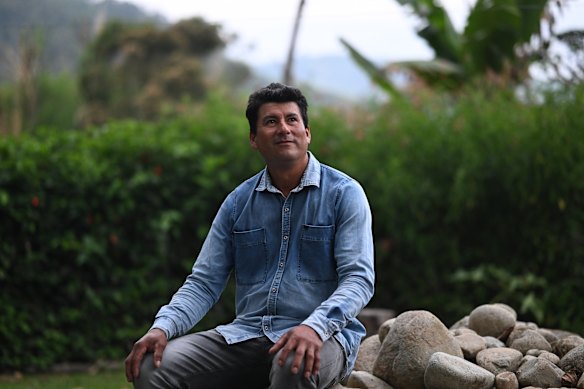
The father of four says life in Junin was peaceful, until the first mining company arrived in the 1990s – a subsidiary of Japan’s Mitsubishi Corporation called Bishimetals.
“In the beginning we didn’t know what mining was. We let them do initial exploration freely,” Ramirez says. “Then we learnt that we have rights, and that nature has rights.”
Locals burnt down Bishimetals’ camp in protest, and pushed the company to abandon Junin in 1997. Canadian miner Ascendant Copper took over the concessions in 2004, but left about four years later, after the Ecuadorian government stripped it of its licence following a tumultuous attempt to hire paramilitaries to deal with community opposition.
After Codelco signed a deal with Enami, Ramirez and other resistance leaders again hit the barricades. The companies were unable to enter the concession until 2014, when the government sent in more than 300 police and military personnel to break through the community roadblock.
Ramirez, who was Junin’s president at the time, watched on from prison. The father of four was heading home from a meeting with government officials in Quito some weeks earlier when he was arrested and charged with sabotage, rebellion and terrorism.
Ramirez was accused of attacking four Enami workers despite witnesses claiming he was at home nursing an injured knee at the time. The farmer was found guilty and sentenced to a year behind bars. He was released after 10 months, amid social pressure. But Codelco and Enami had already established themselves in Junin.
Ramirez says Codelco’s withdrawal was a relief but he knows the fight isn’t over.
“We must continue preparing ourselves for the new companies interested in exploiting the copper that still exists right here,” he says.
“We don’t want them damaging our forests, or the water that flows through our community. If this mine were to be exploited, we would be forced to abandon this territory because a giant pit would be in its place.”
Terán-Valdez, the conservation biologist involved in the court case to suspend Llurimagua, says mining would be devastating.
“For starters, there’s a high likelihood of water pollution when you do open-cut mining. But because of the geographical and climatic characteristics of the area, mining is a very risky activity,” she says.
Terán-Valdez says the northern Andes is an active seismic zone crossed by multiple fault lines. The soils in this part of the country are loose, and the slopes steep, creating a constant risk of landslides. The valley’s subtropical weather patterns mean the concession area is also lashed by heavy rainfall, particularly in winter, increasing the risks of spills, groundwater pollution and slides. Last year, authorities were forced to make an emergency declaration after heavy rainfall led to landslides across Intag and damaged homes and roads.
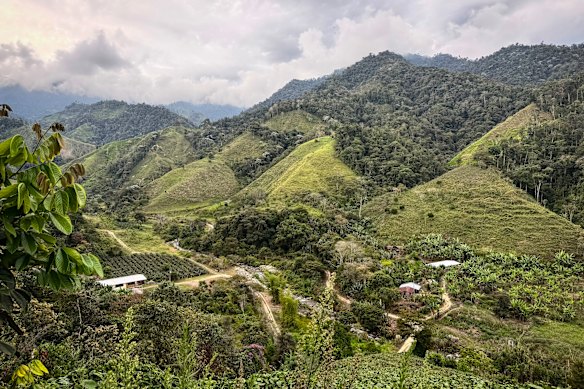
Arsenic has already been detected in potentially dangerous concentrations in the Junin River, the main water source used by families in the area to cook, drink and bathe, according to a 2012 study by Ecuadorian and US researchers supported by Carlos Zorrilla’s DECOIN. The study concluded one possible explanation was that the toxic metalloid had leaked from abandoned holes drilled by Bishimetals to collect rock samples during the first wave of mining exploration in Junin in the 1990s.
“We recommend that any future borehole drilling projects in Intag be approached with extreme caution because of the risk that they could elevate [arsenic] concentrations in surrounding rivers to dangerous levels for decades to come,” the researchers warned.
Locals also believe drilling polluted one of two parallel waterfalls near Junin known as “The Twins”. When this masthead visited last year, orange sludge clung to the rock behind one of the falls, which has been reduced to a stream as pristine water gushed from the other. Small green particles could be seen pooling in the water below.
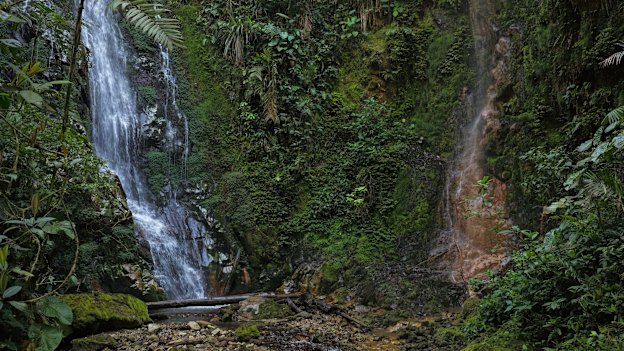
Terán-Valdez says a mine would involve clearing native forest, which could devastate amphibian populations. Unlike other animals such as jaguars and birds which move across large distribution areas, many frog species in the region are found only in a specific waterway. The resistance rocket frog lives in just three waterfalls at the heart of the mining concession, including the unpolluted twin waterfall.
Amphibians are particularly sensitive to environmental changes because of their unique breathing mechanism, in which oxygen from the air or water passes directly into their bloodstream through the skin. That means water pollution or even small changes to soil composition can have a lethal effect. Relocating them to an area away from the mining impact zone, a common strategy floated by mining companies, can also kill them, Terán-Valdez says.
While specific details of what the mining project would look like beyond the advanced exploration stage are unknown, the 1996 preliminary environmental impact study published by Japan’s International Co-operation Agency estimated 200 hectares would need to be set aside for open-cut mining, 664 hectares for a waste dam area, and 221 hectares for a tailings dam. Those figures were based on a much smaller estimated ore reserve of 76 million tonnes. Current estimates place the reserve at 982 million tonnes.
“It is difficult, devastating, and exhausting to be constantly harping on about the obvious,” Terán-Valdez says. “You cannot simply come along and drive species to extinction. You cannot carry out these kinds of activities in the planet’s most biodiverse areas.”
Carlos Zorrilla feels the toll of three decades of fighting too. He says a dark cloud will hang over the Intag Valley for as long as copper sits beneath it. It’s the curse of finding ore.
“The struggle will just go on and on until society wakes up and realises it’s not really worth it to destroy all this cultural and biodiversity wealth for just one type of wealth, the economic,” he says.
“Hopefully, they’ll wake up before I pass on, and I’ll be able to leave this planet knowing that we did our part.”
Disclaimer : This story is auto aggregated by a computer programme and has not been created or edited by DOWNTHENEWS. Publisher: www.smh.com.au



