After a mass hacking attack against the far-right Alternative for Germany, a trove of stolen data was made available online. Liam J. Kelly looks through more than 420,000 email files, finding messages highlighting the party’s close connections to Donald Trump, Russia and more.
Days after Donald J. Trump was elected to be the 45th President of the United States in 2016, Frauke Petry, then federal co-leader of the Alternative for Germany (AfD), called her own vote.
In an email attributed to the former co-chair of the far-right German political party, Petry asked members whether the party should send a “Glückwunsch-Telegramm” — or a formal congratulatory message — to the president-elect.
“We have already been perceived as those who do not join in the collective outcry of the political establishment,” reads a translated version of an email sent on November 10th, which The Local has seen.
“As the only German party that welcomes a new beginning in the US, we should do so officially as well.”
The vote was symbolic, but would hitch the then-fledgling AfD to a winning party that shared many of the same positions on immigration, nationalism and how best to tap into raging populism.
In just one word, another email attributed to Alexander Gauland, the controversial co-founder of the political party, cast his ballot roughly two and a half hours later: “Zustimmung.” (Consent.)
These emails, which were among those revealed by an explosive data leak this month, provide a rare glimpse into the operations of one of Germany’s most controversial political parties.
The Local obtained and reviewed portions of the publicly released data, including roughly 421,000 messages sent to or from email addresses attributed to official AfD party members, as well as other documents.
Much of the data dump was mundane: emails with meeting notes, spam, work-from-home scams and what appear to be phishing attempts.
But other messages from public figures contained in the roughly 281 gigabytes are far more consequential.
Among other things, they highlight instances of antisemitic behavior, share more context of the party’s ties to Russia, its embrace of Trump a decade ago, and the possible mishandling of campaign donations.
Most of all, these files offer a rare look into how an insurgent political party really ticks.
The AfD confirmed the hack and the fact that emails and other data was stolen to the German Press Agency and other outlets, but did not immediately respond to an inquiry by The Local about the breach. Where cited directly, public figures mentioned throughout have been contacted for comment. It has been noted where they responded.
Here’s a look at the major stories resurfaced by the AfD email leak.
Congrats to Trump
In response to Petry, several other past and present AfD members approved the congratulatory message to Trump.
Among them was a message sent via iPhone and attributed to one Dr. Alice Weidel, the party’s current co-chair, who wrote, “Yes:-) [sic].”
On November 11th, the message was sent by Petry.
“I am honoured to congratulate you on your election,” a portion of the final email read. This aligns with the message made public by NTV on November 11, 2016.
READ ALSO: Alternative for Germany members travel to the US on taxpayer money
‘Hitler Pilgrimage’
On October 18th, 2018, local media Thuringer Allgemeine first reported that AfD members, including one from the party’s Thuringia chapter, conducted a visit to several historical locations for Adolf Hitler.
As part of that trip, the group reportedly lit a candle in Hitler’s birthplace, Braunau am Inn in Austria.
They also took a photo before a blanket with a swastika and SS symbology on it. The Local has reviewed a photo that resembles this description. Each of the faces in the photo is anonymized with a white circle.
Two days after Thuringer Allgemeine published their article, an email attributed to Stefan Möller, a party spokesperson and member of the Thuringia state parliament, explained that two party members resigned after the AfD’s state executive committee confronted them with the photo.
The email added that because some details, namely the identity or role of named individuals, could not be confirmed “beyond a doubt,” a state-level investigation team would be tasked to “further clarify the facts of the matter.”
A report presented on October 25th included “the findings to date from the investigation into the facts of the so-called ‘Hitler Pilgrimage’.”
The report bears the signatures of Marcus Bühl, a member of the German federal parliament representing Thuringia, and Torben Braga, a member of the federal parliament and the state party press spokesperson for AfD in Thuringia.
Neither Bühl nor Braga immediately responded to The Local’s request for comment. In October 2018, Braga said that National Socialist ideas or the worship of Hitler is “incompatible with membership” in the AfD.
The report noted that a former party member and judge for the party’s state arbitration court admitted to being one of the people pictured. He also admitted he owned the flag pictured, according to the report.
The report, seen by The Local, indicated that it “could not be confirmed beyond a doubt that a ‘Hitler pilgrimage’ — or an excursion focused on the life and work of Adolf Hitler — took place involving former and current AfD members.”
It also indicated that all AfD members who participated in the vacation trip known to the investigative team “have since left the party.”
READ ALSO: Why the Alternative for Germany is considered a far-right extremist party
“For reasons of principle alone, I will neither confirm nor deny any alleged or actual information obtained through criminal means,” Möller told The Local via email referring to the hack.
“The ‘Hitler pilgrimage’ affair was already extensively reported on nationwide back in 2018. What you’re chasing after here is, quite literally, ‘old news’,” he added.
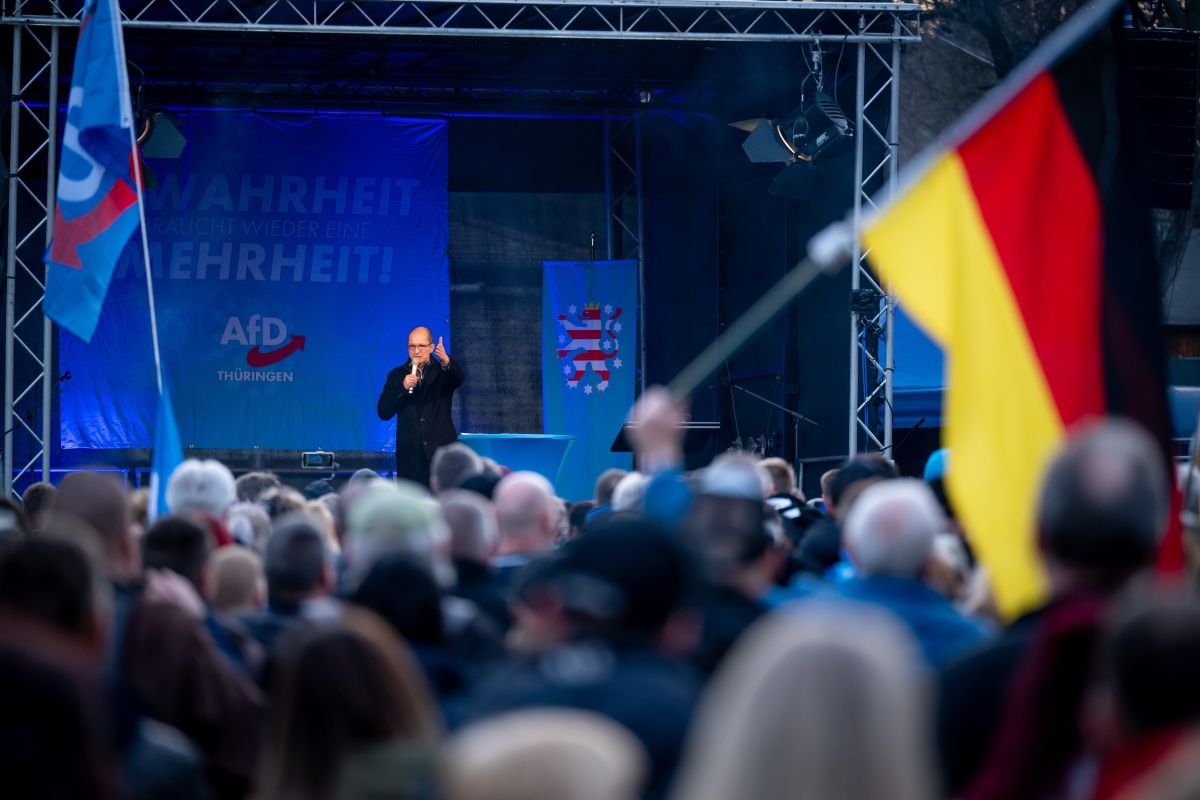
Stefan Möller, Thuringian AfD politician addresses a crowd at a campaign rally. Möller told The Local that a story about party members going on a ‘Hitler pilgrimage’ was “old news”. Photo: picture alliance/dpa | Jacob Schröter
Russian election observation
The AfD’s links to Russia are well documented. The email trove provides additional context into the nature of that relationship.
In January 2018, an email attributed to AfD politician Markus Frohnmaier, a member of the federal parliament for Baden-Württemberg, outlined how the Russian Freedom Foundation has invited him and up to six other AfD members to observe elections in the country.
According to the email chain Frohnmaier presented a complete list of AfD members interested in attending.
Election observation is a standard international practice conducted by intergovernmental and non-governmental bodies to assess whether elections meet international standards. However, credible missions rely on strict non-partisan methodologies and multilateral oversight; individual political parties do not possess the mandate or neutrality to conduct recognised election observations.
READ ALSO: Germany’s AfD and populist BSW pass motion to end aid for Ukraine
Observations by the Organization for Security and Co-operation in Europe recognised improvements in Russia’s election that year, but also highlighted misgivings.
“While candidates could generally campaign freely, the extensive and uncritical coverage of the incumbent as president in most media resulted in an uneven playing field,” the OSCE’s report read.
Asked by another AfD member by email about his own impression of the experience, an email in response from Frohnmaier’s account read: “My impression is that the presidential elections were fair and democratic.”
Frohnmaier did not immediately respond to a request for comment. Citing other leaked emails in 2019, Der Spiegel previously reported his observation of the election in Moscow.
Campaign by Harris Media
Besides cosying up to the Trump administration, the AfD also took a key page from the MAGA playbook: establishing a working relationship with a digital media agency known for boosting the reach of far-right and populist parties.
The work appears to have occurred in the run-up to Weidel’s 2017 federal election campaign.
Harris Media assisted in the Trump campaign in 2016, as well Great Britain’s far-right nationalist party UKIP, according to a report by Der Spiegel from 2017. The company’s own website highlights its work for Israel Prime Minister Benjamin Netanyahu, Texas Senator Ted Cruz and others.
Marketing campaigns by Weidel in 2017, conducted with the support of Harris Media, were noted for their aggressive American style.
The Local reviewed several alleged messages, including marketing tactics Harris Media proposed, and an internal bristling over the way in which the American marketing agency took credit for the AfD’s success.
READ ALSO: ‘Fake’ social media accounts spread disinformation ahead of German election
On August 31st, 2017, an email attributed to a Harris Media executive proposed a marketing tactic the company also employed for Rand Paul, a Republican politician from Kentucky, in 2016. The email linked to a 2016 article by Business Insider detailed how Paul used the strategy.
“Would you be open to providing some live commentary on the debate Sunday night between [Angela] Merkel and [Martin] Schulz,” the email read. The email recommends sharing the live commentary on Facebook Live or live tweeting during the debate.
“I think this could could [sic] be a great way to inject AfD into the conversation of the night, and bring more attention your way,” the email read.
An email attributed to Weidel responded 13 minutes later: “Sure – great idea.”

Co-leader of the far-right Alternative for Germany (AfD) party Alice Weidel (L) stands by the window on the sidelines of a session at the Bundestag in Berlin. (Photo by John MACDOUGALL / AFP)
Donation scandal
The leaked emails also shed fresh light on a financial scandal the AfD faced in 2018.
That year, co-chair Alice Weidel came under intense scrutiny over receiving some €132,000 in illegal campaign donations across several small installments allegedly from a pharmaceutical company in Switzerland.
Weidel has a residence in Einsiedeln, Switzerland.
PODCAST: Inside the AfD email leak and Gen Z protests come to Germany
German law tightly arbitrates how political parties may receive and then use campaign donations. For instance, it is prohibited to receive donations outside the European Union, unless the donor is a German citizen, an EU citizen or the company donating is majority owned by a German or EU citizen. Also anonymous donations above €500 are prohibited, and it is prohibited to send donations through intermediaries to obfuscate the funds’ source.
In this case the donations were deemed illegal because they arrived from a non-EU country and were sent via a series of intermediaries — or “strawmen”.
The German federal parliament fined the party €396,000 — roughly triple the amount of the donation. A Berlin court upheld the penalty in 2023.
Weidel told reporters at Westdeutscher Rundfunk Köln, Norddeutscher Rundfunk , and Süddeutsche Zeitung she was surprised by the donations and said she was “not involved in the day-to-day business of campaign finance.”
Whilst the emails found among the latest leak don’t confirm she was aware of the illegal donations, the timing and contents of them suggest however, that she may have had more understanding of the party’s campaign financing than she initially admitted.
An email to two contacts from July 10th, 2017 and attributed to Weidel, seen by The Local and also reported by German outlets, read: “I have been given donations with which I have to fight my social media election campaign.”
Another email to the two contacts, sent on July 6th, 2017, attributed to Weidel read: “During the election campaign, I will use the donations made to me and deposited into our local chapter’s account exclusively for Facebook.”
Neither Weidel nor the AfD responded to The Local’s request for comment.
In a statement provided widely to German media the party has said that it will not comment on the data. Since the emails had been illegally copied, the party generally refuses to answer questions as to “whether a bit of leaked content is real or fake”.
Disclaimer : This story is auto aggregated by a computer programme and has not been created or edited by DOWNTHENEWS. Publisher: thelocal.de