

This is a huge week for tech stocks. We’ll get Q1 earnings calls from Microsoft, Alphabet, Meta, Amazon, and Apple through Thursday.
Chart via TradingEconomics.com.
ONE BIG THING
A manifesto, a train ride, and a security gap that allowed a shooter to get within yards of Trump
The suspect in the attempted assassination of President Trump at the White House correspondents’ dinner will be arraigned in federal court today. New details are emerging about the alleged shooter’s motives and officials’ response to the apparently lax security surrounding the president. (You can read details of the “manifesto” that Cole Tomas Allen emailed to family members before the shooting here.)
One obvious issue—both the president and Vice President JD Vance were on the same dais, opening the possibility that if both had been killed the presidential succession would have fallen to the speaker of the U.S. House of Representatives. Allen was able to travel to Washington D.C. via train, check into the hotel, and get within yards of the president all while carrying multiple guns and knives—an extraordinary gap in security given that Trump has twice been targeted by assassins before.
Trump used the crisis to push his White House East Wing ballroom as the secure solution for presidential dinners.
IRAN
Iran and Washington are still talking—but mostly getting nowhere
Iran has proposed reopening the Strait of Hormuz while delaying talks on the future of its nuclear program. Iranian Foreign Minister Abbas Araghchi is in Russia today to shore up support from its ally. The proposal is likely to be rejected by President Trump, according to Axios, because normalizing the Strait would end his leverage against the nuclear program. Trump is expected to have talks today with top officials to discuss next steps in the war. The president also said he was not enthusiastic about conducting negotiations in Pakistan, which is an 18-hour flight from Washington, and suggested the Iranians could just call on the phone instead.
- Ceasefire broken: An Israeli strike on Lebanon killed 14 on Sunday; a Hezbollah drone strike on Israel killed one and injured six.
- The takeaway: They’re talking past each other but at least they are talking.
BIG TECH
Grab the popcorn: It’s Musk v Altman in court this week
Elon Musk’s $180 billion lawsuit against OpenAI will be heard in an Oakland, Calif., federal courthouse this week, and observers should expect sparks to fly. Musk is alleging Sam Altman tricked him into investing in OpenAI on the basis that it was a nonprofit that would research AI to benefit all mankind before switching it without Musk’s consent into a for-profit company. He wants CEO Altman and President Greg Brockman removed from their posts. If Musk wins, it hobbles the company’s bid to stage an IPO.
- Soap opera. Wedbush analyst Dan Ives believes the suit will ultimately be settled but not before Musk and Altman have traded punches. “This is a tech soap opera that all investors will be watching as Musk v Altman enters the MMA ring. We believe there will be a lot of dirt and slings thrown around in court between Musk and Altman and that is not a good thing for anyone involved…but Musk has made this personal. We believe any major damage to OpenAI and Altman will be more scrapes and bruises than real consequences to the company and his role as CEO. That said, it’s Elon and never doubt him in these spots,” he advised clients in a note seen by Fortune.
MORE FROM FORTUNE
John Ternus, Apple’s new CEO, inherits a rebounding China business—and some messy headaches – Nicholas Gordon
Baby boomers have now ‘gobbled up’ nearly one-third of America’s wealth share, and they’re leaving Gen Z and millennials behind – Sasha Rogelberg
Chevron CEO says Venezuela must do more for oil industry revival – Bloomberg
Sergey Brin confronted Gavin Newsom at a treehouse party—then launched a political war – Bloomberg
CHART OF THE DAY
Asia’s “fertility shock”
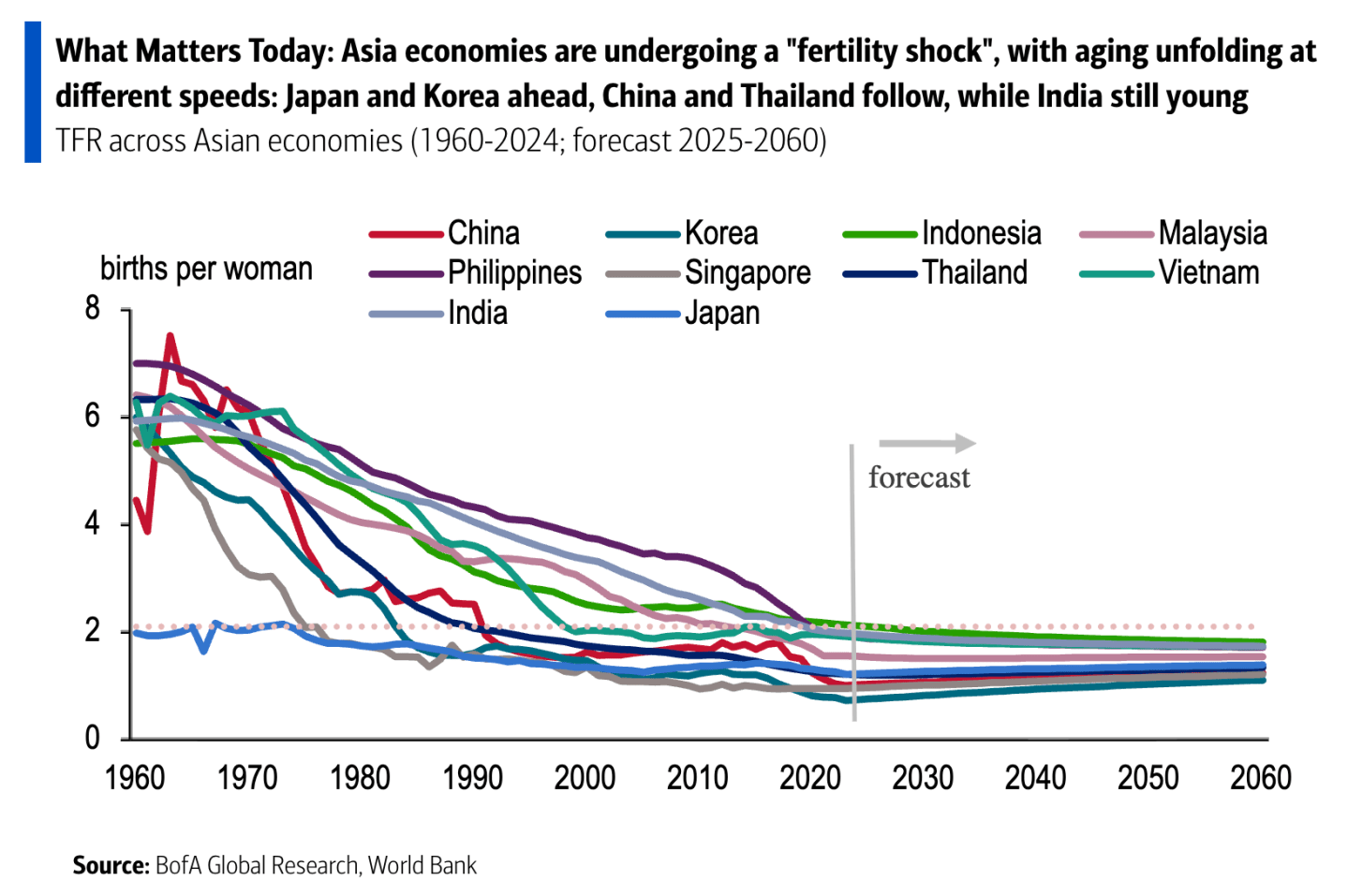
“Asia’s average Total Fertility Rate has fallen from around 6.0 births per woman in the 1960s to an estimated 1.87 by 2025, well below the replacement level of 2.1. Japan and Korea are aging fast, followed by China and Thailand, while India and Indonesia continue to benefit from a longer demographic‑dividend window. Demographic aging is widely seen as a drag on potential growth, through reduced labor supply, weaker innovation, and slower productivity gains,” Bank of America’s Yvonne He and Helen Qiao said in a recent research note.
NUMBER OF THE DAY
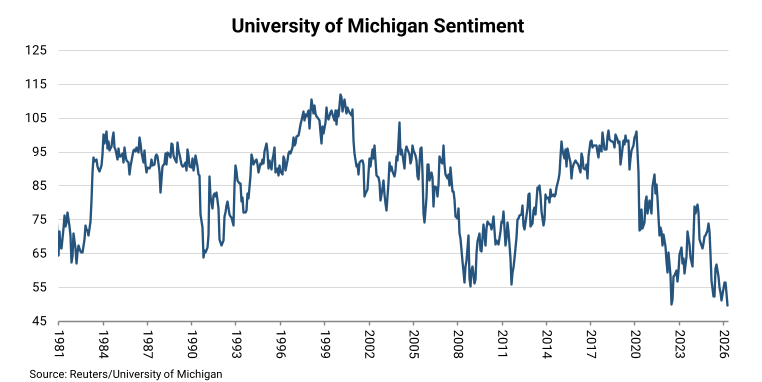
49.8
The University of Michigan’s current gauge of consumer sentiment. “The index remains at a record low, 0.2 index points below the 50.0 reading in June 2022,” according to Jefferies analyst Thomas Simons:
THE FRONT PAGES TODAY
Inside China’s plans to fight in space – FT
We spoke to over 30 CEOs and business leaders. Here’s what worries them most – CNBC
Jane Street Snatches Wall Street Crown With Record $39.6 Billion Trading Haul – Bloomberg
King Charles Is on a Mission to Salvage U.K. Relations With Trump – WSJ
Woman seen snatching wine bottles in aftermath of White House Correspondents’ Dinner shooting – NY Post
ONE MORE THING
CEO of upcoming $1.8 billion quantum IPO says he’s ready for inevitable short-seller attack
IQM Quantum Computers filed confidentially with the SEC in April to go public via a SPAC, which is expected this summer. The company booked $35 million in revenue last year, up 94% from the year before. It has disclosed $100 million in future bookings for its services this year (bookings are agreements not yet recognized as revenue). But the offering will have a valuation of $1.8 billion, begging the question of whether investors will tolerate a stock whose revenues are a tiny fraction of its proposed market cap.
Could this be why IQM wants to go public via a SPAC and not a regular IPO? SPACs have a notorious history as vehicles for companies with poor-quality earnings.
“In general, yes, they have not always been successful,” IQM CEO Jan Goetz told Fortune last week. “The interesting thing is that in quantum, things are different. Like with the technology. All the quantum companies that went public did it through SPACs, so far. And they’re all trading above their $10 initial release price. So actually, in quantum, it’s exactly the other way around. All SPACs have been successful so far.”
They have all been attacked by short-sellers, too. Is Goetz prepared for that?
“Everyone [in quantum computing] has kind of experienced it, and they’re all still there and all still doing well. I think that shows that there are mechanisms to go around this. And yes, we have been, of course, preparing ourselves well for the process, and we have been ramping up the teams, ramping up also our advisors and the knowledge base around it.”
Disclaimer : This story is auto aggregated by a computer programme and has not been created or edited by DOWNTHENEWS. Publisher: fortune.com



