The ceasefire is looking a little more firing and a little less ceasing this morning. According to reports, Iran’s Islamic Revolutionary Guard Corps (IRGC) has targeted an unspecified U.S. air base in the Middle East following U.S. strikes over the Strait of Hormuz.
The IRGC did not say where in the region it had targeted the base, but Kuwait, which is home to a U.S. base, said it had intercepted hostile missile and drone threats—according to the BBC—though it didn’t specify where from.
Israel has also issued an evacuation order for southern Lebanon, after the Israel Defense Forces said it would use “extreme force” targeting Hezbollah infrastructure.
Despite the action, markets remain committed to the view that negotiations between the U.S. and Iran will be successful, with global oil supply normalizing as a result.
“Investors are eyeing U.S. domestic political pressures as grounds for expecting a resolution, in spite of Trump’s denials,” UBS’s Paul Donovan said this morning. “Trump’s approval rating hit a new low in a recent opinion poll, and the administration is being directly blamed for higher prices.”
ONE BIG THING
SpaceX’s AI funding plan
Fortune’s Shawn Tully has spotted another interesting tidbit in SpaceX’s S-1 filing ahead of a highly anticipated $80 billion IPO: SpaceX has already pledged the largest part by far of what’s expected to be the largest sum ever raised in an IPO to third parties.
As my colleague Shawn highlights, the reasoning is that CEO Elon Musk is essentially betting the future on gigantic growth in the new AI franchise. Of the total addressable market of $28.5 trillion he foresees for the company in the S-1, $26.5 trillion of that is in AI.
The pipeline of funding funneled into AI was pointed out by David Trainer of research firm New Constructs, who revealed that $62.8 billion, or 78% of the forecasted $80 billion, is already spoken for by insiders and vendors. Indeed, the Musk-led business has pledged to pay more than three-quarters of the proceeds to third parties such as Valor Equity Partners (a large shareholder), Musk X Corp and xAI investors for repayment of debt, and Echostar for “the Spectrum Acquisition Closing.”
FEDERAL RESERVE
Fed still has an inflation mountain to climb
There’s plenty of work for the Fed to do if it wants to get inflation anywhere close to the central bank’s 2% target, writes Bank of America’s Stephen Juneau.
Core goods inflation is the main reason for the overshoot of the target at present (currently at an annual rate of 3.8%), which BofA believes is largely due to tariffs. However, recent increases in oil prices as a result of tensions in the Middle East won’t help the outlook, either.
Yet even if the Fed gets goods inflation under control, it still has sticky prices in the services sector to contend with. Juneau writes: “It may benefit from further declines in housing inflation given weak asking rent inflation, but that is unlikely to be enough to achieve 2% inflation without improvement in other services…Bottom line: The last mile of inflation remains the hardest.”
NATIONAL DEBT
The best case is still pretty bad
There are five outcomes when it comes to U.S. national debt, writes David Kelly, Chief Global Strategist at J.P. Morgan Asset Management. The best case isn’t that great: It entails debt deterioration, likely as a result of a bout of inflation and a recession, though without the bond market revolt that JPMorgan CEO Jamie Dimon has been warning about.
For this to work, the U.S. economy will also need AI to deliver a stronger-than-expected productivity boost, immigration restrictions to ease, allowing faster labor force growth, and a prolonged period of divided government that prevents either party from piling on more unfunded stimulus.
The worst-case scenario is a full-blown financial crisis. This outcome is “somewhat more likely” than any serious attempt to reduce deficits through spending cuts or tax increases, he writes—a sentence from one of Wall Street’s more sober voices that is now standard, as alarm mounts over the debt situation.
One casualty of this dire outcome is a threat to Fed independence, notes Fortune’s Nick Lichtenberg, if it were forced to artificially lower rates in order to make borrowing cheaper. Kelly observed: “A Fed perceived as subservient to the White House would shatter investor confidence in the Treasury market, raising the specter of the central bank being conscripted to finance federal spending and abandoning its inflation mandate.”
MORE FROM FORTUNE
CHART OF THE DAY
Not another AI gap
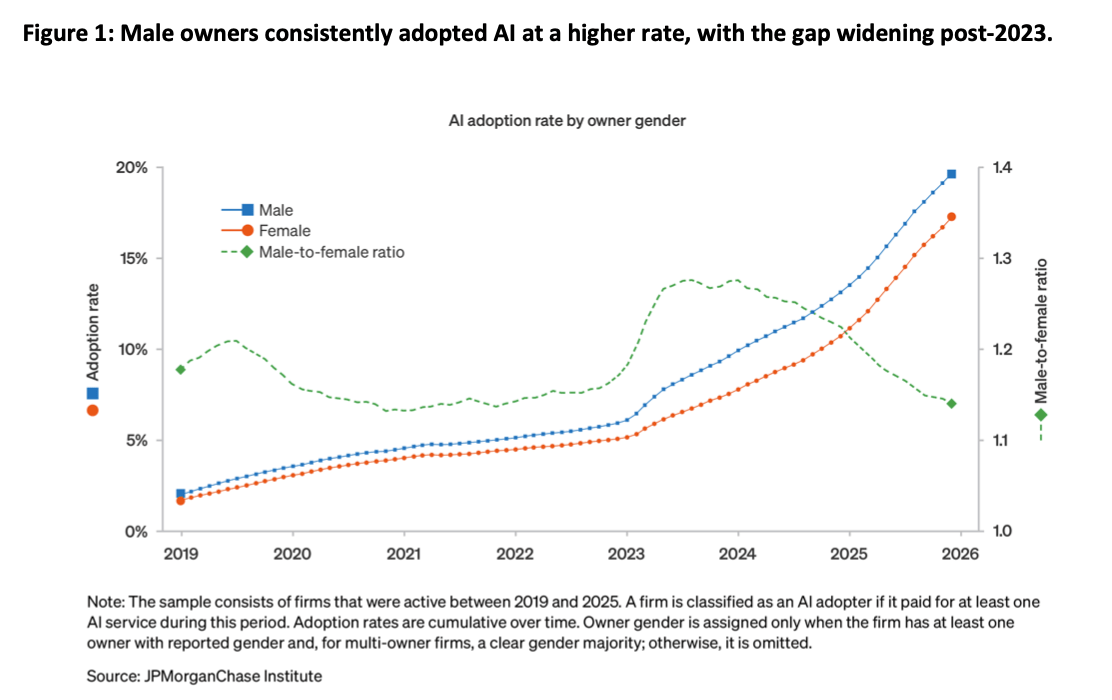
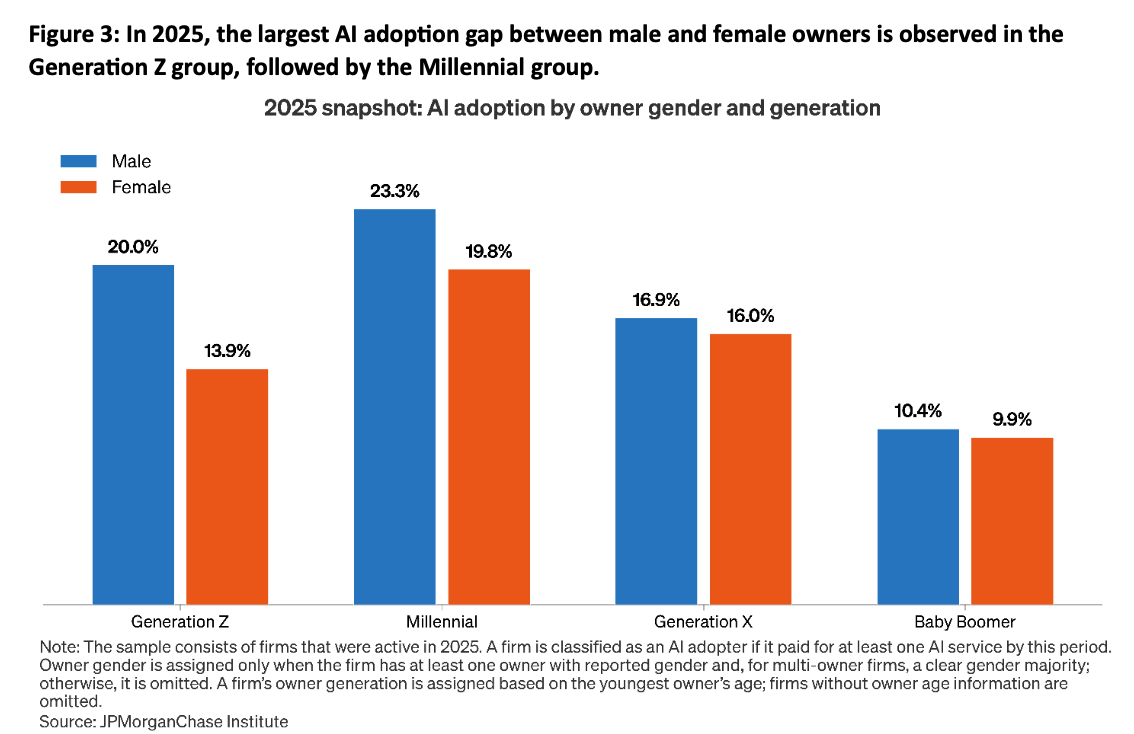
Why have one chart when you can have two?!
JPMorgan Chase Institute’s latest report on the AI adoption gap—shared under embargo with Fortune500 Digest—found small businesses have accelerated their adoption as AI tools grow more accessible and easier to deploy.
However, not everyone is adopting at the same rate, with particular gaps between male and female respondents and by age. The biggest gap was between Gen-Z men and women, at 20% adoption rates for men and 13.9% for women.
The authors of the report (Chi Mac, Chris Wheat, and Andrea Passalacqua) offer two key insights to address the imbalance, suggesting targeted AI training on specific use cases would help both gender and generational confidence gaps. Specific training would build confidence in use cases while also improving technical skills, the report suggests.
Additionally, community-based support and mentorship networks could reduce persistent gender gaps among younger cohorts, as trusted mentors help demonstrate the value of AI adoption to young entrepreneurs.
NUMBER OF THE DAY
11%
Nearly nine out of 10 Americans support legalizing marijuana in some way, according to a January 2026 survey from Pew Research.
Cannabis is classified as a controlled substance under federal law, despite the fact that nearly half the states and the District of Columbia allow people to use marijuana for both medical and recreational reasons.
A majority of U.S. adults (55%) say that marijuana should be legal for medical and recreational use, and another 33% say it should be legal for medical use only.
THE FRONT PAGES TODAY
ONE MORE THING
Beware a taper tantrum
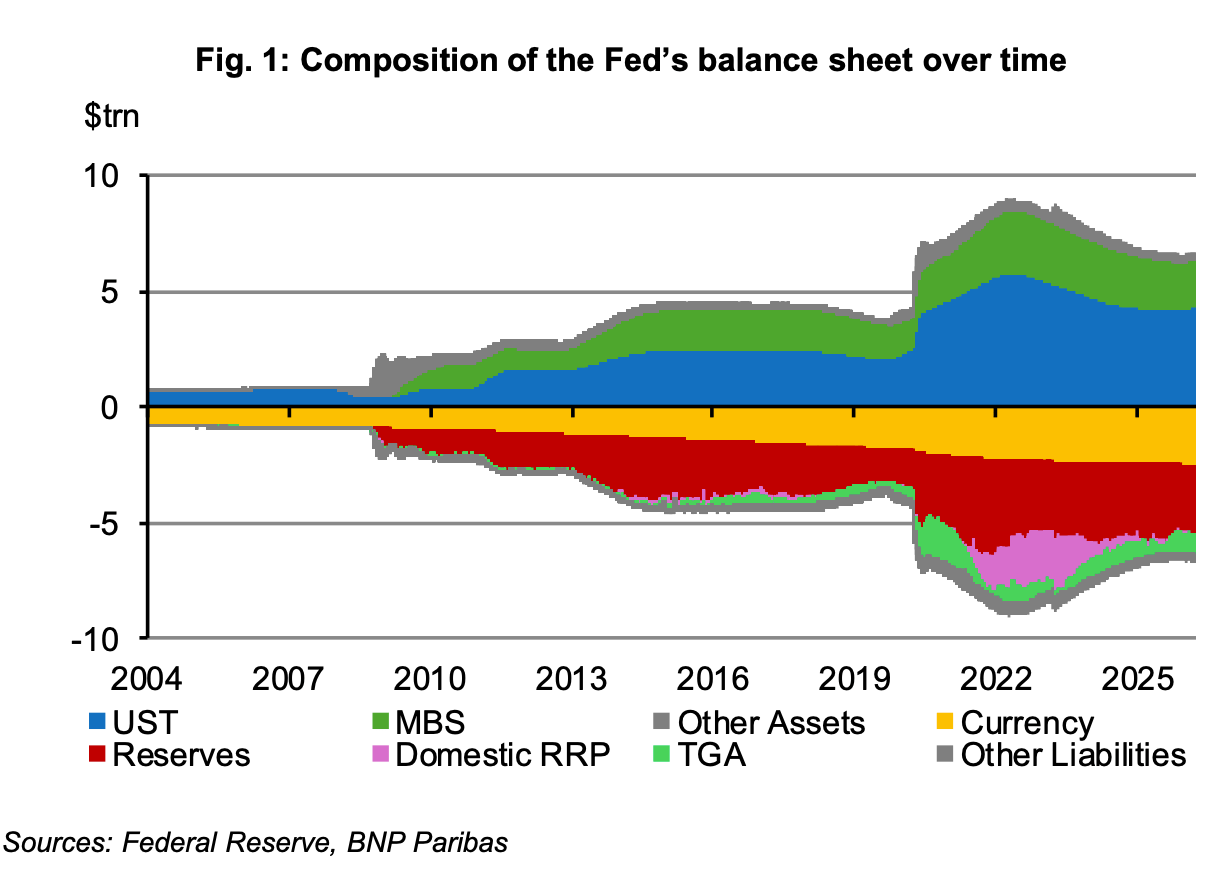
BNP Paribas has been weighing up Kevin Warsh’s signals on shrinking the Federal Reserve’s balance sheet.
A note from the Market 360 team, shared with Fortune, suggests the balance sheet will shrink by approximately $700 billion in a program beginning in 2028. The expectation is that this will be done in a “gradual, predictable, and well-signposted effort” over the course of Warsh’s term, the team wrote.
If those dominoes start to fall in a way that surprises Wall Street, reactions will be much more adverse. Drawing on previous episodes of Fed tightening and balance-sheet reduction, such as 2013 and 2018, the team wrote: “Credit can prove resilient during Fed balance sheet shrinkage (e.g., 2023-2025).”
“However, there were episodes when plans in this area had a negative impact on credit spreads. These were mostly about communications that markets took as hawkish surprises.”
“The May 2013 ‘taper tantrum’ was the most negative, with $IG spreads widening from 130bp to 155bp in the weeks after Chair Bernanke’s speech and only fully retracing this by October.”
Disclaimer : This story is auto aggregated by a computer programme and has not been created or edited by DOWNTHENEWS. Publisher: fortune.com