
Manila: There’s a new contender in Australia’s competition for chicken shop dominance.
Meet Jollibee, the human-sized bee in a white chef’s hat, red blazer and black bow tie. It’s the Philippines’ answer to Ronald McDonald and is known for viral dance moves. And now, Jollibee is coming to Victoria and NSW.
The Philippine chain on Sunday signed exclusive franchise agreements to introduce its fast food and characters to Australian families. Under the deal, 35 restaurants are set to come to Australia in the next five years, a $60 million investment that should create about 900 jobs.
Jollibee will try to win over a crowded market with its signature fried chicken: the “Chickenjoy” is a bone-in piece that typically comes with a side of rice and is best served with gravy.
But other menu items may prove more intriguing to get Australian diners through the door. “Jolly Spaghetti” comes doused in tomato sauce that’s made with banana ketchup for extra sweetness, topped with ground meat, sliced hot dogs and grated cheese. Burger steaks are another option – beef patties drenched in mushroom and beef gravy, served on a mound of garlic rice – and a peach and mango pie rivals its apple counterpart for dessert.
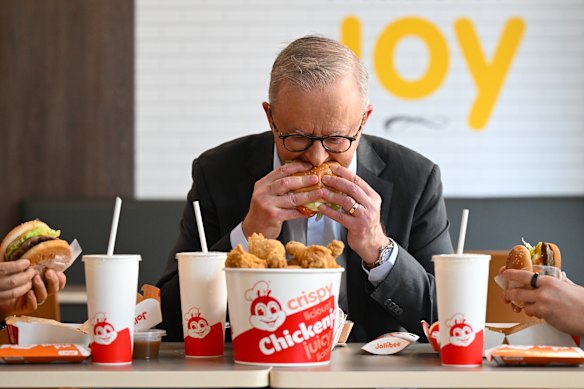
Prime Minister Anthony Albanese, in Manila for the 2026 ASEAN conference, was greeted by Jollibee on Sunday, when he popped by the “Jollibee Biopolis” for lunch with a side of fast-food diplomacy. Given food-based photoshoots can become a trap for politicians, Albanese had a polite bite of a burger before moving on to marvel at the operation.
The Australian investment is the latest expansion for the listed $US2.5 billion Jollibee Group, which began as a small ice-cream parlour in Quezon City, and now serves various menu items from 2000 stores across 17 countries.
Over the past 15 years, it has pushed into markets in the United States, United Kingdom, parts of Europe and the Middle East alongside Asia, and owns a range of other chains, including Compose Coffee, which chief executive Ernesto Tanmantiong previously said aims to challenge Starbucks.
As Jollibee has expanded, the titular character’s family has also grown. You’ll find pictures plastered all over the colourful stores. A high-spirited cheerleader called Hetty, with noodle-like blonde pigtails, embodies the Jolly Spaghetti dish. The smart scientist character is Mr Yum, who represents the “Yumburger” line. Twirlie, wearing pink and purple, is the mascot for dessert, and lovers of potato get their ambassador in Popo, a sporty boy with French fries for hair.
Their smiling faces are one part of the warm-spirited service that Jollibee’s reputation is built on. “In the Philippines, we have a beautiful world, bayanihan. The spirit of the community comes together to help one another succeed,” Tanmantiong said.
“We look forward to bringing our great tasting food and the joy of eating to communities across Australia and to becoming part of the everyday and special moments of Australian families.”
Jollibee will enter a crowded field. Australians no longer look to just KFC, McDonald’s or Red Rooster for fast fried or charcoal chicken.
Lebanese chicken shop El Jannah has become an institution, expanding from five stores in Sydney to 40 stores across Melbourne and Canberra in five years, and wants to grow to 200 restaurants. Its chief executive moved over from Craveable Brands, the parent company that’s also big on chicken, and operates Oporto, Red Rooster and Chargrill Charlie’s, and owned by private equity firm PAG Asia Capital.
Before Chargrill Charlie’s was gobbled up by a bigger chicken brand, it had evolved from a neighbourhood joint to 17 outlets in Sydney and two in Melbourne. Nando’s, Frangos, El Jannah, Ogalo and Oporto also form part of the competition.
While Australians clearly have an appetite for chicken, Tanmantiong will have his work cut out for him in breaking through.
But there’s more to Jollibee’s expansion than another lunch option, and that’s the soft diplomacy.
“What it represents is a benefit of the increased economic relationship between Australia and the Philippines … And Jollibee also will be a source of pride for Australians of Filipino background,” Albanese said on Sunday.
“There are some 400,000 Australians [who] trace their heritage to the Philippines, and they’re proud of that. And we can see here, with the welcome that we’ve received, how enthusiastic the workers are here for being a part of this today, but being a part of what is a symbol of the Philippines. When you see Jollibee anywhere in the world, you know that is Filipino success, and that is a fantastic thing.”
With Calum Jaspan
Cut through the noise of federal politics with news, views and expert analysis. Subscribers can sign up to our weekly Inside Politics newsletter.
 Natassia Chrysanthos is Federal Political Correspondent. She has previously reported on immigration, health, social issues and the NDIS from Parliament House in Canberra.Connect via X or email.
From our partners
Disclaimer : This story is auto aggregated by a computer programme and has not been created or edited by DOWNTHENEWS. Publisher: www.smh.com.au