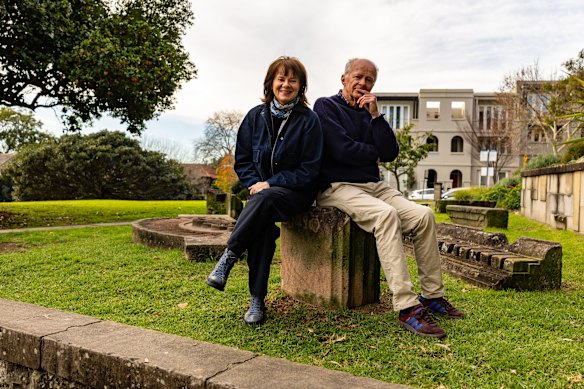

Carrie Tiffany was anxious when she flew from Melbourne to visit the artist Noel McKenna at his Sydney studio. “I’m always nervous about meeting people for the first time and he’s someone I hold in high regard,” she says. “The first thing we did was talk to the dogs, and then we went out to the balcony to look at the butcherbird. So we were slightly communicating through the animals.”
This was the ideal introduction for two animal-loving, creative introverts. “We’re definitely not out there,” says the laconic McKenna. They were collaborating on Tiffany’s new book, The Lady with the Dog, which tells the story of an old woman with dementia whose confusion and loss of language are filtered through an old dog. Words and images travelled in quiet dialogue between Tiffany’s house by the Yarra river and McKenna’s home-studio at Rose Bay.
She has always written about odd but ordinary characters and their animals in exquisite short novels: Everyman’s Rules for Scientific Living (2005), Mateship with Birds (2012) and Exploded View (2019). At just 10,000 words, the new one is described by her publisher as a novella and by Tiffany as “possibly an imaginative biography”, based on her own mother’s experience.
“I’m a miniaturist in all things and the big world annoys me,” she says. “I’ve always looked at things close up. For me it’s very difficult to do something in a story that is wholly original. We’re all working on the seven plots. But it’s exciting what you can do in a sentence that is completely in and of itself, and you can put it next to another sentence and create these strange juxtapositions and reverberations.”
McKenna’s ink drawings perfectly fill out the 100-page hardback book and the spaces in the woman’s mind that words can’t express. “We’re both sort of distilling complicated things to make the essence,” he says.
McKenna, too, is a celebrated artist of everyday domestic life with a timeless nostalgia and gentle humour. He paints lone figures in sparse rooms shared with cats, dogs, birds and horses. He listens to music – Talking Heads or Michael Jackson – and his old dogs, Melman the greyhound and Rosie the Jack Russell terrier, are always nearby. The National Portrait Gallery paired McKenna with the 20th-century artist John Brack for a recent exhibition highlighting their wry social commentary. Another recent show in Sydney was titled Memory.
Tiffany has a strong visual sense and has written essays about contemporary artists. Like McKenna, she admires the assemblages of American artist Joseph Cornell and they both make collages. She first saw McKenna’s art – in an image of a racehorse – on the cover of Gerald Murnane’s essay collection Invisible Yet Enduring Lilacs. Her partner, the New Zealander writer Lloyd Jones, gave her a painting by McKenna called Fish Talking to Horse. McKenna was the artist she wanted to work with on her book.
“I read the story at different times and I could see images coming,” McKenna says. “There were connections with me, with my brother having Alzheimer’s, with the dog, and there’s a black stove mentioned quite a bit. I immediately thought of this outsider artist in America called James Castle who was a deaf mute and spent his whole life making drawings, mainly with soot and spit. I love his work, and that got my interest.”
By chance, there have been seven-year gaps between all Tiffany’s books, which have won many awards, including the first Stella Prize, and twice she was shortlisted for the Miles Franklin. She has always written slowly, while raising her daughter and son, and working with farmers and environmentalists as editor of Landcare magazine.
Now she is a full-time lecturer in English and creative writing at La Trobe University. She has a new grandchild and travels between Melbourne and Auckland with Jones, whose home is on Waiheke Island. They married there two years ago after being separated by the pandemic. (Reading Madame Bovary together on Zoom helped to connect them.)
COVID also brought worse complications. Tiffany grew up in Perth with her mother, brother and stepfather, and left at 16 to work as a park ranger in the Northern Territory. She felt a terrible mixture of guilt and relief at not being able to visit during Western Australia’s two-year border closure.
Her mother had been diagnosed with Alzheimer’s and, wanting a small dog for company, ended up with Sally, “a smelly old German shepherd”. Her stepfather had built a “Colditz-style fence” around the property to prevent them from wandering. The phone was the only link between mother and daughter. “I would always start our phone conversations with ‘How is the dog?’ It seemed to be the main way that we could say something to each other. In the last few weeks we would have some sweet, strange conversations, and often when the noun was missing I would insert ‘dog’. So we had a lot of strange conversations about dogs.”
By the time Tiffany caught the first possible plane to Perth, her stepfather had suffered a near-fatal heart attack and been taken to hospital, and her mother had been admitted to a psychiatric hospital. All she could do was be with them as they died; first her stepfather and, weeks later, her mother. He had done his stoical best to look after her in their grim isolation.
She found the dog another home and cleared the house, which was cluttered with meaningless piles her mother had placed in every room: bank statements, pegs, jelly beans, dentures, cake forks, coins, Christmas decorations. Angry with the West Australian government for sacrificing vulnerable old people to a hardline policy, she thought about writing something for a newspaper. “But perhaps I’m not that sort of writer,” she says. “I always need distance to make sense of things. About a year later I realised I wanted to write about her confusion and about the dog.”
While cleaning the house she had re-read Anton Chekhov’s short story The Lady with the Dog, about a banker who falls in love with a young woman he sees with her little dog, and their adulterous affair. Tiffany sees her novella as an oblique homage to Chekhov’s sad love story.
“I realised that I was thinking of that fateful woman as my mother, and I felt that her life had been fateful,” she says. “Things happened to her when she was a young woman that really set things in stone for her and made her life much more constrained and difficult as she got older. This played into her dementia in ways I felt awful about because I think a lot of the time she was trapped in autobiographical memory.”
Tiffany’s story was even shorter until she added some of her mother’s memories of being sent to live with her grandmother after her father returned from war, her early unhappy marriage, and the dogs scattered throughout her life. Also, she says, “for a writer, the thing that happens in language is fascinating – the gap where the word doesn’t exist can be quite poetic because it can let all this other meaning flow into that gap”. The woman in the story scrambles her words, speaking of her “pressing gown” and “snifferchiefs”.
The pages have dashes, empty spaces and McKenna’s drawings. They show the woman and dog circled by a fence, and the woman with a question mark; the dog watching a spider, or a huge, pointing finger. Most disconcerting are an upside-down clock and two clocks with different times. Doctors ask people with dementia to draw a clock face, and their jumbled numbers can be “heartbreaking but also beautiful”, Tiffany says. “They seem to be denying time, which is the thing you don’t have when you have Alzheimer’s.”
Much of the work on Tiffany’s short books is beneath the finely honed surface. But there may not be a seven-year wait for the next one. She has almost finished a novel partly inspired by the Canberra artist Rosalie Gascoigne’s timber triptych Suddenly the Lake.
“It’s about an older couple and I think it’s an erotic novel,” she says with amused shock. “We’ll see.”
The Lady with the Dog by Carrie Tiffany (NewSouth) is out now.
What else is happening in the book world?
The Booklist is a weekly newsletter for book lovers from Jason Steger. Get it delivered every Friday.
 Susan Wyndham is a former literary editor of The Sydney Morning Herald. She has been a reporter, feature writer, Good Weekend editor and a Herald deputy editor. Today she is an author, writer and arts commentator.Connect via X.
From our partners
Disclaimer : This story is auto aggregated by a computer programme and has not been created or edited by DOWNTHENEWS. Publisher: www.smh.com.au