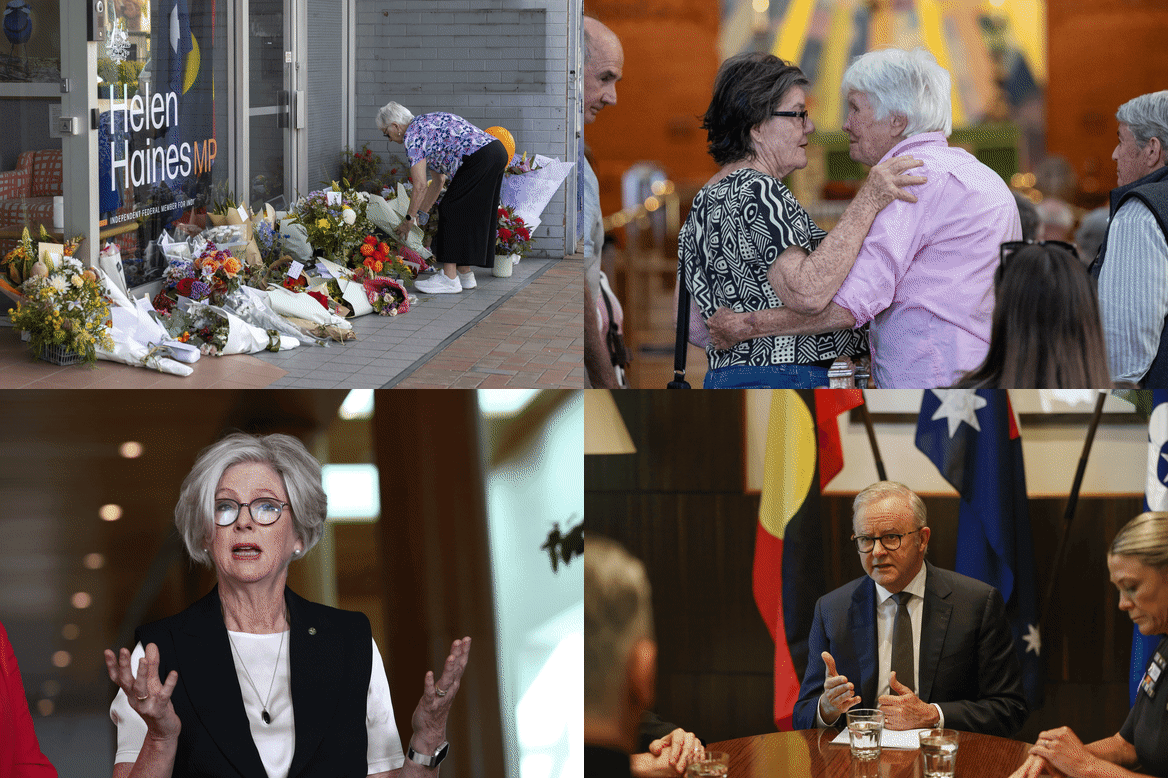
The grotesque and senseless attack on Helen Haines is a tragic reminder of the vulnerability of Australian democracy to the growing viciousness that seems to be coursing through our national life.
A politician of palpable integrity, the independent federal MP for Indi was severely injured after being struck by a vehicle outside her north-eastern Victorian electorate office in Wangaratta on Monday afternoon. She has lost one leg and surgeons are attempting to save the other.
Local man Brendan Nugent is being questioned by police, who are treating the incident as isolated.
The outpouring of sympathy for Haines, who is held in deep affection and widely admired as the most respected politician in parliament, is matched by deep concerns about the trajectory of political violence. Australia joins other nations in grappling with rising incivility, increasingly hostile political discourse and a surging number of threats against elected leaders.
Thankfully, violent physical attacks against Australian politicians are a rarity. We are a nation more used to verbal aggression, public demonstrations and eggings as the preferred forms of political protests.
But not always. In June 1966, federal Opposition Leader Arthur Calwell survived an assassination attempt with a sawn-off shotgun outside Mosman Town Hall in Sydney; 28 years later, NSW state Labor MP John Newman was shot dead outside his Cabramatta home. Calwell’s attacker suffered mental illness, Newman’s hit was organised by a political rival. Both were sentenced to life.
Haines is neither a polarising presence nor a factional heavyweight. Rather, she personified the best and fairest in Australian public life since she replaced the retiring pioneer of the community independent movement Cathy McGowan seven years ago. Haines was also pivotal in the establishment of the National Anti-Corruption Commission.
With personal attacks now seemingly creeping into the political realm, the Wangaratta incident has alarmed state and federal MPs, who have been subject to increasingly threatening behaviour. Since national security investigation teams were launched in October last year, 41 people have been charged with offences relating to threats against federal MPs and high office-holders. Victoria is already contemplating increased security at next month’s state election.
Albanese recently spent weeks away from his Sydney residence as the government bolstered security and built a blast-resistant safety bunker in Kirribilli House, with 20 ongoing court cases regarding threats to the prime minister. Liberal MP Andrew Hastie received major security upgrades to his home and office because of threats against him.
ASIO director-general Mike Burgess identified the change in our national life when he said Wangaratta had occurred in an environment where increased levels of grievance, intolerance and polarisation had made violence seem permissible, and politically motivated violence more likely.
“ASIO has seen direct correlations between inflamed language, inflamed tensions and acts of violence. I genuinely believe the temperature of our security environment would be several degrees lower if we recommitted to conversing with civility, debating with respect and disagreeing with restraint,” Burgess said.
While politicians generally have a poor reputation with the public, most enter public life to make a difference and make Australia better, even if they disagree on how to do that. It is a difficult job that requires hard work, constant scrutiny and personal sacrifice. Australia’s democracy is dependent on people willing to do that job. Attacks such as this will make that pool smaller. This is a particular problem for women, who seem disproportionately targeted.
Research by nonpartisan not-for-profit organisation Women for Election reveals that almost 90 per cent of female politicians had experienced gendered online abuse, with more than half reconsidering their positions in public office.
NSW Agriculture Minister Tara Moriarty has reported threats to her following a feral pig program announcement, while NSWOpposition Leader Kellie Sloane deactivated her X account after abuse for criticising a neo-Nazi protest last November.
The Wangaratta attack has prompted diverse responses from MPs, including a call to scrap question time in parliament to reduce violence directed towards politicians and their staff.
One of the defining characteristics of Australian politics has been to allow individuals to disagree with respect and not hide politicians behind security.
Being able to approach local MPs in the street is a vital part of our democracy. It helps keep politicians in touch with their communities, a casual and traditional freedom that should not be surrendered to violence or fear.
Politicians are entitled to do their work in safety. On this dark day for Australian democracy, it is incumbent on politicians of all stripes to lead by example and counteract what Burgess describes as violent rhetoric with a civil, sensible and constructive national conversation.
The nation is united behind Helen Haines and her family.
 The Herald’s View – Since the Herald was first published in 1831, the editorial team has believed it important to express a considered view on the issues of the day for readers, always putting the public interest first.
From our partners
Disclaimer : This story is auto aggregated by a computer programme and has not been created or edited by DOWNTHENEWS. Publisher: www.smh.com.au