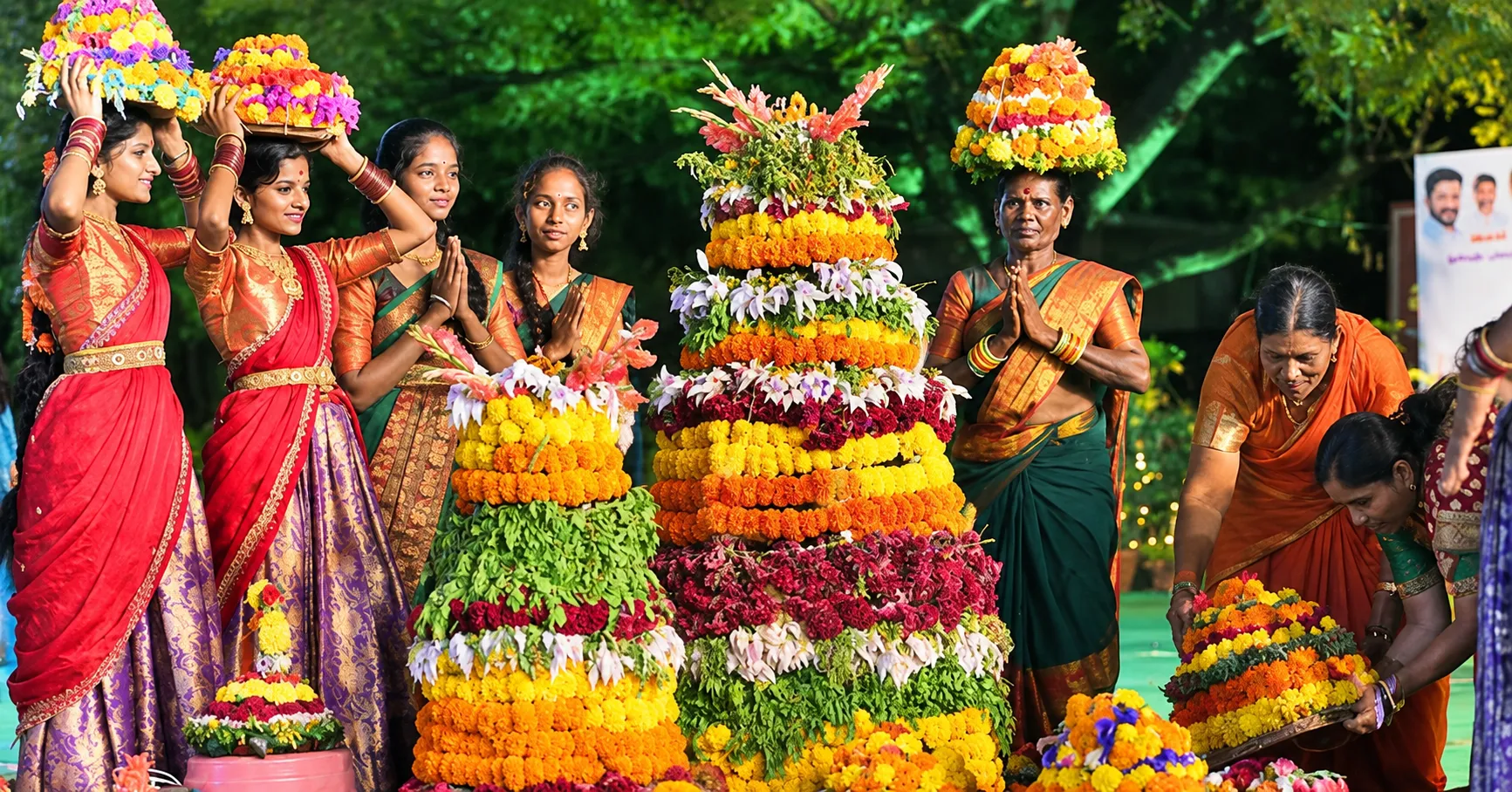
Every year, as the monsoon retreats from Telangana’s parched plains, women wake before sunrise to gather wildflowers that bloom nowhere else in quite the same way, stacking them into towers shaped like temple gopurams.
The ritual is called Bathukamma, and while it now draws crowds from Los Angeles to London, its earliest echoes lead back roughly 800 years, to the fort city of Warangal and a queen who governed disguised as a king.
A queen’s devotion becomes a kingdom’s memory
The Kakatiya dynasty ruled large parts of present-day Telangana through the 12th and 13th centuries, with their capital at Orugallu, known today as Warangal. Their reign left behind some of the Deccan’s finest architecture, including the Thousand Pillar Temple, built in 1163 under King Rudradeva, and the Ramappa Temple, completed in 1213 and now a UNESCO World Heritage Site.
It was Rudradeva’s descendant, Rani Rudramadevi, who became part of one of the enduring stories associated with Bathukamma. Ganapatideva, her father, had no son, so he formally designated her as his male heir through the putrika ceremony and gave her the name Rudradeva.
She took the throne around 1262, ruled in male attire, put down rebellions from nobles who resisted a woman’s authority, and strengthened the Warangal Fort her father had begun.
Historical tradition credits her with promoting the worship of Kakatamma, a regional mother goddess, particularly around Mogilicharla, where grand processions were held on Durga Ashtami, complete with music, dance, and the ceremonial immersion of the deity in nearby water.
That closing ritual has often been cited as one thread in the long history of Bathukamma: flowers offered to water and a prayer for their return the following year echo the symbolism of what is now Saddula Bathukamma, the grand finale of the nine-day festival.
But Rudramadevi’s story is not an uncontested founding account of Bathukamma. Historians and scholars have also traced the festival to older local agricultural, seasonal and feminine fertility traditions, some of which may predate the Kakatiyas.
The Kakatiya-Rudramadevi connection is therefore one of the historical memories woven into the festival’s story, rather than a definitive origin.
Historians admit the precise origin remains genuinely contested, but the Kakatiya connection is the version sung most often in Bathukamma’s own folk songs.
It is this layered history that leads many in Telangana to call Warangal the symbolic birthplace of Bathukamma, even as other folk traditions, including stories involving a Chola king’s daughter and goddess Parvati, circulate alongside it.
Flowers that follow the rains
Whatever its exact origin, Bathukamma is unmistakably a festival of the land. It begins on ‘Mahalaya Amavasya’ and runs for nine days until Durga Ashtami, tracking the seasonal shift from Varsha Ruthu, the monsoon, to Sharad Ruthu, autumn.
/filters:format(webp)/english-betterindia/media/media_files/2026/09/21/3-2026-09-21-12-28-15.jpg)
As the rains recede, wild and largely medicinal flowers bloom across Telangana’s uncultivated plains, chiefly gunuka and tangedu, alongside banti and chamanti.
Men and boys gather these blooms each morning, and women arrange them into seven concentric layers resembling a temple gopuram, crowned with a small turmeric idol called Gauramma.
Each of the nine days carries its own food offering, from sesame and rice on the first day to a rich, sweetened rice preparation on the last, and every evening the flower stack is carried in procession, sung to in call-and-response folk verses, and finally immersed in a pond or lake.
This closing act depends entirely on Telangana’s older water culture: the region’s dense network of tanks and lakes was originally built to trap monsoon runoff for farming, a legacy so tied to local memory that a lake in Hyderabad’s Amberpet still carries the festival’s name.
Many of these water bodies, strained by decades of urban growth, are now being nursed back to life by community-led efforts that echo the same ecological instinct Bathukamma has carried for centuries: give back to the water what it once gave you.
From village courtyards to a state’s identity
When Telangana became India’s 29th state in 2014, its government declared Bathukamma, alongside Bonalu, an official state festival on 26 June, 2014.
Since then, the state has funded free sarees and large public celebrations, and Bathukamma has grown into an emblem of Telangana identity celebrated well beyond its borders, among diaspora communities in Dubai, Qatar, the United Kingdom, the United States and Australia.
That instinct to keep an old practice alive through new hands runs through much of Telangana’s culture. In Cheriyal, a handful of Nakashi artist families still hand-paint the scroll paintings that once accompanied travelling storytellers narrating exactly the kind of oral folklore Bathukamma’s songs preserve.
/filters:format(webp)/english-betterindia/media/media_files/2026/09/21/3-2026-09-21-12-36-44.webp)
Around Pochampally, weavers whose craft was transformed by the Laxmi Asu Machine, invented by a school dropout to spare his mother’s aching joints, show how tradition survives by adapting rather than standing still.
And as concerns grow nationally over flowers dumped into rivers after festivals, entrepreneurs elsewhere are already turning discarded blooms into incense and dye rather than letting them pollute the water, a shift Bathukamma’s own communities are beginning to consider for their post-immersion flowers too.
This year, Bathukamma runs from 11 October to 18 October. As it has for generations, the festival will unfold as women’s private history made public: songs never written down, carried instead from mother to daughter, filling Telangana’s streets, courtyards and lakesides with colour that, if the Kakatiya-era memory holds, has been blooming there for the better part of a millennium.
Sources
‘Historical traditions link Bathukamma to Kakatiya-era worship of goddess Kakatamma at Mogilicharla’: Orugallu Andhalu, Published 18 March, 2026
‘About Bathukamma‘: Government of Telangana, Official Bathukamma portal
‘How Bonalu festival has become an empowering space for trans women in Telangana’: Written by Jagadish Babu for The News Minute, on Bonalu and Bathukamma being awarded state festival status on 26 June, 2014
Disclaimer : This story is auto aggregated by a computer programme and has not been created or edited by DOWNTHENEWS. Publisher: thebetterindia.com