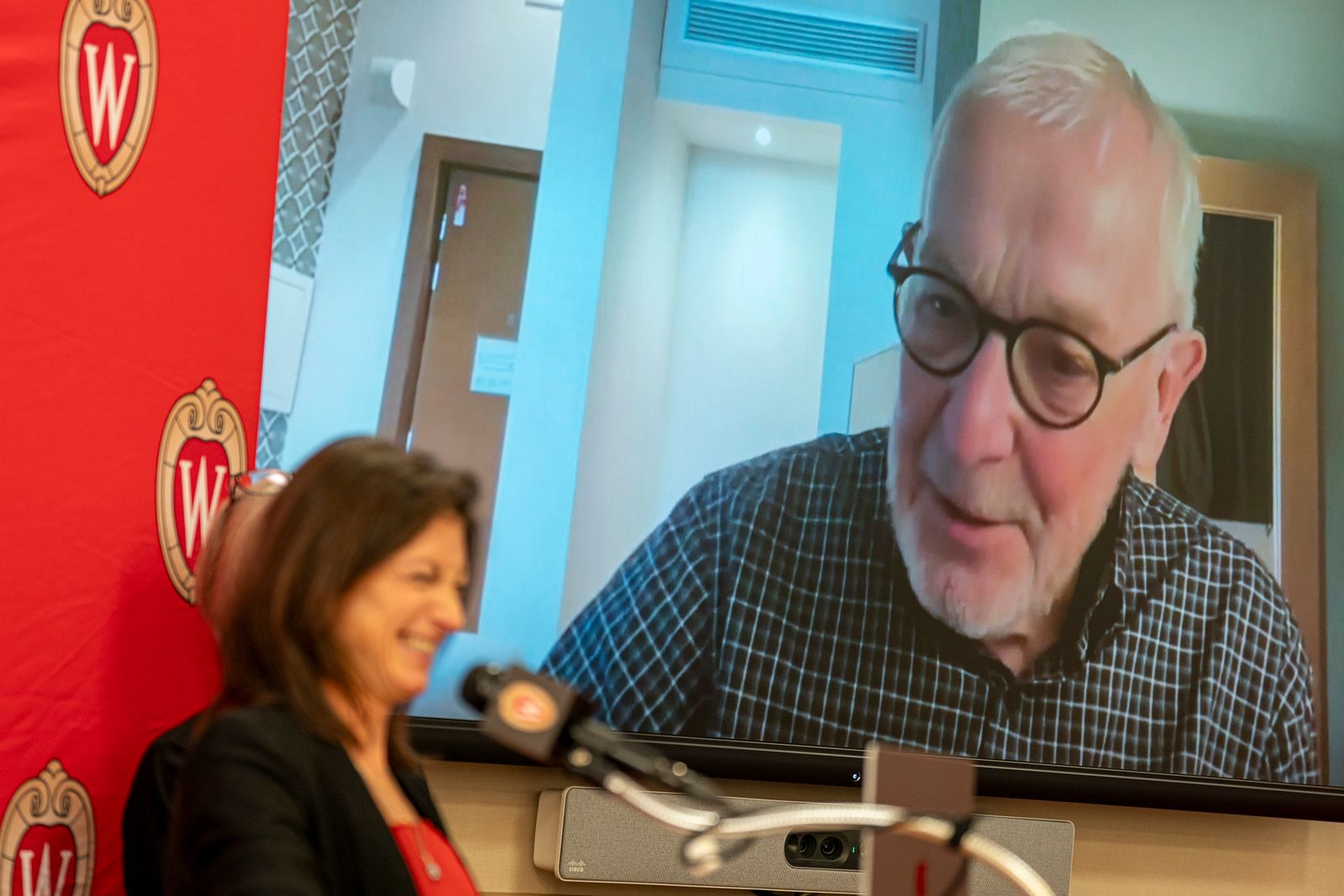
“for some reason, I woke up at 5:30, and the first thing I did was go to the New York Times website to check the headlines,” Juan Carlos Díaz Vélez recalls of the previous morning. “To my great surprise, there was a breaking news story: Francis Halzen had just been awarded the Nobel Prize in Physics. I immediately started sending messages, only to discover that my colleagues in Europe had found out long before I did.”
Juan Carlos Díaz Vélez works at the Wisconsin IceCube Particle Astrophysics Center at the University of Wisconsin–Madison. The new Nobel laureate is his boss.
“When I arrived at the WIPAC offices, everyone was smiling and congratulating one another,” Díaz Vélez says. “We gathered in the conference room to watch the press conference with Francis Halzen, who was in Italy at the time attending a conference. We’ll wait for his return to celebrate, and in the meantime, we’ll keep working on the neutrino study, because this work never ends.”
That work is detecting an elusive particle using detectors inside a big block of ice.
“Neutrinos are subatomic particles that participate in reactions within the nuclei of atoms,” Díaz Vélez explains. “They are produced by radioactivity on Earth—and even in watermelons and bananas, due to their potassium-40 content—as well as in our own bodies.”
Not that any of us notice. These particles do not interact easily with matter. As their name suggests, neutrinos have no electric charge, so they can travel through space in a straight line without being affected by magnetic fields, and they constantly pass through the entire Earth without interacting with a single atom. “Neutrinos from the sun are so abundant that 1 billion of them pass through the nail of a thumb every second,” Díaz Vélez says.
The neutrinos studied by Halzen’s team are not the run-of-the-mill particles we’re encountering constantly—if unknowingly. They are interested in very high-energy neutrinos that come from deep space. These cosmic particles may originate from supernova remnants or even black holes. The intense magnetic fields of such phenomena can accelerate particles like protons to very high energies.
“When these particles collide with the interstellar medium—which consists of gas and plasma—they produce gamma rays and neutrinos,” Díaz Vélez says. “That is why neutrinos are perfect messengers from high-energy cosmic-ray sources. The highest-energy neutrino sources we have detected come from active galactic nuclei, which contain supermassive black holes.”
And the team Díaz Vélez is part of has detected such neutrinos at a facility located at the geographic South Pole known as the IceCube Neutrino Observatory—no relation to the famous rapper. The observatory contains an array of 5,160 optical sensors buried deep underground, covering 1 cubic kilometer of ice.
“The South Pole ice sheet is very transparent at a depth of 1.5 kilometers, so the sensors can detect the light produced by subatomic particles called muons, which are generated as a result of rare interactions between neutrinos and ice atoms,” says Díaz Vélez, who also participated in the construction of IceCube in 2010. The observatory began operations the following year.
The project’s first major discovery was the detection of neutrinos from astrophysical sources outside our solar system. One of the most notable sources was TXS 0506+056, located in collaboration with other observatories that collected various gamma-ray, optical, and radio signals. TXS 0506+056 is a high-energy blazar, a galaxy that appears extremely bright and revolves around a supermassive black hole. The researchers looked for other objects with similar characteristics and confirmed that this class of sources is capable of producing high-energy neutrinos. More recently, they have been able to observe the Milky Way as a diffuse source of neutrinos.
In addition to astronomy, IceCube has made significant contributions to our understanding of the nature and behavior of these particles. For example, there are three known types of neutrinos, and last year’s Nobel laureates in physics discovered that these particles can transform from one type to another as they travel. IceCube has enabled increasingly precise measurements of this phenomenon.
“Another area of research is cosmic rays, which is what I focus on,” says Díaz Vélez. “We have discovered that they do not come uniformly from all directions but rather from preferred directions, and this tells us about the distribution of their sources in the galaxy.”
Cosmic rays consist of protons and nuclei of heavier atoms, and they constitute a very high portion of the project’s data. “Detecting a neutrino is like looking for a needle in a haystack,” the researcher says. “For every neutrino IceCube detects, more than a million muons produced by cosmic rays are detected.”
Díaz Vélez serves as the product coordinator for the IceCube collaboration, overseeing the processing of experimental data and the production of simulations. “This involves calculating the direction of arrival, the energy, and the type of particle detected every two milliseconds,” he says. “We also need to simulate cosmic rays and neutrinos at comparable rates. Both tasks require high-performance computing networks distributed around the world, totaling approximately 10,000 CPU cores and 1,000 GPUs.”
The researcher notes that while the IceCube project is based in Antarctica and headquartered in Wisconsin, it’s an international collaboration of 450 people at 58 institutions across 14 countries. Many of those involved in the work are masters and doctoral students, and although the award bears only one scientist’s name, behind that name lies the work of dozens of colleagues.
“It’s worth mentioning that Francis is a great figure and a leader but also a very friendly and generous person,” says Díaz Vélez. “In general, we see him more as a colleague than as a boss. In fact, if it weren’t for his passion and dedication, this experiment would never have been successful.”
This story originally appeared in WIRED en Español and has been translated from Spanish.
Disclaimer : This story is auto aggregated by a computer programme and has not been created or edited by DOWNTHENEWS. Publisher: wired.com