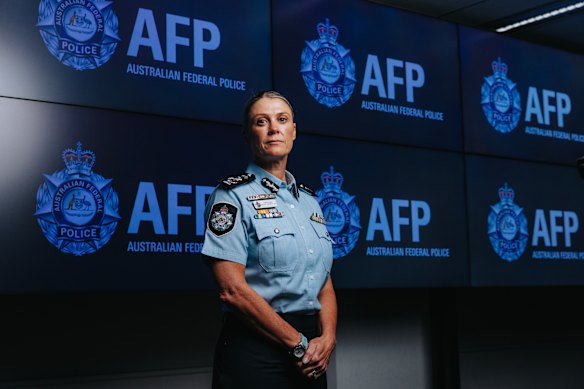

The Australian Federal Police will expand its overseas operations into more countries to target offshore organised crime figures orchestrating violence in Australia, as it works to keep pace with evolving criminal methods being enhanced by artificial intelligence and emerging technology.
AFP Commissioner Krissy Barrett will this month travel to Japan to meet with law enforcement counterparts as part of efforts to strengthen diplomatic ties with the country – a key partnership for Australia in the Pacific and South-East Asia.
In a wide-ranging interview marking a year since her appointment as the AFP’s first female commissioner, Barrett identified Sayit Erhan Akca, the alleged orchestrator of a hoax terror plot purportedly targeting Sydney’s Jewish community, as the agency’s number one overseas target.
“He still remains a high-value target for me,” Barrett told this masthead.
The discovery of an explosives-laden caravan in Dural, on Sydney’s north-western fringe, last January sparked fears of a potential attack on the Jewish community amid increased antisemitic attacks across the city. Notes found in the caravan led authorities to believe that several locations in Sydney, including the Great Synagogue, would be targeted.
Authorities believe Akca, who has been living in the Middle East and Asia since fleeing Australia on drug importation charges in mid-2023, orchestrated the plot in an attempt to leverage a return to the country.
Akca previously told the ABC that he offered the cache of explosives to authorities in exchange for a reduced sentence and for his bail to be reinstated if he returned to Australia.
“What he did in terms of taking advantage of a very fearful, vulnerable, wounded Jewish community at that time … and using that and praying on that, I mean, that’s absolutely reprehensible,” Barrett said.
“So he is absolutely one of my targets.”
Barrett said a major focus in the next 12 months was expanding the AFP’s global operations, including deploying more officers overseas to disrupt organised crime networks targeting Australia.
“How do we intervene earlier? That is much cheaper for us. It’s much quicker for us, and it’s much safer for us as a country to do it that way,” she said.
Targeting offshore criminal ringleaders orchestrating violent conflicts in Australia has become increasingly challenging for authorities, who are unable to apprehend high-value targets living in foreign jurisdictions beyond the reach of Australian law enforcement agencies.
One of Barrett’s top priorities in the year ahead is leveraging relationships with foreign partners to stymie the influence of organised crime figures operating in countries where extradition to Australia is unlikely, including that of exiled tobacco kingpin Kazem Hamad, who was this year sentenced to life imprisonment in his home country of Iraq.
“We have capabilities that no other law enforcement agency has. We have reach, we have access that no other law enforcement agency has,” Barrett said.
“This is where I’ve really challenged the workforce today. We need to really lift in terms of how we are using those unique capabilities that we have.”
Several of the AFP and NSW Police’s highest priority targets are believed to be living in the Middle East, South-East Asia and Europe, including members of Sydney’s Alameddine crime family, and rival group the Coconut Cartel.
As the AFP explores where its resources are best utilised, Barrett said Japan’s strategic positioning in South-East Asia and the Pacific offered an opportunity for Canberra and Tokyo to combine efforts to impact crime in the regions.
“That goes beyond operational law enforcement, talking regional stability and regional security and sovereignty,” Barrett said.
The Pacific has emerged as a key focus for the AFP during the first year of Barrett’s tenure as the region is increasingly targeted by organised crime networks trafficking illicit drugs into Australia via vulnerable island nations.
Barrett wanted the AFP to adopt an aggressive, front-foot approach to defending Australia and its future from domestic and global security threats, she said.
Another of Barrett’s key focuses is protecting children from exploitation, abuse and radicalisation, including by sadistic online networks increasingly targeting young Australians.
“We’re just seeing a growing caseload of young victims and perpetrators in that tech-enabled crime space,” she said.
Barrett raised concerns about research findings from the Australian Cybercrime Observatory, published in July, that found young victims of online sexual exploitation were more likely to seek help from artificial intelligence platforms than authorities.
“Parents and caregivers need to know that this is happening and I urge them to have conversations with their children about coming forward to a trusted adult, including law enforcement, if they are being sexually exploited online, so the appropriate help and support can be provided,” she said.
Combatting organised crime networks’ use of emerging technologies and artificial intelligence to streamline and upscale their drug trafficking operations is another challenge facing authorities, Barrett said.
“Tech-enabled crime used to be sort of constrained to a few crime types,” Barrett said. “Now everything we investigate, there is a tech aspect to it.”
The AFP’s traditional operating method – which Barrett described as siloed – is no longer the best practice to investigate and disrupt organised crime, she said. Increasingly blurred lines between criminal groups now collaborating to orchestrate large-scale drug imports required the agency to restructure its approach to international organised crime.
“We need to be more dynamic in how we do that,” Barrett said. “We need to continue to evolve.”
Start the day with a summary of the day’s most important and interesting stories, analysis and insights. Sign up for our Morning Edition newsletter.
From our partners
Disclaimer : This story is auto aggregated by a computer programme and has not been created or edited by DOWNTHENEWS. Publisher: www.smh.com.au