
“Let me show you a picture of my grandmother,” Isabel Allende says.
She disappears for a moment from her office into her house in Marin County, near San Francisco. Then she’s back, her scarlet blazer and marbled scarf bright against the white walls. She holds up a sepia photograph in a silver embossed frame: the clairvoyant Isabel Barros Moreira, her mother’s mother, her face placid, with dark hair and dark eyes.
The creators of the new series adaptation of Allende’s landmark book “The House of the Spirits” — the first three episodes premiere Wednesday on Prime Video — had not seen this photograph, but her grandmother could very well be one of the actors, Allende says. Many of the characters in “The House of the Spirits,” Allende’s 1982 debut novel, are modeled after members of her family, including her grandmother, grandfather and mother. The story, known for its suffusive magical realism, follows three generations of the del Valle Trueba women through the turbulent history of a conservative South American country, inspired by Allende’s Chile.
So when the author watched all eight episodes — she is an executive producer but entrusted the showrunners with adapting — one of the first thoughts flying through her mind was how much the actors looked like she imagined them. It stands in contrast to the 1993 film adaptation that starred Meryl Streep and Jeremy Irons as the characters loosely based on Allende’s grandparents. (She has said previously that the movie was a product of its time; people weren’t used to subtitles then.)
But this “House of the Spirits” is the first Spanish-language onscreen adaptation — and the first television adaptation, for that matter — and it’s helmed by three Chilean showrunners: Francisca Alegría, Fernanda Urrejola and Andrés Wood. It marks the fourth major project in the creative partnership between Alegría and Urrejola, and they’ve long dreamed of someday adapting something by the author.
“It was kind of magical realism, in a way, because we were looking to adapt some of Isabel Allende’s novels, but we never imagined ‘The House of the Spirits,’” Urrejola says.
The reason was because someone else already had the rights: the entertainment company FilmNation. But in June 2020, FilmNation asked Alegría and Urrejola to adapt the title, and they set out to compile the show bible, including the script of the first episode, the arc of the whole season, and the fact that it would be shot entirely in Chile.
When Allende watched the show, she was struck by the landscapes of the country — the vast desert, verdant forests and farmland, snowcapped peaks — its authenticity and flavor. “I saw what it always should have been,” she said in September at a series announcement event in Santiago.
After Alegría and Urrejola began developing the project, Wood joined as co-showrunner and director. (Urrejola also plays the adult Blanca Trueba.) Wood said he read “The House of the Spirits” for the first time when he was 15 or 16 in 1983, under the dictatorship of Augusto Pinochet, which Allende had fled eight years prior. The book was forbidden then, and the dictatorship threw the political storylines into stark relief.
More than 40 years later — highlighted by Alegría and Urrejola’s framing — different aspects stand out to him now. “It’s this kind of book, in a way, that [is] classic,” Wood says. “And they are classic because they allowed us to reread it, and they speak in the present. That’s magic.”
It’s why this series is so important right now, he adds: “Because now we are in a moment of crisis, of people saying that we want to annihilate society,” and not just saying that, but acting on it. “We are watching a lot of atrocities [in real time].”
This particular adaptation bookends the story with the character Alba (played in young adulthood by Rocío Hernández), the granddaughter of the clairvoyant matriarch Clara del Valle (played in older age by Dolores Fonzi) and the conservative, volatile patriarch Esteban Trueba (Alfonso Herrera). The first episode opens with Alba, bruised and battered, returning to her grandparents’ home, the house of the spirits, to piece together what led to her present state.
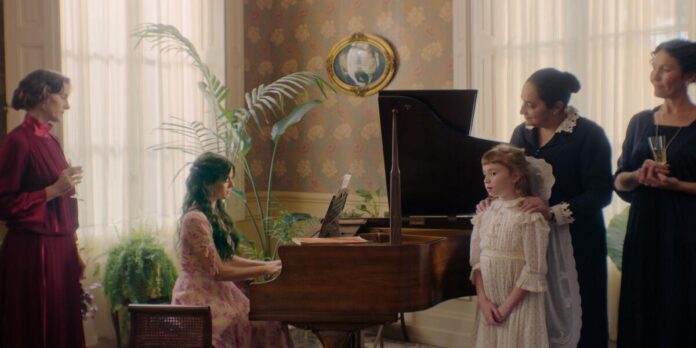
Rosa (Chiara Parravicini) and young Clara (Francesca Turco) in “The House of the Spirits.”
(Diego Araya / Prime Video)
“That’s why we choose to start with Alba, who is the granddaughter that is able to start her healing process by understanding her family history,” Urrejola says. “It’s all about memory. It’s all about bringing back what happened before in order not to reproduce the same mistakes or to learn and to also understand why things happen. Nothing comes from nothing.”
Memory, in this story and elsewhere, serves as a tool for healing and change; Allende herself found catharsis in the act of writing the book. In 1981, when Allende was writing “The House of the Spirits,” she was working as an administrator at a secondary school in Caracas, Venezuela, where she was living in exile, blacklisted by Pinochet’s government after arranging safe passage for refugees. She was working 12 hours a day, going through a host of changes: Her marriage was collapsing, she was about to have an empty nest and was about to turn 40. She was feeling frustrated, angry, empty.
“Writing the book, at night and on the weekends, gave me a purpose, kept me engaged and focused, entertained — remembering, remembering, trying to put everything in there,” she says. “And at the end, I felt that I had it. I had my past, my family, my country, my home there. It was like a brick, and I had it. So there was a sense of: It was not going to be lost. I do have roots. I do have memories, and they are here in these pages.”
“The House of the Spirits” spans half a century, including the coup that replaced a socialist president with a military dictator, based on Salvador Allende and Augusto Pinochet, respectively, though neither are ever named. (Salvador Allende was Isabel Allende’s father’s cousin.) After the coup — in the story and in reality — opponents, civilians and those deemed suspicious were regularly kidnapped and tortured. To better understand what those people went through, the showrunners interviewed several female survivors who experienced torture under the regime.
“Even in the worst, most dark places, these women found humor, and these women found love,” Alegría says. “We always found what Isabel Allende talks about. … That within tragedy, there’s going to be love, within passion there’s going to be pain. … And that work of actively searching in our memory, in our country’s memory, in these women’s memories, was very important for us.”
More than 40 years and 30 books later, Allende’s work loops through the same themes like stitches in a tapestry: family (both blood and chosen), resilient women, the terror of absolute power and violence, but mostly love — love of a place, of a country, of justice, the love of women for other women. These are the same aspects of “The House of the Spirits” that remain most relevant today, Allende says. “And why are we saved, as humanity? Because of love.”
To adapt a hallowed and revered work of this scope, across decades and generations, brimming with magical realism, was, of course, daunting for the showrunners. To ground themselves, they returned often to the warm lifeblood of the story: the relationships, especially those between women, like that of Clara and her sister-in-law, Férula (Fernanda Castillo). Their relationship has no label, and Isabel Allende didn’t explicitly identify Férula as a queer character, but the subtext was there.
“We just have a beautiful, sensitive relationship between two women that in the adversity of living, of this violent world — represented by the man that is between them, in a way — they still find their own ways to give each other support and love, no matter what,” Alegría says. “When we look at each other through the eyes of compassion, we can dialogue, we can love, we can forgive, and we can treat each other as human beings.”
More to Read
Disclaimer : This story is auto aggregated by a computer programme and has not been created or edited by DOWNTHENEWS. Publisher: latimes.com


