
The NHS has been told it must become more resilient to increasingly frequent heatwaves supercharged by the climate crisis, as the UK government puts adaptation to extreme heat high on its agenda. But what other public services are already feeling the strain?
Transport
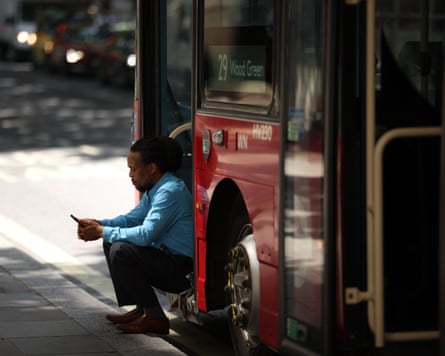
London bus drivers plan to go on strike later this month over their working conditions, as many have been experienced cab temperatures reaching close to 40C in the recent heat. Most London buses are fitted with air-flow cooling systems rather than air conditioning. Sadiq Khan, the mayor, has said drivers should not be working in unsafe hot conditions, but Arriva, the private operator, has said it will take time to update its fleet.
Rail services have also been disrupted as the shrinkage of soil due to the dry weather has made embankments unsafe in the south of England because sleepers, part of the tracks, can move or drop out of position. Heat can also warp rails, leading operators to impose lower speed limits for safety.
On the roads, the RAC has reported that breakdowns have soared by a fifth, often owing to engines overheating, or tyre blowouts on overheated road surfaces.
Farming and food
This year’s harvest could be the worst on record, analysis published on Wednesday found, as the third year running of drought in England left farmers with dry soil and damaged crops. Cereals and oilseed yields could be down as much as 2.5m tonnes across the UK, worth £390m in lost revenue for arable farmers, according to the Energy and Climate Intelligence Unit thinktank. Livestock farmers are also under pressure: grass growth has halved, forcing some to use feed they had hoped to save for winter.
This followed an unusually wet start to the year but most farms are not in a position to store water adequately on their farms. The Country Land and Business Association (CLA), representing landowners, is calling for planning reforms to make small reservoirs on farms easier, while some regenerative farming practices can also help to store more water on land.
If dry conditions persist into autumn, farmers will have further problems preparing for next year. Tom Lancaster, the food and farming analyst at the Energy and Climate Intelligence Unit (ECIU) thinktank, said: “At the start of spring, farmers were hopeful of a better year, but the dry April and July and record-breaking heat have left farmers facing down the barrel of a third awful harvest in a row.
“Farming is now the sector most exposed to climate change and the risks and damage that it brings. From the wettest winter on record in 2024, to the hottest summer in 2025 and now unprecedented heat and drought this year, we are in danger of UK farming entering a climate doom loop, as repeated impacts undermine the capacity of farmers to drill next year’s crop.”
As farmers have struggled, the price of fresh food has risen. The wholesale price of tomatoes is up by more than 60%, iceberg lettuce by 90% and potatoes by more than 40%. The outlook abroad is gloomy too, with a super El Niño increasingly possible, so relying on imports to make up the shortfall may bring more problems with it.
Working conditions
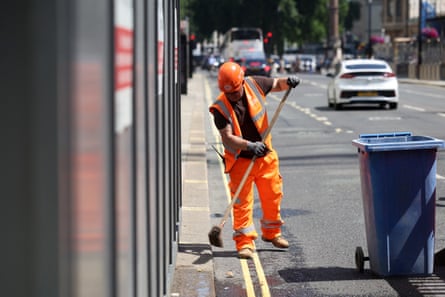
The UK does not have a maximum legal temperature for workers, and employees have struggled, particularly those working in poorly repaired public buildings. Court cases have been disrupted, with one judge in Bristol telling a jury in July they had to listen to a defendant through a virtual link because the dock was unusable in the heat.
Some public libraries that are already equipped with air conditioning are operating as “cool spaces” for communities. Maps can be found online showing where they are available.
Paul Nowak, secretary general of the TUC, told the Guardian: “After a summer of heatwaves, it is clear we need to adapt to the climate crisis.”
Employers need to keep staff working indoors and outdoors safe, with regular breaks or flexible working, proper equipment and access to water, he said, but legislation was also needed.
“As heatwaves become our new normal, we need to find ways to work and live with hot weather,” he said. “That means new laws on maximum working temperatures, adapting buildings and workplaces to keep them cool, and ambitious climate action to tackle the problem at its root.”
Schools
Pupils are off at the moment, escaping the stuffy classrooms that reduced some to tears in the summer term, but some of the inequalities in the UK’s education system continue: the Guardian revealed that private schools were continuing to water their lawns, despite hosepipe bans covering close to half of England and some of Wales.
The heat should be less severe when most return in September, but the Climate Change Committee has called for all schools to have air conditioning by 2050, and for a rethink of the traditional school year. It suggested that having exams in June may no longer be the most sensible way of arranging the academic timetable, given evidence that heat can affect pupils’ test performance.
Disclaimer : This story is auto aggregated by a computer programme and has not been created or edited by DOWNTHENEWS. Publisher: theguardian.com





