On a misty morning in May in south-west Washington state, Laura Oltmann, a 41-year-old dietitian, had barely clocked in when an unfamiliar overhead announcement echoed through the hospital.
“We get overhead pages for different types of emergencies. But this one, we don’t get very often,” recalled Oltmann.
Doctors, nurses and staff began guessing what could have happened. Perhaps it was a train derailment. Maybe a major highway crash. As the speculation grew, so did the uncertainty. Staff started calling one another. The answer shook them all. “Someone mentioned there had been an explosion at this plant, and that we were probably going to be getting some patients from there,” Oltmann said.
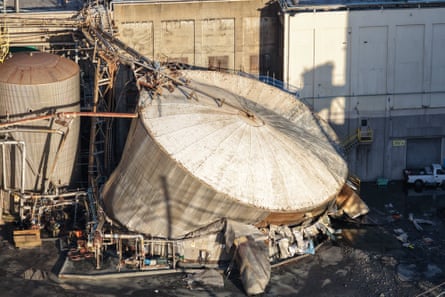
Forty miles south, in the port city of Longview, residents had awakened to a thunderous boom. At approximately 7.18am, as workers changed shifts at a paper mill company, Nippon Dynawave Packaging, a tank of white liquor, a caustic chemical used in the paper-making process, imploded. Hours passed with no explanation of what had caused it or how it could have happened at all, and suspicion began to brew.
With roughly a thousand people working at the mill, thousands more were waiting for a phone call. Parents called children. Wives called husbands. Grandparents called grandchildren.
“For those that did not get that response,” said Jeff Wilson, a Republican state senator representing Longview, who also sits as the port commissioner, “all they got was silence.” In the end, 11 people were killed in one of Washington state’s deadliest industrial accidents in nearly a century.
Nowhere was that impact felt more deeply than in Longview itself, a working-class city of about 38,000 people whose economy and identity have long been tied to the paper industry, shipping and logging. For generations, families have depended on the mills for their livelihoods. The disaster struck at something the city had long regarded as permanent: the mills where generations had gone to work, and helped many send their children to college or put down a down payment on a home.
The implosion rippled through nearly every corner of a community affected by mill closures and economic change. Those concerns will likely have an impact at the ballot box. As summer turned toward fall and the leaves along the Columbia River began to turn yellow, memorial services gave way to campaign rallies. The same communities that had gathered around grieving families were preparing for one of the country’s most closely watched House races in November.
Nearly two months after the implosion, on 8 July, Wilson still spoke first about the workers, the funerals he had attended, the families and the co-workers who ran toward danger looking for one another. He recalled brothers Tyler and Brad Covington, 27 and 29; he said: “They went to work together. And then they died together.”
Before entering politics, Wilson spent more than 23 years cleaning tanks at the Nippon Dynawave mill. In the aftermath of the tragedy, he worked routinely with Democratic congresswoman Marie Gluesenkamp Perez’s office as local, state and federal officials responded to the disaster, his role in Olympia intersecting with hers in Washington.
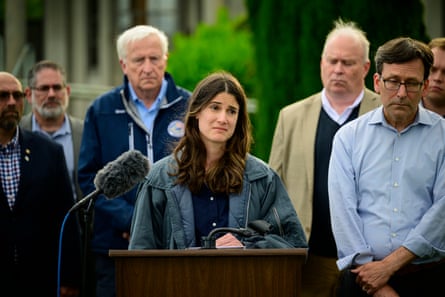
Though he declined to endorse her re-election, Wilson credited the Democratic congresswoman with being “present and accountable” and praised her for asking questions rather than “rubber-stamping anything”.
For a community divided by many of the same political forces pulling at the rest of the country, the disaster briefly created a sense of togetherness, as the whole community grieved the deaths of many of their neighbor and family members.
“Natural disasters will tend to bring people together,” said Mark Alan Smith, a political science professor at the University of Washington who studies American politics and religion. “It’s something people can unify around … across race and class and other divisions.”
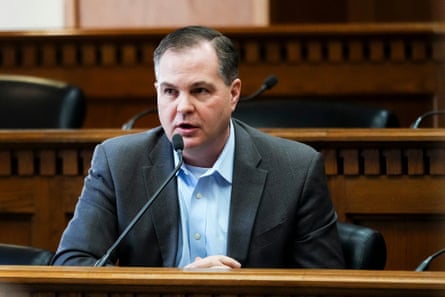
On 4 August, Gluesenkamp Perez and Republican state senator John Braun advanced from a field of nine to face off for the district’s congressional seat in November. Braun finished first with about 39.7% of the vote to Gluesenkamp Perez’s 36.4%. Brent Hennrich, the progressive Democrat who argued that Gluesenkamp Perez no longer represented many of her party’s voters, took 16.7%.
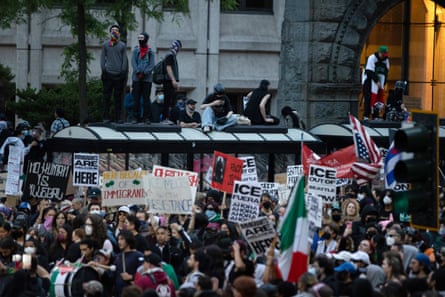
The results exposed the competing pressures facing Gluesenkamp Perez heading into the general election. Braun finished ahead of the incumbent, while Hennrich’s showing demonstrated the size of the progressive bloc she will have to contend with in November. Many of those voters remain angry over parts of her vote on the Safeguard American Voter Eligibility (Save) Act (which would require proof of citizenship to vote), ICE funding and a bill restricting how public schools address gender identity.
When asked about those direct criticisms of the congresswoman – whom many on the left feel has drifted from the party – her campaign responded with a written statement to the Guardian that cast her independence as the reason south-west Washington should return her to office. “DC has enough career politicians following national agendas,” said campaign manager Timothy Gowen. “Southwest Washington deserves an independent representative who delivers real results. Marie will always be loyal to her district first.” The statement did not address questions about her voting record or the primary result.
The race stretches far beyond Longview and the nearby city of Battle Ground. Washington’s third congressional district runs from the Pacific coast through the timber towns of the lower Columbia and inland farm country to Vancouver and the fast-growing suburbs north of Portland. Logging, paper mills, agriculture, shipping and manufacturing still shape daily life across much of it, while its politics pull hard in opposite directions.
That geography has forced Gluesenkamp Perez to build an unusual coalition. Her political survival has depended partly on voters who do not ordinarily identify with Democrats, including moderates and conservatives drawn to her emphasis on the trades, guns and independence from her party. But that same positioning has alienated Democrats who believe she has moved too far from them.
“Two years ago, people reported having to hold their nose and vote for her, because she was better than [former opponent and one-time counter-intelligence official] Joe Kent,” said LaDonna Kirkpatrick, chair of the 18th Legislative District Democrats, speaking in a personal capacity. “But now we’re in a situation where I’m hearing from so many people that even if she wins the primary, they will not vote for her. And the frustration is real. I’m feeling that personally.”
Thea Zaine, chair of the 20th Legislative District Democrats, speaks for the bloc of progressive Democrats whose discontent showed up in the primary returns. Her organization was the only Democratic party body in the district to endorse Hennrich.
“We believe in protecting immigrants. She’s voted to give more money to ICE,” Zaine said. “She voted to give funding to wars in Iran. And she takes money from Aipac, and she’s voted to fund the genocide in Gaza. She voted against the war powers resolution to rein in Trump.”
For Zaine, those votes have made the choice straightforward. But not every young, left-leaning voter who shares her frustration has reached the same conclusion.
Tanner Manley, 25, an incoming law student who lives near Vancouver and describes himself as left-leaning, shares much of the critique. He plans to vote for Gluesenkamp Perez anyway.
“Of course, I wish more progressive candidates were viable here, and that Marie would take a clear moral stand on Israel and reject Aipac funding the way she refuses corporate Pac money,” he said. “In another race with different options, I’d likely support a different candidate.”
What keeps Manley with her is closer to home. After the Longview disaster, the US Chemical Safety and Hazard Investigation Board, the independent federal agency investigating the tank failure at the Longview paper plant, faced elimination under the administration’s proposed budget. In June, Gluesenkamp Perez backed an amendment restoring $14m for the agency, which passed the House appropriations committee with Republican support.
“That might not satisfy progressives watching from the other side of the country,” Manley said, “but try telling people in this district that that kind of fight in Congress doesn’t matter.”
Neither candidate’s campaign has made the Longview tragedy a centerpiece of the race. A recent poll underscores how little room both candidates have: the survey, conducted by DHM Research for Oregon Public Broadcasting, found Braun at 48% and Gluesenkamp Perez at 47% after undecided voters were asked which candidate they leaned toward, with 5% still undecided.
Smith, of the University of Washington, said events that bring communities together can be difficult to translate into partisan advantage.
“In order for something like that to affect how people vote, somebody has to channel it,” Smith said. “It’s hard to channel anything where everybody agrees.”
That could change, he said, “if you can somehow link your opponent to some negative aspect” of the event. So far, neither campaign has done so. And Wilson praised Gluesenkamp Perez’s handling of the disaster.
“She’s been representing, you know, from the federal angle, well on this,” he said.
The response also fit the political identity Gluesenkamp Perez has cultivated in south-west Washington, where she has emphasized the trades and the economic pressures facing rural and working-class communities. In an interview with OPB, she described watching the decline of industries that have long sustained towns across the region.
“Mill after mill close in our region,” she said. “It’s just got people really at high anxiety levels.”
A recent poll underscores how little room both House candidates have. The survey, conducted by DHM Research for Oregon Public Broadcasting, found Braun at 48% and Gluesenkamp Perez at 47% after undecided voters were asked which candidate they leaned toward, with 5% still undecided.
About three miles north of Nippon Dynawave, at the Pentecostal church where Ron Peterson is pastor, the disaster remains part of the community’s memory.
For Peterson, 38, the tragedy had briefly brought together people who otherwise disagreed about much else. But when I asked him about politics, he drew a distinction.

“We don’t win politically,” he said. “We win spiritually.”
A few miles south, and across a district where the divisions are not only political, Chydell Armijo, 35, mother of two, was thinking about something more immediate. She had little enthusiasm for either political party. What worried her was whether people like her could still build a stable life: whether a small business could survive, whether her children could find opportunity and whether working people could still move up.
“I honestly feel like everybody is struggling,” Armijo said. “There is no such thing as middle class any more.”
For all the attention on which party will control this congressional seat after November, Armijo saw a divide that would remain regardless of who won.
“Our economic system has become difficult, in many ways, for us to climb,” she said.
Disclaimer : This story is auto aggregated by a computer programme and has not been created or edited by DOWNTHENEWS. Publisher: theguardian.com