SYOSSET, N.Y. — Three feet to the left of John Hanser, wearing all-white and a cheery grin, stands a character of such profound empathy and genuine love that it’s only reasonable to wonder if you’re in the presence of an actual saint.
Her name is Maria Hanser, John’s wife of 51 years, and his caretaker for much longer.
“You think this started two years ago?” she says, pointing down at her husband, who is seated in an electric wheelchair and bundled in at least three layers despite the warmth of a brilliant Long Island October afternoon. “Try fifty-one years ago. We’re together for life.”
Maria Hanser’s case for sainthood is compelling even if her miracles are not of the loaves and fishes variety. Forget about the 51 years of marriage to the same man (even if tolerating anyone for half a century is miraculous in its sheer persistence). No, focus on the more mundane miracles that now fill Maria’s life: She clothes John, transports him and feeds him. She speaks for John, translating his sometimes garbled sentences; advocates for him, with doctors, therapists, and all manner of insurance headaches; and rehabilitates him by copying his hours of daily physical therapy in a regimen she administers back at their house. (When I ask how John takes to her teaching, Maria turns stern. “I’m hard on him,” she says.)
But Maria’s most impressive miracle, the one that brought her and John to the red-brick patio next to the clubhouse at Long Island’s Woodside Country Club, is not any of these things. It’s that Maria dreams for her husband — and dreams so hard and with such force that perhaps the most far-flung of those dreams has come true: Today, for the first time in two years and despite the extreme skepticism of his many doctors, John Hanser will play golf again.
Maria laughs as she considers that sentence.
“This program…” she says. “It was an answer to my prayers.”
***
THE FIRST 88 YEARS of John Hanser’s life were a glimpse into the American dream.
In his twenties, John joined the Navy and spent two years patrolling the Mediterranean. In his thirties, he took a job working for the NYPD in midtown Manhattan. And in his 40s and 50s, he raised a middle-class family with Maria in a middle-class town in a middle-class part of the world.
John was never paid lavishly for his work or his intellect — he has long possessed an astonishing gift for tinkering with consumer electronics — but always believed in the virtue of an honest day’s wage. He believed that if you gave enough, you also got enough.
Sometime in the 1970s, one of John’s buddies from the force first introduced him to golf, and he was hooked almost immediately. For John, golf was a natural extension of his meritocratic worldview. It was also a place where he could find connection with the men in his life — and sharpen his own stubbornly driven instincts.
“He’s a competitive person. Very competitive,” Maria says. “When he used to play, whoever got it closest to the hole on each hole would get $1. And he would come home pretty much every time to tell me that he got $14. I said, ‘Oh yeah, and how much did you pay for the golf?’”
Still, for most of John’s early years in the sport, golf was a daydream more than it was a pastime. The Hansers didn’t make enough money for John to disappear on golf trips, and there was enough chaos at home to keep him from spending his weekends on the course.
It wasn’t until retirement that John really fell for the sport, and not until the Hansers picked up and moved to Myrtle Beach in early 2024 that John considered his golf love in full bloom.
“We finally had a little money that we had been saving,” Maria says. “Golf was at the center of our plans.”
Then, shortly after the move, everything changed. In January of 2024, John went to the hospital with stomach pain and was told he’d suffered a mild heart attack. He went home and began cycling through drugs given to heart attack patients to mitigate the risk of future health problems. In May, he went off the drugs, and in July, he was in the house one morning when something went gravely wrong. By the time he made it to the hospital, his life had changed forever.
“They told me he had a massive stroke, almost like a double-stroke,” Maria says. “I was told he’d probably never walk again.”
The stroke wiped out John’s strength on his right side and hampered his ability to speak, but when he finally woke, something else was on his mind.
“When the stroke happened — I could cry right now — he said, ‘I’ll never play golf again.’” Maria remembers. “And he gave all his golf stuff to our grandson. Everything.”
The two years since John parted ways with his golf dreams have been some of the darkest of his life. John has endured more than 600 days of physical therapy — and countless more hours of speech and physical work at home with Maria — but he has only regained a fraction of his strength. He can walk, but a motorized wheelchair is his preferred method of transportation. He can speak, but the words come slower and language comprehension is a challenge. He cannot swing a golf club, or walk down the fairway, or remember the feeling in his hands when he really gets a hold of one. The vast majority of his conversations with friends — the conversations that used to take place on the golf course — are stories about the rounds he’s missed.
“It’s been very hard hearing his friends come by the house and tell him about their lives,” Maria says. “Very hard.”
Some days, the totality of it bowls John over. Many days he feels helpless, but on the worst days, he’s something else: hopeless.
“Usually patients, after a while like this, they give up,” Maria said. “John has not.”
There are a few theories about how John has managed to navigate his recovery at the tender age of 90, but the easiest one stands right by his side. John might have given up at some point in the two years following his stroke, but Maria wouldn’t let him.
“He’s a motivating person,” Maria says with a grin. “He motivates other people.”
A few months ago, a burst of motivation brought Maria all the way to the Parks and Recreation Department in her hometown of Melville, N.Y. Maria wasn’t fully sure what she was hoping to find, but she certainly wasn’t expecting what she got: a flyer for a golf program for military veterans happening a few towns over, in Syosset. No ability level required. Disabled players encouraged.
A few weeks later, Maria and John showed up to the first day of camp at PGA HOPE — a non-profit in the golf world specializing in helping military veterans find community through golf. Camps from PGA HOPE take place all over the country, and all year long. Typically, they specialize in recent combat veterans hoping to find fellow vets out in civilian life, but John was an interesting exception. Here was a military veteran from more than sixty years ago who needed community as badly as anyone stepping off the battlefield in 2026.
John arrived for the first day of class unsure if he’d be able to stick it out for the whole lesson. Then something amazing happened. The Long Island version of PGA HOPE was taught by the man who would come to be his second guardian angel: Paul Glut, a Marine Corps veteran and teaching pro out of Woodside Country Club in Syosset.
Paul met John and, like the legendary bandmates, the chemistry arrived soon after. Maria suspects she knows the reason why: In a world full of people all too willing to feel badly for John, Paul was one of the few people willing to give him a hard time.
“They kid each other. John called him a pisser and a good guy,” Maria said. “They break each other’s chops constantly, and they have the most fun time.”
When asked about his ball-busting tendencies, Paul shares a knowing smile.
“Sometimes when I want him to really hit the ball, I’ll just scream ‘Marine Corps!’ at him,” Paul says. “He really takes to that; it’s like he knows that we Marines are tougher than the Navy guys.”
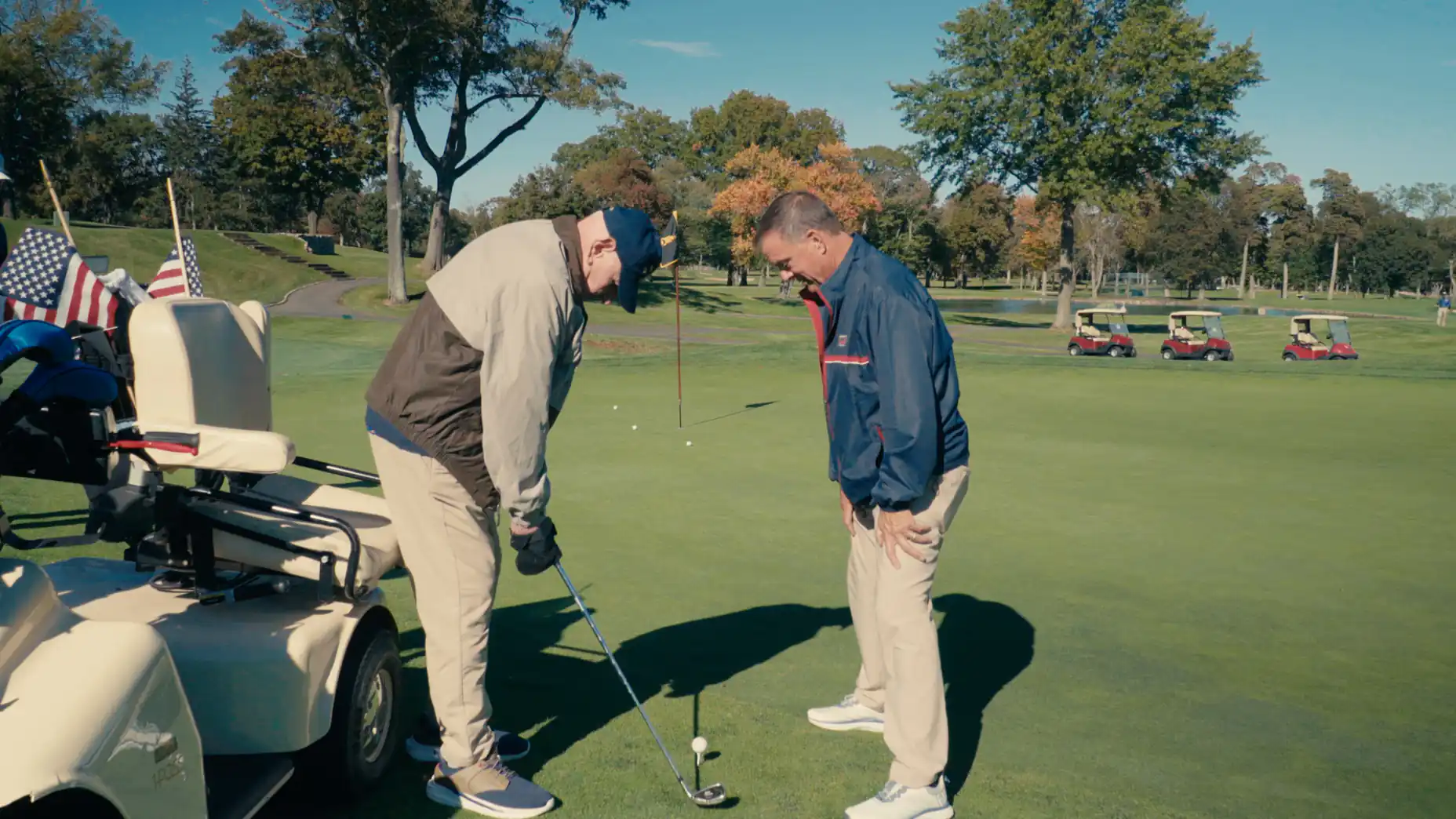
Eventually, with Paul’s needling, John learned how to hold the club again. Then he graduated to short-game shots, with the help of a side-seater cart. And finally, on a glorious Thursday afternoon at Woodside, John and Paul moved off the practice range and back onto the golf course. The dream John had allowed to die was suddenly very real — spare for one … minor detail.
“I was so excited for him, and then I remembered, ‘oh my gosh, we don’t have any golf clubs!’” Maria says with a laugh. “I was ready to buy him a new set when Paul told me he’d take care of it.”
When the afternoon of the big day arrived, John was nervous. It wouldn’t be golf the way he wanted it or remembered it, and he was still learning the technique from the side-seater cart. But after two years away from the sport, it was golf nonetheless, and you didn’t have to spend very long around him to know what it meant.
“I never thought I’d hear somebody say ‘golf saved my life,’” Paul says. “I hear that pretty often at this camp.”
John has not said those words exactly, but in so many ways, he doesn’t have to. You can see the expression on his face change when Paul enters his orbit. You can hear the laughter enter his lungs.
“Oh boy…” John says when asked about his new teacher. “Paul?”
His face scrunches into a scowl.
“He’s alright.”
“Alright?!” Paul screams, overhearing him from a few feet away. “Are you kidding me?”
And just when it seems Paul’s 90-year-old student is going to deliver some bad news, he bursts out into laughter, his face spreading into a smile wider than the first fairway.
“That’s what I thought,” Paul says, a grin sneaking past his bravado.
GOLF
It’s hard to overstate what these moments feel like for the Hansers. To know how nice it is for Maria to hear John’s laughter is to recognize that she has spent much of the last two years in the absence of it. To know what it’s like for John to receive the gift of golf is only to imagine how it must have felt to spend two years thinking it was robbed from you.
“This program has been more than meaningful,” Maria says. “It has been something that John looked forward to every week.”
Nobody in John’s orbit is deluded about his long-term prospects as a golfer. It’s unlikely he will ever take another full swing with a golf club, or complete a full 18-hole round. Some parts of his golf “life” might be over.
Fortunately, John has played for long enough to know this is true of every golfer. The game changes as we age. The elusivity is the point.
“You never win at golf. No matter how good you are,” Paul says. “Even when you shoot your best round ever, everybody always tells me, ‘I shot my best round, but I double-bogeyed that hole, and I missed the putt over here.’”
“Golf is about competing with yourself,” Maria agrees. “It’s about wanting to do better.”
On a perfect Thursday afternoon on Long Island, there was no ambiguity over if John had found golf’s inner meaning. From the side of a putting green in the sun, the golfer and his new coach began their first round as friends, punching low dribblers out in the direction of the flagstick.
The first few swings were short, and the next few were long, but then John started to get the hang of it — gently rocking his 8-iron in the direction of the ball.
On maybe his 10th try, he caught a good one, watching as the ball struck the center of the clubface and traveled down toward the flagstick. The ball seemed to take forever on its roll, and John was stuck there, watching, while Paul and Maria screamed at it with all their might.
Back in the old days, John might call what happened next a regular occurrence. On this day, though, his wife called it something else.
“Here we are,” Maria said. “Hope.”
You can reach the author at james.colgan@golf.com.
Disclaimer : This story is auto aggregated by a computer programme and has not been created or edited by DOWNTHENEWS. Publisher: golf.com