After a summer win, India’s Gen Z protesters face a winter of uncertainty
-
Published
Cheers erupted at Delhi’s Jantar Mantar protest site in July as news broke that Gen-Z protests had forced federal education minister Dharmendra Pradhan to resign.
One protester turned to me, beaming: “This is the youth’s victory.”
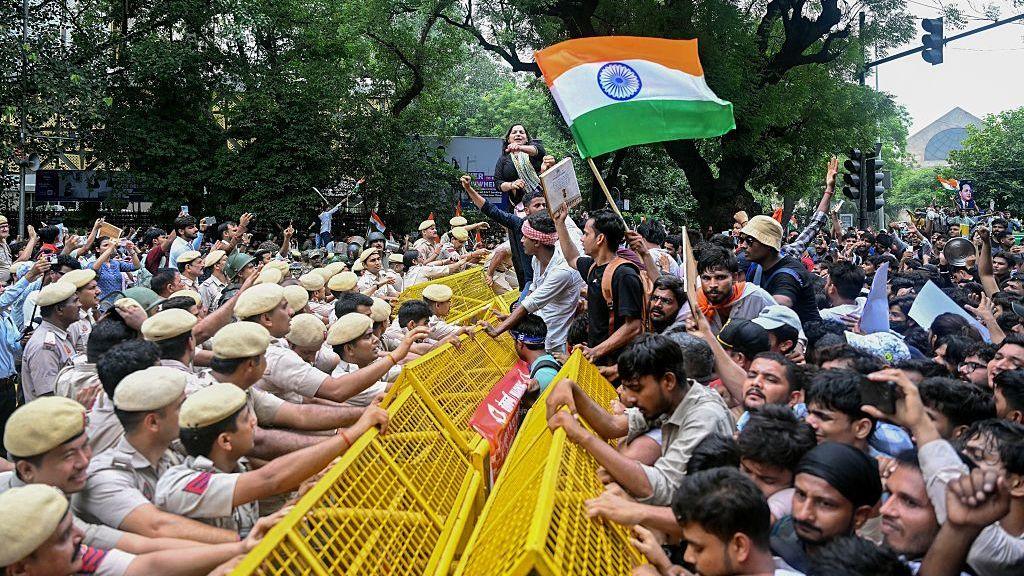
Just over three months later, the mood has shifted dramatically. Student protesters are now struggling even to assemble. Demonstrations by the Gen Z-led Cockroach Janta Party (CJP) last month over voting rights were met with sweeping restrictions and thousands of peaceful protesters were detained.
The summer had seen a new wave of dissent in India, driven by deep frustration among the youth and fuelled by irreverent online satire.
The movement spread across the country, and Prime Minister Narendra Modi, a leader with a strongman image, unaccustomed to open criticism or mockery, struggled to contain it. But the government’s increasingly forceful security response suggests it has learned from its rare concession to protesters, invoking public order to curb dissent.
The ruling Bharatiya Janata Party (BJP) national spokesperson Syed Zafar Islam rejected accusations of heavy-handedness and told the BBC: “The right to protest and freedom of expression is mandated by the constitution, but it has to be done within the law. It cannot override the rights of others, at the cost of public security”.
This is by no means the first time the Modi government has faced large-scale protests.
But the breadth of them pose a challenge for the BJP, according to Yamini Aiyar, former president of the Centre for Policy Research and visiting professor at Brown University.
 Image source, Hindustan Times via Getty Images
“They are not defined by caste, gender or economic class,” Aiyar said. “Even some of the core BJP base, the upwardly mobile, lower-income classes, were attracted by the movement.”
The scale of the youth protests is also magnified by its online presence. Protesters have broken a longstanding political taboo, openly mocking the prime minister online.
“It’s more than just laughs,” said Sakhi, a student protester who identifies as they/them and affiliated with one of Delhi University’s left-wing student organisations.
“The fear of repercussions in other generations isn’t felt as much in ours,” they said. “Comedy is a new language to challenge authority.”
Previous protest movements posed serious challenges to Modi but were easier to dismiss as representing narrow sections of society or to label “anti-national”, according to Aiyar.
In 2020, farmers protesting against controversial agricultural reforms were blocked from entering Delhi, leading to months of demonstrations and, at times, clashes on the capital’s borders. After a year of protests, the government abandoned the reforms.
Protests against a contentious citizenship law in 2019 and 2020 are a stark reminder of the powers of the judiciary should anyone be deemed a national security threat.
Student activist Umar Khalid was arrested under anti-terror laws after violent clashes in Delhi that killed 53 people, mostly Muslims. He was accused of being a “key conspirator”. He has now spent more than six years in jail without his trial having begun.
His partner Banojyotsna Lahiri told the BBC they have no regrets, but that the situation instilled “a kind of fear that has prevailed”.
 Image source, Hindustan Times via Getty Images
“We are just looking at a very dark mesh of empty space, because we don’t know when the endpoint is,” Lahiri said. Khalid’s latest appeal was lodged this month.
Aiyar believes opponents are using a familiar “playbook” today to “de-legitimise” protests, but that it isn’t resonating as convincingly.
Nevertheless, the youth protests have struggled to recapture this summer’s momentum.
CJP leaders, including spokesperson Saurav Das, have faced repeated detentions and legal action. Das and fellow leader Ashutosh Ranka spent a week in Delhi’s Tihar jail after being accused of trespassing at Jantar Mantar.
The site of their summer victory has since been struck off the list of authorised protest venues, a decision being challenged in court.
Protesters from other groups, including the left-wing All India Students’ Association (Aisa), have also faced police action over allegations of defying orders.
“We were expecting some kind of crackdown,” said Das. He added that “the government has learnt a lot” since the summer.
Legal experts warn the proceedings themselves can have a chilling effect.
“A lot of cases can lead to acquittals, but it can take years. The process is the punishment, and that can deter protesters,” said Ali Khan, an assistant professor at Lloyd Law College.
The restrictions on demonstrations have become excessive, according to constitutional lawyer Vrinda Grover, who is advising the CJP.
 Image source, Hindustan Times via Getty Image
“Those who are organising the protests have repeatedly emphasised that this is non-violent,” she argued. “Rights have been whittled down in the name of law and order.”
The BJP has rejected suggestions it is suppressing peaceful dissent.
Islam told the BBC that demonstrations “cannot override the rights of other citizens just because a handful of people want to protest and be responsible for violence”.
Even dissenting online carries risk. Sakhi’s viral social media posts have attracted targeted abuse and transphobic attacks. The BBC has seen posts threatening them with violence and rape.
Sometimes, it can deter Sakhi from protesting or even make them change the way they dress.
“Making people laugh can turn into being called anti-national,” Sakhi said. “They want me to feel damaged,” they added.
They claim some of their content was removed after getting millions of views.
Under India’s information technology laws, the government can order platforms to block content on national security grounds. Notices on X and Instagram have shown accounts being withheld in India.
CJP leaders have likened the crackdown to the 1975 Emergency, when then prime minister Indira Gandhi suspended civil liberties and jailed political opponents.
Yet dissent has not been stamped out.
Opposition parties have, in part, filled the void. Tens of thousands gathered in Delhi on 1 November for a rally organised by INDIA bloc, an alliance of opposition parties led by Congress, and permitted by the authorities.
CJP leaders, meanwhile, insist the movement is bigger than their organisation.
When Das walked out Delhi’s Tihar prison on 21 October, photographs showed him smiling.
“I would just say wait and watch,” Das told us. “Time is on our side. We are a very young generation.”
-
-
Published21 October

-
-
-
Published11 October

-
-
-
Published10 October

-
Disclaimer : This story is auto aggregated by a computer programme and has not been created or edited by DOWNTHENEWS. Publisher: BBC