
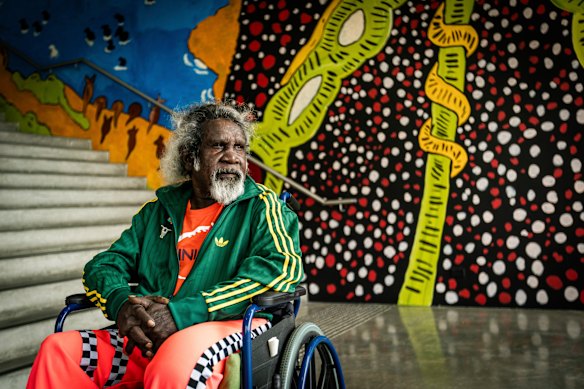
John Prince Siddon was working as a young jackaroo when a horse-riding accident altered the course of his life.
“One old fellow yell to us, saying: ‘There, follow them cattle, wheel them north.’ So off I gallop with my horse full speed, racing to wheel them cattle. Next moment, ‘Bang!’, I was laying on the ground, with them other stockman holding me, telling me, ‘Stay still, don’t move or look.’”
After a horse fell on him, his colleagues rushed for help. “One of the men got up on his horse, start [galloping] to [the] nearby homestead, race to get help. They brought a mattress, and they put me on the ute, back of a Toyota. Brought me to Noonkanbah station and put me on a Flying Doctor [plane].”
Siddon woke up in a hospital bed to find his right leg had been amputated. “Doctors said I couldn’t walk. I proved them wrong,” he recounts.
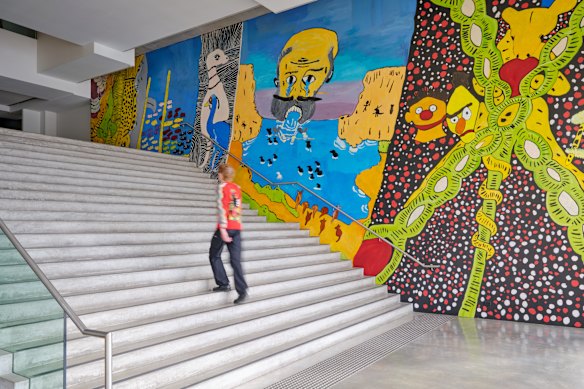
Forty years later, the Museum of Contemporary Art Australia (MCA) has unveiled the Walmajarri artist’s largest work to date: the 2026 Foyer Wall Commission. Titled Worra Munga! Ernie and Bert Dreamtime voice, the 15-metre-long technicolour epic is a surreal blend of desert storytelling and global pop culture.
Siddon’s artistic journey began in 2009 at Mangkaja Arts in Fitzroy Crossing, east of Broome. This arts centre has been a vital space for more than 100 creators – including Siddon’s father, Pompey – and is known for pushing the boundaries of Indigenous art. Similar to the work of Yankunytjatjara artist Kaylene Whiskey, Siddon’s style incorporates pop icons and childhood memories.
“John Prince has such a distinct visual language,” says Rebecca Ray, the MCA’s First Nations curator and commission co-curator.
“He draws on established aesthetics associated with the Kimberley region but incorporates figurative painting and symbolic imagery to explore social and political histories – from the consequences of human impact and environmental crises to cultural fragmentation.”
The commission cascades down the double-height staircase, greeting visitors with a vibrant mix of Sesame Street characters and native wildlife. Sharks, barramundi and praying mantises co-mingle with Bert, Ernie, Big Bird and the Cookie Monster. These were the television puppet characters Siddon adored as a child. “I mix them up, like a jigsaw,” he says.
Watching global events unfold from his home in Broome, Siddon has dedicated the work to all young people experiencing conflict around the planet. It will be on show until 2028, taking over the space previously held by artists such as Diena Georgetti and Vincent Namatjira.
Siddon found his calling after his accident and hasn’t stopped since, often painting late into the night. “Something comes into my head and I can’t stop,” he says.
Ray notes that it is common for some Indigenous artists to find success later in life, at times due to forced labour under colonial pastoral industries in their earlier years.
“You look at artists such as Emily Kame Kngwarreye, who came to painting late and created some 3000 works in just a few years. Prince is following in those footsteps; he simply fell in love with the brush.”
Siddon’s jackaroo days are well behind him, and he occasionally uses a wheelchair for support as he ages. He was a party to the 2023 class action wage claim challenging Western Australia’s historical decision to withhold up to 75 per cent of Aboriginal stockmen’s wages. Though he has yet to receive a settlement – which is expected to be modest – his success in the art world has provided a different kind of legacy.
He has been a finalist several times in the Telstra National Aboriginal and Torres Strait Islander Art Awards and was a finalist in the 2023 Sulman Prize. A suite of his works now features in the 25th Biennale of Sydney at White Bay Power Station.
Siddon is known for painting on unconventional surfaces – from bullock skulls and satellite dishes to pelts, oil barrels and scrap tin – and exploring new mediums. Lately, he has moved into ceramics and sculpture. He’s always on the lookout for boab nuts to paint too, having been taught the traditional Kimberley craft of boab nut carving.
While installing the commission at the MCA, he has begun work on a monumental-sized dingo created from polymer clay, inspired by The Sphinx. It will be cast in bronze, and is probably destined for a new show at Arthouse Gallery.
Start the day with a summary of the day’s most important and interesting stories, analysis and insights. Sign up for our Morning Edition newsletter.
Disclaimer : This story is auto aggregated by a computer programme and has not been created or edited by DOWNTHENEWS. Publisher: www.smh.com.au


