When you’re seriously ill, wanting to look good isn’t necessarily vanity. Sometimes it’s about holding on to the person you used to be.
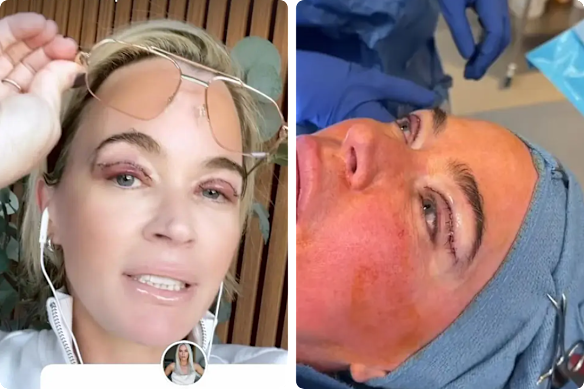
Real Housewives of Beverly Hills star Teddi Mellencamp has spoken out in defence of her decision to undergo cosmetic surgery while receiving treatment for stage four cancer. The daughter of singer John Cougar Mellencamp recently underwent an upper blepharoplasty — surgery to remove excess skin from her eyelids – while battling metastasised melanoma.
She says her doctors approved the procedure, but the decision sparked criticism, with some questioning why she’d choose to undergo an elective cosmetic procedure while facing such a serious illness.
And I can’t help but wonder: why the hell not?
Why does wanting to feel good about yourself become inappropriate the moment your medical history gets complicated? Why can’t someone be fighting for their health and thinking about their appearance at the same time?
As someone who’s undergone chemotherapy, I’m firmly in Mellencamp’s corner. Not long after learning I’d need chemo as a last-ditch attempt to stop my multiple sclerosis from progressing, I did what any perfectly rational woman facing a life-altering medical treatment would do – I started researching cosmetic procedures.
My thinking was simple: if I was about to lose my hair, people were going to be looking at my face. And if my face was suddenly the main event, I wanted it to be a good one.
First stop: veneers.
Until I had children, I’d always had a picture-perfect smile. But somewhere along the way my once-straight teeth had forgotten their choreography. Suddenly, losing my hair seemed like an excellent reason to do something about it.
Unfortunately, the dentist had other ideas. Before veneers, I’d need Invisalign. For 12 months. Not exactly the quick pre-chemo glow-up I’d imagined. Undeterred, I moved on to plan B: HIFU, a non-surgical skin-tightening treatment. I arrived at my consultation ready to hand over my hard-earned, only to be told I needn’t have bothered.
The practitioner refused to do it. I was told my skin looked “youthful” and therefore I didn’t need it. I asked if she’d mind putting that in writing.
Fine. Clearly the universe wanted me to age naturally. But I wasn’t finished. Plan C: Botox. Surely a few strategically placed injections could give me a confidence boost before everything went sideways?
Nope. Again I was advised against it. According to the practitioner, with chemotherapy starting in a few weeks the effects wouldn’t last long and I’d be lucky to get a week’s worth of wrinkle-free forehead.
Three appointments. Three knockbacks. Not a single cosmetic improvement.
I realised my rather ridiculous quest for a pre-chemo glow-up was about something much bigger than vanity. Following my MS came endless hospital admissions, disease-modifying treatments and eventually chemotherapy as part of a stem cell transplant. My body had begun to feel less and less like my own.
It became unpredictable, unreliable and increasingly what felt like the property of doctors, medications and symptoms I couldn’t control. Seeking out cosmetic treatments wasn’t about looking younger or more beautiful, it was about wanting some control. I had no power over how my body would respond to chemotherapy, but perhaps I could control my smile, or my skin, or the wrinkles on my forehead.
And is it any wonder I was concerned about my appearance when women spend their lives being told how much it matters? Here lies another uncomfortable contradiction. Women spend much of their lives wrestling against ageing and trying to maintain their appearance, but when we become seriously ill, caring about how we look is considered frivolous.
You can be terrified about your health and still want nice hair. You can be grateful for treatment and hate what it’s doing to your body. These things aren’t mutually exclusive. What looks like vanity from the outside can be something far more complicated on the inside.
Mellencamp received the tick of approval from her medical team, so keyboard warriors have no business telling her what she should and shouldn’t care about.
As for me, my hair is growing back and I’m feeling stronger each day. After everything my body has put me through, I wouldn’t mind a little Botox. Assuming someone will actually let me have it this time.
Brooke Bayes is a journalist and author of But You Don’t Look Sick.
From our partners
Disclaimer : This story is auto aggregated by a computer programme and has not been created or edited by DOWNTHENEWS. Publisher: www.smh.com.au